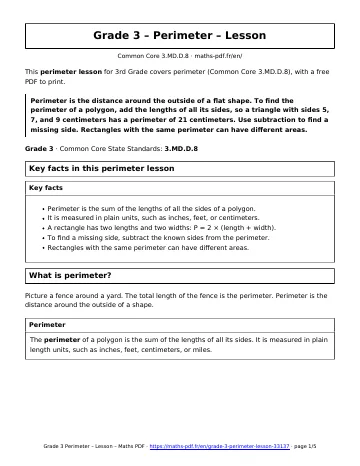
3rd Grade Perimeter Lesson (Free PDF)

This perimeter lesson for 3rd Grade covers perimeter (Common Core 3.MD.D.8), with a free PDF to print.
Perimeter is the distance around the outside of a flat shape. To find the perimeter of a polygon, add the lengths of all its sides, so a triangle with sides 5, 7, and 9 centimeters has a perimeter of 21 centimeters. Use subtraction to find a missing side. Rectangles with the same perimeter can have different areas.
Grade 3 · Common Core State Standards: 3.MD.D.8
Key facts in this perimeter lesson
- Perimeter is the sum of the lengths of all the sides of a polygon.
- It is measured in plain units, such as inches, feet, or centimeters.
- A rectangle has two lengths and two widths: P = 2 × (length + width).
- To find a missing side, subtract the known sides from the perimeter.
- Rectangles with the same perimeter can have different areas.
What is perimeter?
Picture a fence around a yard. The total length of the fence is the perimeter. Perimeter is the distance around the outside of a shape.
Add the sides of the triangle: \(5 + 7 + 9 = 21\). Its perimeter is 21 centimeters.
How do you find the perimeter of a polygon?
- Write the length of every side. Use the same unit for all of them.
- Add all the side lengths.
- Write the unit with the answer.
Example. A rectangle is 8 feet long and 3 feet wide. It has two sides of 8 feet and two sides of 3 feet.
\(8 + 3 + 8 + 3 = 22\), so the perimeter is 22 feet. A shortcut is to add one length and one width, then double: \(2 \times (8 + 3) = 22\).
In a regular polygon, all the sides are equal. Multiply one side by the number of sides.
\(6 \times 4 = 24\), so the perimeter of the hexagon is 24 centimeters.
How do you find a missing side length?
If you know the perimeter and all but one side, add the sides you know. Then subtract that sum from the perimeter.
The known sides add to \(9 + 3 + 4 + 3 + 6 = 25\). The missing side is \(30 – 25 = 5\) feet.
Can different rectangles have the same perimeter?
Yes. These three rectangles all have a perimeter of 14 units, but they cover different amounts of space.
The perimeters match, yet the areas are 6, 10, and 12 square units. Rectangles with the same perimeter can have different areas, and rectangles with the same area can have different perimeters.
Perimeter lesson: questions and answers
What is the difference between perimeter and area?
Perimeter is the distance around the outside of a shape, measured in units like feet. Area is the amount of flat space inside, measured in square units like square feet.
Do I always add all the sides to find perimeter?
Yes, the perimeter is the sum of all the sides. For a rectangle you can add the length and width and double it. For a regular polygon you can multiply one side by the number of sides.
How do I find a missing side when I know the perimeter?
Add the side lengths you know. Subtract that sum from the perimeter. The difference is the missing side.
Why do some sides have no label in a figure?
In shapes with right angles, opposite lengths can be found from the labeled ones. Find them before you add, so you do not skip any side.
Can two rectangles have the same perimeter but different areas?
Yes. A 2 by 5 rectangle and a 3 by 4 rectangle both have a perimeter of 14, but their areas are 10 and 12.
How to use this perimeter lesson
Read the definitions first, then follow the worked method line by line and redo the example on paper without looking. When every step makes sense, move on to the worksheet, then check yourself with the quiz.
Download the perimeter lesson as a PDF with the button below and keep it with your notes.
All Grade 3 chapters: Grade 3 math.