3rd Grade Understanding Multiplication Lesson (Free PDF)
This multiplication meaning lesson for 3rd Grade covers understanding multiplication (Common Core 3.OA.A.1, 3.OA.A.3), with a free PDF to print.
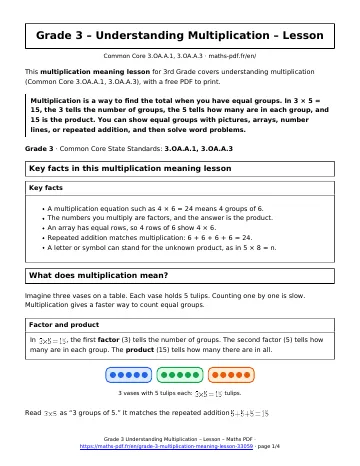
Multiplication is a way to find the total when you have equal groups. In 3 × 5 = 15, the 3 tells the number of groups, the 5 tells how many are in each group, and 15 is the product. You can show equal groups with pictures, arrays, number lines, or repeated addition, and then solve word problems.
Grade 3 · Common Core State Standards: 3.OA.A.1, 3.OA.A.3
Key facts in this multiplication meaning lesson
- A multiplication equation such as 4 × 6 = 24 means 4 groups of 6.
- The numbers you multiply are factors, and the answer is the product.
- An array has equal rows, so 4 rows of 6 show 4 × 6.
- Repeated addition matches multiplication: 6 + 6 + 6 + 6 = 24.
- A letter or symbol can stand for the unknown product, as in 5 × 8 = n.
What does multiplication mean?
Imagine three vases on a table. Each vase holds 5 tulips. Counting one by one is slow. Multiplication gives a faster way to count equal groups.
Read \(3 \times 5\) as “3 groups of 5.” It matches the repeated addition \(5 + 5 + 5 = 15\).
How do arrays and number lines show multiplication?
An array puts equal groups in rows and columns. Each row is one group. Here are 4 rows with 6 chairs in each row.
A number line shows equal jumps. A frog makes 5 jumps of 4 feet each, so it lands on 20.
Can multiplication measure amounts?
Yes. Equal groups can be cups, pounds, or gallons. Four pitchers hold 3 cups of lemonade each.
Which words and symbols go with multiplication?
| Idea | Example | Meaning |
|---|---|---|
| Equal groups | \(4 imes 3\) | 4 groups of 3 |
| Repeated addition | \(3 + 3 + 3 + 3\) | add the group size 4 times |
| Array | 4 rows, 3 columns | 12 objects in a grid |
| Unknown product | \(4 imes 3 = n\) | the letter hides the total |
Do not add the two factors. The sum \(4 + 3 = 7\) counts only one group of 4 and one group of 3. Always ask: how many groups, and how many in each group?
How do you solve a multiplication word problem?
- Find the number of equal groups.
- Find the size of each group.
- Draw a picture or a tape diagram.
- Write the equation and find the product.
Example. Diego puts 8 stickers on each of 5 pages. How many stickers is that?
The equation is \(5 \times 8 = n\). Count by 8s: 8, 16, 24, 32, 40. So \(n = 40\), and Diego uses 40 stickers.
Multiplication meaning lesson: questions and answers
What does 7 × 3 mean?
It means 7 groups with 3 in each group. You can add 3 seven times: 3 + 3 + 3 + 3 + 3 + 3 + 3 = 21.
What is the difference between a factor and a product?
Factors are the numbers being multiplied. The product is the result. In 6 × 4 = 24, the numbers 6 and 4 are factors and 24 is the product.
How is an array different from equal groups?
An array lines the groups up in rows and columns, so every row has the same number of objects. It is easy to see and count equal groups this way.
Can multiplication be used with measurements?
Yes. If 4 jugs hold 3 gallons each, then 4 × 3 = 12 gallons. The groups can be any equal amounts, such as cups, pounds, or feet.
Why does a word problem use a letter like n?
The letter stands for the number you do not know yet. In 5 × 8 = n, you find the product, and n = 40.
How to use this multiplication meaning lesson
Read the definitions first, then follow the worked method line by line and redo the example on paper without looking. When every step makes sense, move on to the worksheet, then check yourself with the quiz.
Download the multiplication meaning lesson as a PDF with the button below and keep it with your notes.
All Grade 3 chapters: Grade 3 math.
More 3rd Grade math
Lessons
See all



Worksheets
See all
Tests
See all Area Test with Point Values
- Adding and Subtracting Within 1,000 Test with Point Values
- Multiplication and Division Facts Within 100 Test with Point Values
- Scaled Graphs and Line Plots Test with Point Values
- Time, Liquid Volume and Mass Test with Point Values
- Equivalent and Comparing Fractions Test with Point Values