Geometry Theorems About Triangles Lesson (Free PDF)

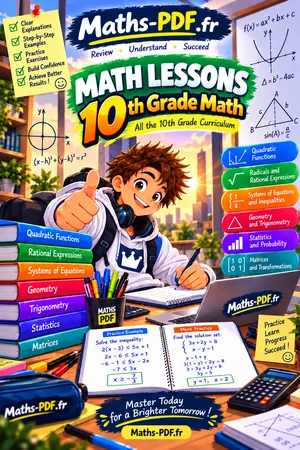
This triangle theorems lesson for Geometry covers theorems about triangles (Common Core G-CO.C.10), with a free PDF to print.
The interior angles of every triangle add to 180 degrees, and an exterior angle equals the sum of its two remote interior angles. Base angles of an isosceles triangle are congruent. A midsegment is parallel to the third side and half as long, and the medians meet at the centroid. Any two sides must add to more than the third.
Geometry · Common Core State Standards: G-CO.C.10
Key facts in this triangle theorems lesson
- Triangle angle sum: 180 degrees.
- Exterior angle = sum of the two remote interior angles.
- Isosceles triangle: base angles are congruent; equilateral angles are 60 degrees each.
- Midsegment: parallel to the third side and half its length.
- Medians meet at the centroid, two thirds of the way from each vertex.
What is the triangle angle sum theorem?
The three interior angles of every triangle add to \(180^{\circ}\). A quick reason: draw a line through one vertex parallel to the opposite side. The alternate interior angles match two of the triangle’s angles, and together with the third angle they fill a straight line.
What is the exterior angle theorem?
An exterior angle forms a linear pair with an interior angle. Its measure equals the sum of the two remote interior angles, the ones not next to it.
What do we know about isosceles triangles?
What is a midsegment?
A midsegment connects the midpoints of two sides. It is parallel to the third side and exactly half as long.
What are medians and the centroid?
A median joins a vertex to the midpoint of the opposite side. The three medians meet at one point, the centroid, which is two thirds of the way from each vertex along each median. Its coordinates are the average of the vertex coordinates.
Which side lengths make a triangle?
The triangle inequality says that any two sides add to more than the third. Sides of 5, 7 and 13 fail because \(5 + 7 = 12 < 13\). If two sides are \(a\) and \(b\), the third side \(c\) satisfies \(|a - b| < c < a + b\).
Example: Two angles of a triangle are \((2x + 10)^{\circ}\) and \((3x – 5)^{\circ}\) and the third is \((x + 25)^{\circ}\). Then \(6x + 30 = 180\), so \(x = 25\) and the angles are 60°, 70° and 50°.
Triangle theorems lesson: questions and answers
Why do the angles of a triangle add to 180 degrees?
Draw a line through one vertex parallel to the opposite side. Alternate interior angles show that the three angles of the triangle fit along that straight line, which measures 180 degrees.
What is a remote interior angle?
Remote interior angles are the two interior angles that are not adjacent to a given exterior angle. Their sum equals the exterior angle.
How do you find a centroid in the coordinate plane?
Average the x-coordinates and the y-coordinates of the three vertices. For (0, 0), (6, 0) and (3, 9) the centroid is (3, 3).
What does the triangle inequality say?
The sum of any two side lengths must be greater than the third side. So sides 4, 5 and 10 cannot make a triangle.
How long is a midsegment?
A midsegment is half as long as the side it is parallel to. If the third side is 18, the midsegment is 9.
How to use this triangle theorems lesson
Read the definitions first, then follow the worked method line by line and redo the example on paper without looking. When every step makes sense, move on to the worksheet, then check yourself with the quiz.
Download the triangle theorems lesson as a PDF with the button below and keep it with your notes.
All Geometry chapters: Geometry math.

More Geometry math
Lessons
See all



Worksheets
See all




Tests
See all Similar Triangle Theorems Test with Point Values
- Geometric Constructions Test with Point Values
- Parallel Lines and Transversals Test with Point Values
- Arc Length and Sector Area Test with Point Values
- Cross Sections and Solids of Revolution Test with Point Values
- Coordinate Geometry and Proofs Test with Point Values