8th Grade Translations, Reflections and Rotations Lesson (Free PDF)
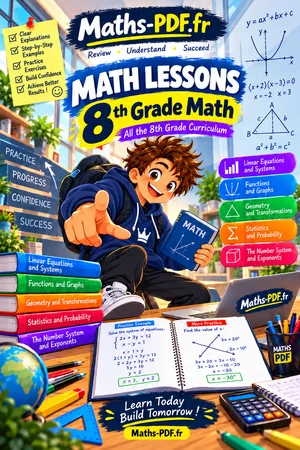
This rigid transformations lesson for 8th Grade covers translations, reflections and rotations (Common Core 8.G.A.1, 8.G.A.2, 8.G.A.3), with a free PDF to print.
Translations, reflections and rotations are rigid transformations: they move a figure without changing its side lengths or angle measures, so the image is congruent to the original. A translation slides, a reflection flips across a line, and a rotation turns about a point. You can find image coordinates with simple rules on the coordinate plane.
Grade 8 · Common Core State Standards: 8.G.A.1, 8.G.A.2, 8.G.A.3
Key facts in this rigid transformations lesson
- Translation by \((a, b)\): \((x, y) \to (x + a, y + b)\).
- Reflection across the x-axis: \((x, -y)\); across the y-axis: \((-x, y)\).
- Rotation about the origin: \(90^{\circ}\) counterclockwise \((-y, x)\); \(180^{\circ}\) \((-x, -y)\); \(90^{\circ}\) clockwise \((y, -x)\).
- Rigid motions preserve lengths, angles and parallel lines.
- Two figures are congruent if a sequence of rigid motions maps one to the other.
What is a rigid transformation?
A rigid transformation moves a figure without changing its size or shape. The three kinds are translations, reflections and rotations. The original figure is the preimage and the moved figure is the image, whose vertices are marked with a prime symbol such as \(A^{\prime}\).
How do you translate a figure?
A translation slides every point the same distance in the same direction. To translate right \(a\) and up \(b\), add \(a\) to every x-coordinate and \(b\) to every y-coordinate: \((x, y) \to (x + a, y + b)\). Moving left or down uses negative numbers.
How do you reflect and rotate?
A reflection flips a figure across a line, the line of reflection. Across the x-axis, \((x, y) \to (x, -y)\). Across the y-axis, \((x, y) \to (-x, y)\). A rotation turns a figure about a point. About the origin, \(90^{\circ}\) counterclockwise sends \((x, y)\) to \((-y, x)\), \(180^{\circ}\) sends it to \((-x, -y)\), and \(90^{\circ}\) clockwise sends it to \((y, -x)\).
What does congruent mean?
Two figures are congruent if a sequence of rotations, reflections and translations maps one onto the other. To describe a sequence, list the moves in order. For example, triangle \(T\) with vertices \((0, 0)\), \((2, 0)\), \((0, 3)\) is congruent to the triangle with vertices \((5, 1)\), \((7, 1)\), \((5, 4)\), because a translation 5 right and 1 up maps one to the other.
- Compare the order of the vertices (a reflection reverses it).
- Choose a move that sends one vertex to its image.
- Check that every other vertex lands correctly.
Rigid transformations lesson: questions and answers
What does the prime symbol mean?
The point \(A^{\prime}\), read A prime, is the image of point A after a transformation.
Does a reflection change the size of a figure?
No. A reflection flips the figure, but all lengths and angles stay the same. Only the orientation (the order of the vertices) is reversed.
How do I rotate a point 90 degrees clockwise?
Swap the coordinates and change the sign of the new y-value: \((x, y) \to (y, -x)\). For \((3, 1)\) you get \((1, -3)\).
Which transformations change orientation?
Only reflections reverse the order of the vertices. Translations and rotations keep the same orientation.
How do I show two figures are congruent?
Describe a sequence of translations, reflections and rotations that maps one figure exactly onto the other.
How to use this rigid transformations lesson
Read the definitions first, then follow the worked method line by line and redo the example on paper without looking. When every step makes sense, move on to the worksheet, then check yourself with the quiz.
Download the rigid transformations lesson as a PDF with the button below and keep it with your notes.
All Grade 8 chapters: Grade 8 math.

More 8th Grade math
Lessons
See all

Worksheets
See all

Tests
See all Linear Functions as Models Test with Point Values
- Square Roots and Cube Roots Test with Point Values
- Rational and Irrational Numbers Test with Point Values
- Scatter Plots and Association Test with Point Values
- Understanding Functions Test with Point Values
- Proportional Relationships and Slope Test with Point Values