2nd Grade Adding Within 100 Lesson (Free PDF)
This add within 100 lesson for 2nd Grade covers adding within 100 (Common Core 2.NBT.B.5, 2.NBT.B.6), with a free PDF to print.
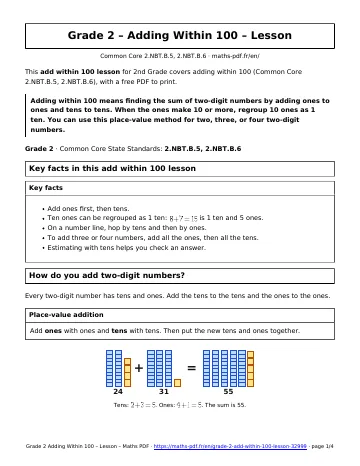
Adding within 100 means finding the sum of two-digit numbers by adding ones to ones and tens to tens. When the ones make 10 or more, regroup 10 ones as 1 ten. You can use this place-value method for two, three, or four two-digit numbers.
Grade 2 · Common Core State Standards: 2.NBT.B.5, 2.NBT.B.6
Key facts in this add within 100 lesson
- Add ones first, then tens.
- Ten ones can be regrouped as 1 ten: \(8 + 7 = 15\) is 1 ten and 5 ones.
- On a number line, hop by tens and then by ones.
- To add three or four numbers, add all the ones, then all the tens.
- Estimating with tens helps you check an answer.
How do you add two-digit numbers?
Every two-digit number has tens and ones. Add the tens to the tens and the ones to the ones.
What is regrouping when you add?
Sometimes the ones add up to 10 or more. Ten ones are the same as one ten. You trade them for a ten rod. This trade is called regrouping.
How can you add on a number line?
Hop by tens first, then hop by ones. To add \(46 + 27\), hop 20 and then 7.
How do you add three or four two-digit numbers?
Add all the ones first. Look for pairs that make 10, like 8 and 2. Then add all the tens, plus any new tens.
Why does regrouping work?
Ten ones and one ten are worth the same amount. Picture a bag of 15 pennies. You can swap 10 pennies for 1 dime. Now you have 1 dime and 5 pennies. The total did not change, only the way you grouped it. Regrouping in addition works the same way, so a new ten goes into the tens column.
What are the steps? Try this method.
- Line up the numbers so the tens are over tens and the ones are over ones.
- Add the ones: \(6 + 7 = 13\). That is 1 ten and 3 ones. Write 3 in the ones place.
- Add the tens, plus the new ten: \(5 + 2 + 1 = 8\).
- Write the answer: \(56 + 27 = 83\).
Check your work by estimating. 56 is close to 60 and 27 is close to 30. Since 60 and 30 make 90, an answer near 83 makes sense.
Add within 100 lesson: questions and answers
What does regrouping mean in addition?
Regrouping means trading 10 ones for 1 ten. If the ones add up to 13, you write 3 ones and move 1 ten to the tens column.
Should I add the ones or the tens first?
Add the ones first. Then you know if there is a new ten to add to the tens column.
How can I add on a number line?
Start at the first number. Hop by tens, then hop by ones. The last landing spot is the sum. For \(46 + 27\) hop 20, then 7.
How do I add four two-digit numbers?
Add the four ones digits first and regroup if the total is 10 or more. Then add the four tens digits and any new tens.
How can I check my addition?
Round both numbers to the nearest ten and add. The answer should be close. You can also add in a different order and get the same sum.
How to use this add within 100 lesson
Read the definitions first, then follow the worked method line by line and redo the example on paper without looking. When every step makes sense, move on to the worksheet, then check yourself with the quiz.
Download the add within 100 lesson as a PDF with the button below and keep it with your notes.
All Grade 2 chapters: Grade 2 math.