2nd Grade Fluency Within 20, Even and Odd Numbers Lesson (Free PDF)
This fluency even odd lesson for 2nd Grade covers fluency within 20, even and odd numbers (Common Core 2.OA.B.2, 2.OA.C.3), with a free PDF to print.
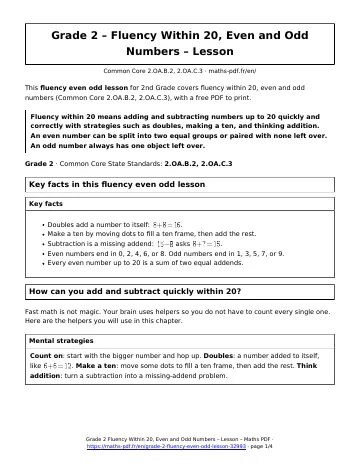
Fluency within 20 means adding and subtracting numbers up to 20 quickly and correctly with strategies such as doubles, making a ten, and thinking addition. An even number can be split into two equal groups or paired with none left over. An odd number always has one object left over.
Grade 2 · Common Core State Standards: 2.OA.B.2, 2.OA.C.3
Key facts in this fluency even odd lesson
- Doubles add a number to itself: \(8 + 8 = 16\).
- Make a ten by moving dots to fill a ten frame, then add the rest.
- Subtraction is a missing addend: \(15 – 8\) asks \(8 + ? = 15\).
- Even numbers end in 0, 2, 4, 6, or 8. Odd numbers end in 1, 3, 5, 7, or 9.
- Every even number up to 20 is a sum of two equal addends.
How can you add and subtract quickly within 20?
Fast math is not magic. Your brain uses helpers so you do not have to count every single one. Here are the helpers you will use in this chapter.
What is the make-a-ten strategy?
A full ten frame is easy to see. If one number is close to 10, give it some dots from the other number. Then add the leftover dots to 10.
How do doubles and near doubles help?
Doubles are easy to remember: \(6 + 6 = 12\). A near double is one away from a double. Since \(6 + 6 = 12\), then \(6 + 7 = 13\), which is one more.
How do you subtract within 20?
Think of the missing part. To solve \(15 – 8\), ask: \(8 + ? = 15\). Since \(8 + 7 = 15\), the answer is 7.
What are even and odd numbers?
How do you write an even number as two equal addends?
An even number splits into two equal groups. Write the groups as an addition sentence. For example, \(14 = 7 + 7\) and \(20 = 10 + 10\). An odd number cannot do this.
How do you use make a ten? Try this method.
- Pick the number that is closer to 10. Here it is 9.
- Find how much it needs to reach 10: \(9 + 1 = 10\).
- Break the other number into that piece and the rest: \(6 = 1 + 5\).
- Add the ten and the rest: \(10 + 5 = 15\).
So \(9 + 6 = 15\).
Fluency even odd lesson: questions and answers
What is a doubles fact?
A doubles fact adds the same number twice, like \(7 + 7 = 14\). Doubles are easy to remember and help you solve near doubles.
How can I tell if a number is even?
Look at the ones digit. If it is 0, 2, 4, 6, or 8, the number is even. You can also make pairs and see that no object is left over.
Can an odd number be written as two equal addends?
No. When you split an odd number into two groups, one group always has one more. For example, 9 splits into 4 and 5, which are not equal.
Why does making a ten help?
Adding to 10 is easy because the ones digit becomes 0. After you reach 10, you only add what is left over.
How can I check a subtraction answer?
Add the answer to the number you subtracted. If you get the starting number, it is right. For example, \(15 – 8 = 7\) because \(8 + 7 = 15\).
How to use this fluency even odd lesson
Read the definitions first, then follow the worked method line by line and redo the example on paper without looking. When every step makes sense, move on to the worksheet, then check yourself with the quiz.
Download the fluency even odd lesson as a PDF with the button below and keep it with your notes.
Download the fluency even odd lesson as a PDF with the button below and keep it with your notes.
All Grade 2 chapters: Grade 2 math.
Print this page
Download PDFDownload the 2nd Grade Fluency Within 20, Even and Odd Numbers Lesson (PDF, 71 KB)More 2nd Grade math
Lessons
See all





Worksheets
See all


Tests
See all Arrays and Equal Groups Test with Point Values
- One- and Two-Step Word Problems Test with Point Values
- Measuring Length Test with Point Values
- Adding and Subtracting Within 1,000 Test with Point Values
- Money: Dollars and Coins Test with Point Values
- Skip Counting and Comparing Numbers Test with Point Values