AP Statistics Probability Rules and Simulation Worksheet (PDF)
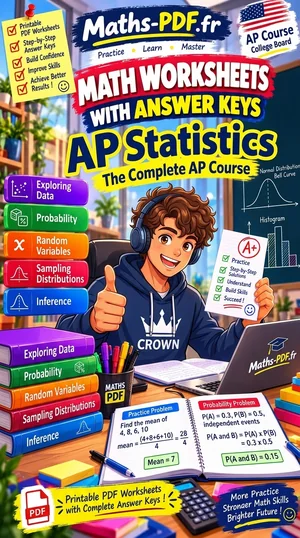
This probability simulation worksheet for AP Statistics covers probability rules and simulation (Common Core AP STAT 4.1, AP STAT 4.2, AP STAT 4.3, AP STAT 4.4, HSS-CP.A.1, HSS-CP.B.7), with a free PDF to print.
AP Statistics · Common Core State Standards: AP STAT 4.1, AP STAT 4.2, AP STAT 4.3, AP STAT 4.4, HSS-CP.A.1, HSS-CP.B.7
Probability simulation worksheet: exercises 1 to 10
Exercise 1 – Interpret a probability
A weather service says the chance of rain tomorrow is 30%. Interpret this statement.
Exercise 2 – Law of large numbers
The graph shows the proportion of heads in 200 flips. Why does the line wobble at first but settle near 0.5?
Exercise 3 – Gambler's fallacy
A fair coin lands tails 6 times in a row. Diego says heads is now more likely. Is he right?
Exercise 4 – Equally likely outcomes
A bag has 5 red, 3 blue, and 2 green marbles. One is picked at random. Find P(red), P(blue or green).
Exercise 5 – Sample space of two coins
List the sample space for flipping two coins and find the probability of exactly one head.
Exercise 6 – Two dice
Two fair dice are rolled. Find P(sum = 7) and P(sum = 11).
Exercise 7 – Complement rule
The probability that a bus arrives on time is 0.82. Find the probability it is late.
Exercise 8 – At least one
Two dice are rolled. Find the probability that at least one die shows a 6.
Exercise 9 – Mutually exclusive events
In a deck of 52 cards, find P(king or queen) for one card.
Exercise 10 – General addition rule
In a deck of 52 cards, find P(heart or king).
Exercises 11 and up
Exercise 11 – Read a Venn diagram
The Venn diagram shows 200 students. Find P(honor roll), P(sports), and P(honor roll and sports).
Exercise 12 – Neither
Using the same Venn diagram, find the probability a student is on the honor roll or plays sports, and the probability of neither.
Exercise 13 – Are they mutually exclusive?
For a randomly chosen student, A = plays a sport and B = plays an instrument. P(A) = 0.5, P(B) = 0.3, P(A or B) = 0.6. Are A and B mutually exclusive? Find P(A and B).
Exercise 14 – Run a simulation
A shooter makes 70% of her free throws. Digits 0 to 6 mean a made shot and 7 to 9 a miss. Use the digits above in groups of 3 (3 shots per trial, 10 trials) to estimate the probability that she makes at least 2 of 3 shots.
Exercise 15 – Compare with the exact value
For the shooter with probability 0.7 per shot, the exact probability of at least 2 made shots in 3 is 0.784. Compare it with the simulation estimate of the previous problem and explain any difference.
Exercise 16 – Design a simulation
About 25% of cereal boxes contain a prize. Describe a simulation to estimate how many boxes you expect to buy until you get a prize.
Exercise 17 – Probability of a union
P(A) = 0.4, P(B) = 0.35, and the events are mutually exclusive. Find P(A or B) and P(neither).
Exercise 18 – Raffle
A raffle has 200 tickets and Maya buys 8. What is the probability she wins one prize? If there are 3 prizes drawn (without replacement), what is the probability she wins none? Give a bound or compute exactly.
Exercise 19 – Multi-step
In a survey, 60% of students have a laptop, 45% have a tablet, and 25% have both. Find the percent with a laptop or a tablet, and the percent with neither.
Exercise 20 – At least one six
A die is rolled 4 times. Find the probability of at least one 6.

Key facts behind this probability simulation worksheet
- Probability = long-run relative frequency; always between 0 and 1.
- Law of large numbers: more trials bring the relative frequency closer to the probability.
- Complement rule: P(A not happening) = 1 – P(A).
- General addition rule: P(A or B) = P(A) + P(B) – P(A and B); subtract nothing if A and B are mutually exclusive.
- Simulation: assign digits, simulate trials, repeat many times, then estimate.
How to use this probability simulation worksheet
Work through the exercises in order: they go from simple to challenging. Write every step on paper, then compare with the solutions page and redo any exercise you missed the next day.
Download the probability simulation worksheet as a PDF with the button below and keep it with your notes.
Download the probability simulation worksheet as a PDF with the button below and keep it with your notes.
All AP Statistics chapters: AP Statistics math.

More AP Statistics math
Lessons
See all

Worksheets
See all Conditional Probability and Independence Worksheet
- Random Variables, Expected Value and Combining Variables Worksheet
- Mean, Median, Standard Deviation and Outliers Worksheet
- Binomial and Geometric Distributions Worksheet
- z-Scores and the Normal Distribution Worksheet
- Variables and Categorical Data Displays Worksheet

Tests
See all- Conditional Probability and Independence Test with Point Values
- Binomial and Geometric Distributions Test with Point Values
- Variables and Categorical Data Displays Test with Point Values
- Random Variables, Expected Value and Combining Variables Test with Point Values
- Five-Number Summary, Boxplots and Comparing Distributions Test with Point Values
- z-Scores and the Normal Distribution Test with Point Values