6th Grade Equivalent Expressions and the Distributive Property Worksheet (PDF)
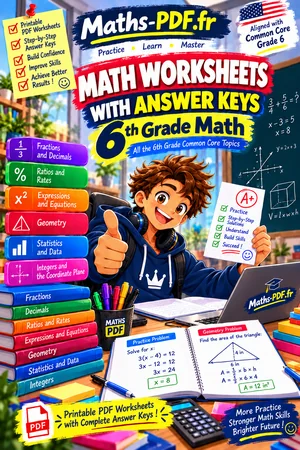
This grade 6 equivalent expressions worksheet for 6th Grade covers equivalent expressions and the distributive property (Common Core 6.EE.A.3, 6.EE.A.4), with a free PDF to print.
Grade 6 · Common Core State Standards: 6.EE.A.3, 6.EE.A.4
Grade 6 equivalent expressions worksheet: exercises 1 to 10
Exercise 1 – Distribute over a sum
Use the distributive property to write \(4(x + 3)\) without parentheses.
Exercise 2 – Distribute with a coefficient
Exercise 3 – Distribute over a difference
Exercise 4 – Distribute a variable sum
Exercise 5 – Factor out the GCF
Exercise 6 – Factor a sum
Exercise 7 – Combine like terms
Simplify \(5x + 3x\).
Exercise 8 – Combine several terms
Exercise 9 – Subtract like terms
Exercise 10 – Two variables
Exercises 11 and up
Exercise 11 – Which are equivalent?
Which of the expressions are equivalent to 3(x + 2)? Explain.
Exercise 12 – Test with a number
Exercise 13 – Add versus multiply
Exercise 14 – Area of a rectangle
A rectangle has height 5 and width x + 2. Write two equivalent expressions for its area.
Exercise 15 – Distribute then combine
Exercise 16 – Distribute a fraction
Exercise 17 – Tickets and fees
Exercise 18 – Perimeter of a triangle
A triangle has three equal sides, each x + 3 inches long. Write the perimeter in two equivalent ways.
Exercise 19 – Simplify with a difference
Exercise 20 – Multi-step expression

Key facts behind this grade 6 equivalent expressions worksheet
- Equivalent expressions have the same value for every value of the variable.
- Distributive property: a(b + c) = ab + ac.
- Like terms have the same variable part and can be combined.
- Factor out the GCF to reverse the distributive property.
- Substitute values to test whether two expressions are equivalent.
How to use this grade 6 equivalent expressions worksheet
Work through the exercises in order: they go from simple to challenging. Write every step on paper, then compare with the solutions page and redo any exercise you missed the next day.
All Grade 6 chapters: Grade 6 math.
Free printable PDF
6th Grade Equivalent Expressions and the Distributive Property Worksheet
Download PDF
More 6th Grade math
Lessons
See all


Worksheets
See all




Tests
See all Multi-Digit and Decimal Operations Test with Point Values
- Exponents and Order of Operations Test with Point Values
- Ratios and Ratio Language Test with Point Values
- Integers and Rational Numbers on the Number Line Test with Point Values
- Unit Rates and Rate Language Test with Point Values
- Mean, Median, Spread and Box Plots Test with Point Values