6th Grade Equivalent Expressions and the Distributive Property Lesson (Free PDF)
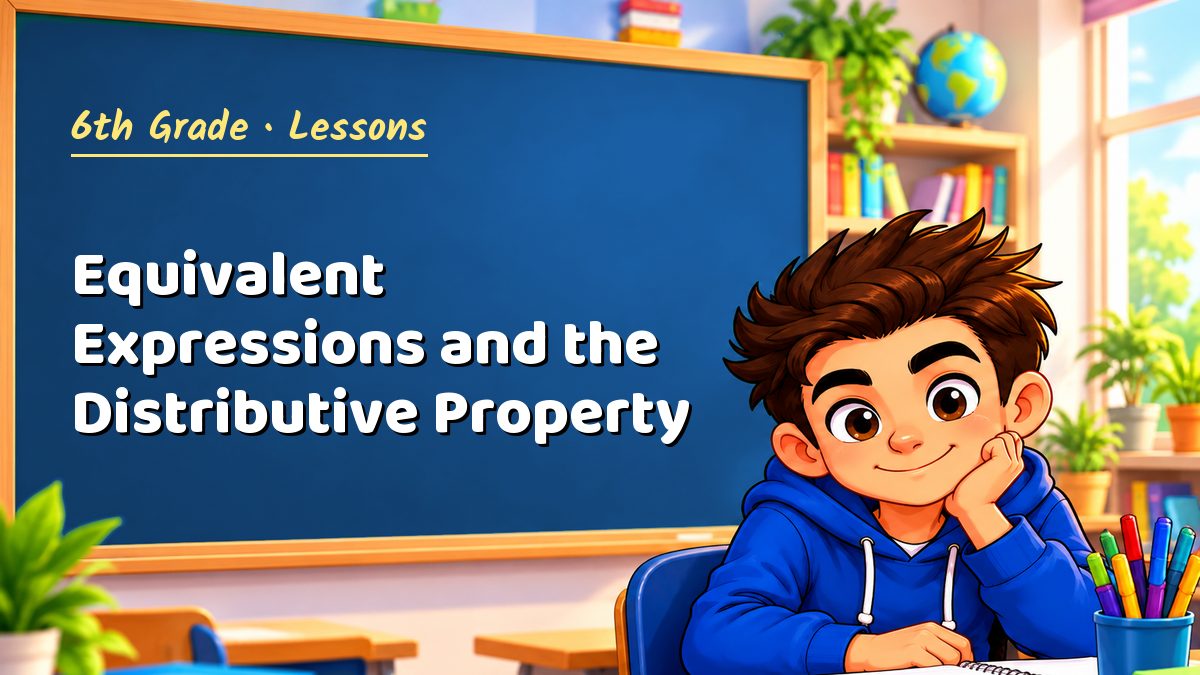

This grade 6 equivalent expressions lesson for 6th Grade covers equivalent expressions and the distributive property (Common Core 6.EE.A.3, 6.EE.A.4), with a free PDF to print.
Equivalent expressions have the same value for every value of the variable. The distributive property, a(b + c) = ab + ac, rewrites 3(x + 2) as 3x + 6, and combining like terms rewrites 2x + 3x as 5x. To check whether two expressions are equivalent, substitute several numbers and compare the results.
Grade 6 · Common Core State Standards: 6.EE.A.3, 6.EE.A.4
Key facts in this grade 6 equivalent expressions lesson
- Equivalent expressions have the same value for every value of the variable.
- Distributive property: a(b + c) = ab + ac.
- Like terms have the same variable part and can be combined.
- Factor out the GCF to reverse the distributive property.
- Substitute values to test whether two expressions are equivalent.
What are equivalent expressions?
Two expressions are equivalent if they have the same value for every value of the variable. For example, \(3(x + 2)\) and \(3x + 6\) are equivalent. When \(x = 1\), both are 9. When \(x = 2\), both are 12.
How do you use the distributive property?
Multiply the outside factor by every term inside the parentheses. For \(5(2y + 7)\), compute \(5 \cdot 2y = 10y\) and \(5 \cdot 7 = 35\), so the result is \(10y + 35\). You can also work backward and factor out the greatest common factor: \(8x + 12 = 4(2x + 3)\).
How do you combine like terms?
Like terms have the same variable part. Add or subtract their coefficients. \(2x + 3x = 5x\), but \(2x + 3\) cannot be combined because one term has a variable and the other does not.
How can you test whether two expressions are equivalent?
Substitute several values for the variable. If the results ever differ, the expressions are not equivalent. For \(2(x + 5)\) and \(2x + 5\) with \(x = 4\), the values are 18 and 13, so they are not equivalent.
- Distribute any factors outside parentheses.
- Group the like terms together.
- Add or subtract the coefficients.
- Check with a number for the variable.
Example: \(3(2x + 5) – 4x + 1 = 6x + 15 – 4x + 1 = 2x + 16\). Check with \(x = 2\): both forms equal 20.
Grade 6 equivalent expressions lesson: questions and answers
What does equivalent expressions mean?
Equivalent expressions have the same value no matter what number replaces the variable. For example, 2(x + 3) and 2x + 6 are equivalent.
What is the distributive property?
It says a(b + c) = ab + ac. Multiply the outside number by each term in the parentheses.
What are like terms?
Like terms have the same variable part, such as 3x and 5x. You add or subtract their coefficients to combine them.
How do you factor out a common factor?
Find the GCF of the terms, divide each term by it, and write the GCF times the new sum. For 8x + 12, the GCF is 4, so the result is 4(2x + 3).
How can you check that two expressions are equivalent?
Substitute a few values for the variable. If the values are always equal, they are equivalent. If any pair differs, they are not.
How to use this grade 6 equivalent expressions lesson
Read the definitions first, then follow the worked method line by line and redo the example on paper without looking. When every step makes sense, move on to the worksheet, then check yourself with the quiz.
Download the grade 6 equivalent expressions lesson as a PDF with the button below and keep it with your notes.
All Grade 6 chapters: Grade 6 math.

More 6th Grade math
Lessons
See all




Worksheets
See all




Tests
See all Area of Triangles and Polygons Test with Point Values
- Exponents and Order of Operations Test with Point Values
- Ratios and Ratio Language Test with Point Values
- Volume of Prisms with Fractional Edges Test with Point Values
- Equivalent Expressions and the Distributive Property Test with Point Values
- Ratio Tables and Graphs of Ratios Test with Point Values