
Grade 6 Math Lessons
The sixth grade year in 22 lessons, from Ratios and Ratio Language to Mean, Median, Spread and Box Plots, each one with its Key facts and a closing set of questions and answers.
- 70 US Letter pages
- 22 chapters
- 106 lesson sections
- PDF to print
- Cards accepted without a PayPal account
- Instant download, up to 3 devices
About this book
Sixth grade introduces the language of ratios and the first algebra. The lessons move from ratio tables and percents to exponents, algebraic expressions and the distributive property, and end with mean, median and box plots.
Every chapter opens with the skills it builds; in Greatest Common Factor and Least Common Multiple, for instance: understand factors and multiples, find the GCF, find the LCM. A Key facts box sums up what to remember. Most of the 106 lesson sections of the book are written as questions a student would ask, such as What are factors and multiples?
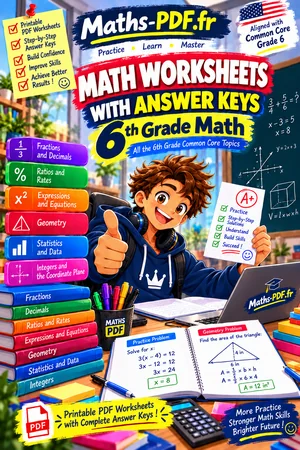
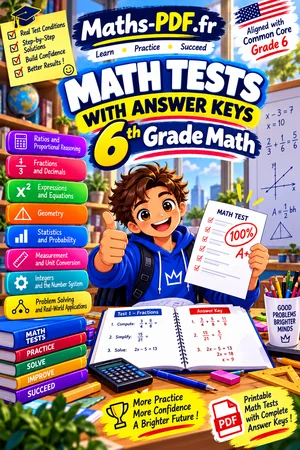
For a sixth grader starting middle school, a parent, or a teacher who wants a test or a worksheet for each chapter. Pair it with the Grade 6 Math Worksheets with Answers to practice each chapter right after reading it.
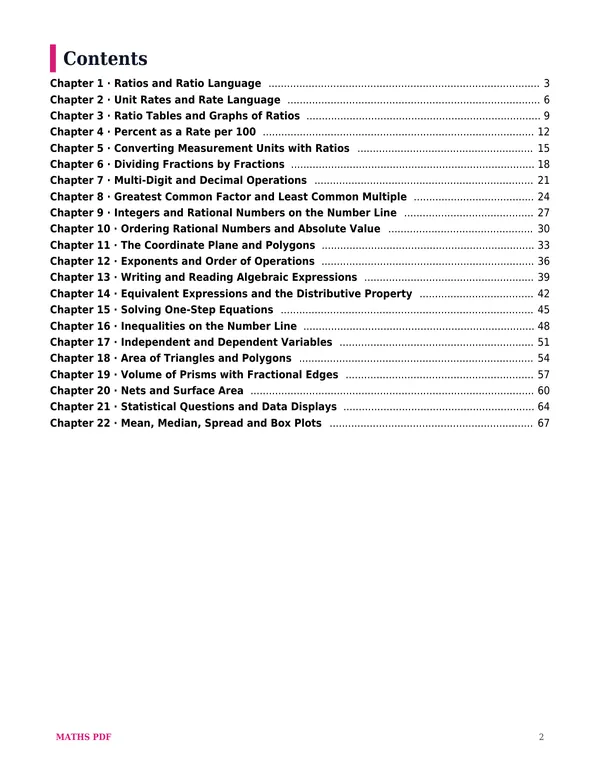
Detailed contents
The 22 chapters of the Grade 6 lesson book, the sections of each lesson and the page where each chapter starts.
-
1
Ratios and Ratio Language
- What is a ratio?
- How do you write and read a ratio?
- What are equivalent ratios?
- How do you solve a ratio problem with a tape diagram?
- Ratios lesson: questions and answers
-
2
Unit Rates and Rate Language
- What is a rate and a unit rate?
- How do you find a unit rate?
- How do you use a unit rate to solve problems?
- How do you find the better buy?
- Grade 6 unit rates lesson: questions and answers
-
3
Ratio Tables and Graphs of Ratios
- What is a ratio table?
- How do you find missing values?
- How do you graph a ratio?
- How do you compare two ratios with tables?
- Ratio tables lesson: questions and answers
-
4
Percent as a Rate per 100
- What does percent mean?
- How do you find a percent of a quantity?
- How do you find the whole when you know the part?
- Where do you use percents?
- Percent lesson: questions and answers
-
5
Converting Measurement Units with Ratios
- What does it mean to convert units?
- When do you multiply and when do you divide?
- How do you convert with a ratio?
- Unit conversions lesson: questions and answers
-
6
Dividing Fractions by Fractions
- What question does a fraction quotient ask?
- What is the rule for dividing by a fraction?
- Why does flipping work?
- Where do fraction quotients show up?
- Divide fractions lesson: questions and answers
-
7
Multi-Digit and Decimal Operations
- How do you divide multi-digit numbers?
- How do you add and subtract decimals?
- How do you multiply decimals?
- How do you divide by a decimal?
- Decimal operations lesson: questions and answers
-
8
Greatest Common Factor and Least Common Multiple
- What are factors and multiples?
- How do you find the GCF?
- How do you find the LCM?
- How does the GCF help with the distributive property?
- When do you use GCF and when do you use LCM?
- Gcf lcm lesson: questions and answers
-
9
Integers and Rational Numbers on the Number Line
- What are positive and negative numbers?
- How do you use integers to describe real situations?
- What are opposites?
- How do you graph rational numbers on a number line?
- Integers rationals lesson: questions and answers
-
10
Ordering Rational Numbers and Absolute Value
- How do you compare rational numbers?
- How do you order fractions and decimals?
- What is absolute value?
- Why does order differ from absolute value?
- Compare absolute value lesson: questions and answers
-
11
The Coordinate Plane and Polygons
- How does the coordinate plane work?
- What is a reflection?
- How do you find distance on the plane?
- How do you draw polygons on the plane?
- Grade 6 coordinate plane lesson: questions and answers
-
12
Exponents and Order of Operations
- What is an exponent?
- What is the order of operations?
- How do you evaluate an expression with a variable?
- Exponents lesson: questions and answers
-
13
Writing and Reading Algebraic Expressions
- How do you write expressions from words?
- What are terms, coefficients, and factors?
- How do you read an expression as one thing?
- Write expressions lesson: questions and answers
-
14
Equivalent Expressions and the Distributive Property
- What are equivalent expressions?
- How do you use the distributive property?
- How do you combine like terms?
- How can you test whether two expressions are equivalent?
- Grade 6 equivalent expressions lesson: questions and answers
-
15
Solving One-Step Equations
- What is an equation and a solution?
- How do you solve equations with addition and subtraction?
- How do you solve equations with multiplication and division?
- How do you write an equation for a story?
- One step equations lesson: questions and answers
-
16
Inequalities on the Number Line
- What is an inequality?
- How do you graph an inequality?
- How do you write an inequality from words?
- How do you use inequalities in real situations?
- Grade 6 inequalities lesson: questions and answers
-
17
Independent and Dependent Variables
- What are independent and dependent variables?
- How do you connect a table, a graph, and an equation?
- What is different about y = x + 2?
- Variable relationships lesson: questions and answers
-
18
Area of Triangles and Polygons
- How do you find the area of a rectangle and a parallelogram?
- How do you find the area of a triangle?
- How do you find the area of a trapezoid?
- How do you find the area of other polygons?
- Area polygons lesson: questions and answers
-
19
Volume of Prisms with Fractional Edges
- What is volume?
- How do you find volume with fractional edges?
- How do you solve volume problems?
- Volume fractions lesson: questions and answers
-
20
Nets and Surface Area
- What is a net?
- How do you find the surface area of a prism?
- How do you find the surface area of a pyramid?
- How do you handle a triangular prism?
- Nets surface area lesson: questions and answers
-
21
Statistical Questions and Data Displays
- What is a statistical question?
- How do you show data on a dot plot?
- How do you read a histogram?
- How do you describe a distribution?
- Statistical questions lesson: questions and answers
-
22
Mean, Median, Spread and Box Plots
- What are the mean, median, and mode?
- How do you measure spread?
- What is a box plot?
- Which measures should you use?
- Center spread lesson: questions and answers
Sample pages
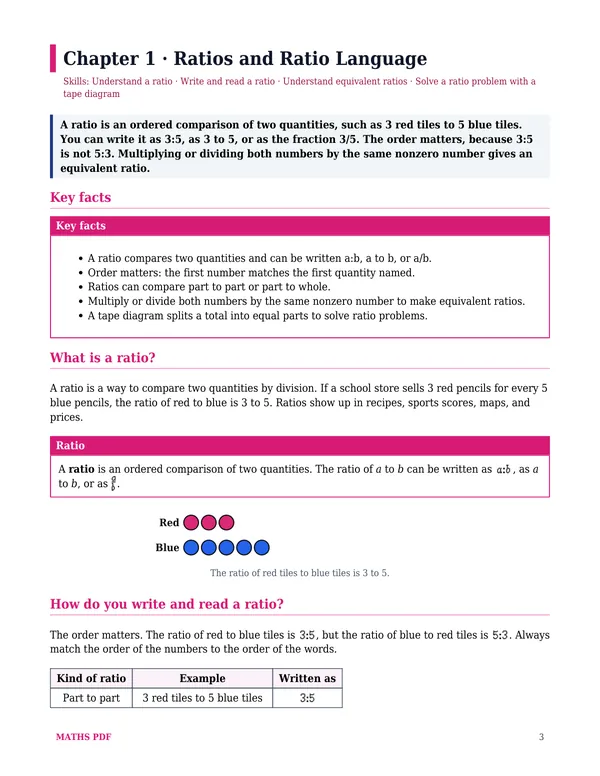
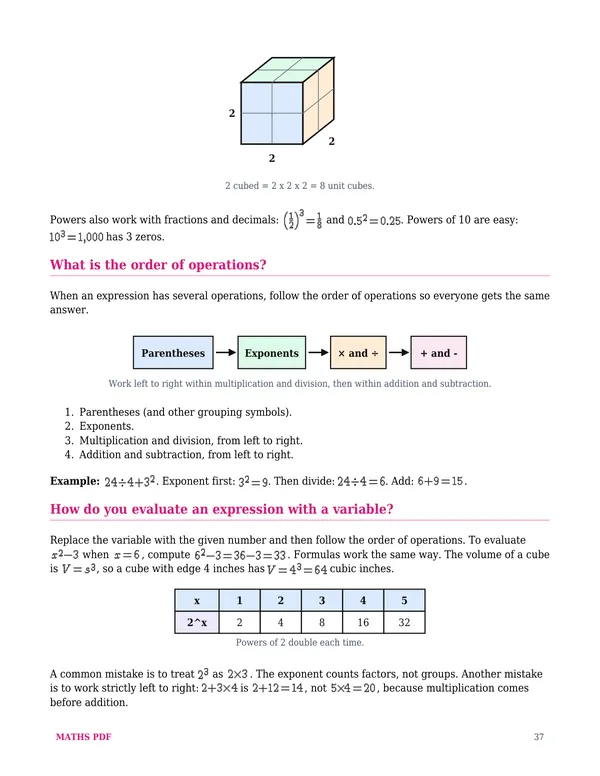
Three pages from the Grade 6 Math Lessons, exactly as you will print them. Click to enlarge.
How to use this lesson book
Read one chapter at a time
The 22 chapters follow the order of the sixth grade year; at about 3 pages each, a chapter is one short sitting.
Copy the key facts
Write the Key facts of The Coordinate Plane and Polygons on an index card: a ready-made summary for the night before a quiz.
Try the closing questions
Cover the answers at the end of Solving One-Step Equations and answer first: the best way to check understanding.
Frequently asked questions
What is in the Grade 6 lesson book?
70 US Letter pages and 22 chapters, one lesson per chapter, with 106 lesson sections in all. The full contents are listed above on this page.
Does the Grade 6 lesson book include exercises?
Each chapter ends with a short set of questions and answers. For full practice, the Grade 6 Math Worksheets with Answers follows the same 22 chapters.
Do I need the Grade 6 Math Worksheets with Answers along with the lesson book?
No, the Grade 6 Math Lessons stands on its own. But both books follow the same 22 chapters of Grade 6; together they make a complete year, lesson then practice.
How do I receive the Grade 6 Math Lessons?
Right after paying with PayPal or a card, you reach your download page, where the Grade 6 Math Lessons is waiting. An email with the link is sent too.
Can I print the Grade 6 lesson book and open it on several devices?
Yes: the 70-page PDF of the Grade 6 Math Lessons prints as often as you need and opens on three devices (computer, tablet, phone). It carries your name at the bottom of the pages.
More answers on the shop page, or through our contact form.