
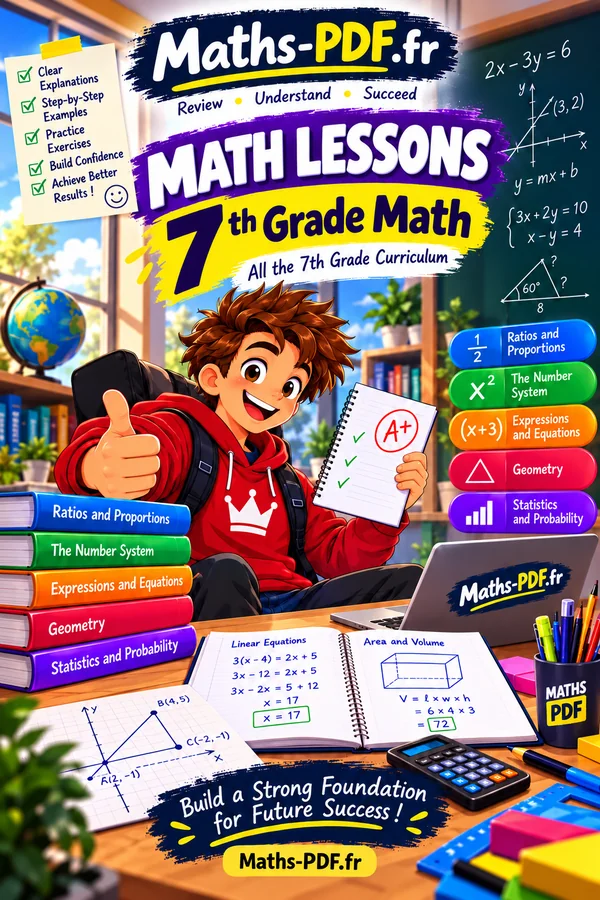
Grade 7 Math Lessons
The seventh grade year in 20 lessons, from Unit Rates with Fractions to Compound Events and Simulations, each one with its Key facts and a closing set of questions and answers.
- 64 US Letter pages
- 20 chapters
- 97 lesson sections
- PDF to print
- Cards accepted without a PayPal account
- Instant download, up to 3 devices
About this book
Seventh grade is about proportional relationships. The lessons explain unit rates with fractions, the equation y = kx and percent problems, then cover operations with rational numbers, circumference and area of circles, and random sampling.
Every chapter opens with the skills it builds; in Solving Two-Step Equations, for instance: understand a two-step equation, solve px + q = r, solve p(x + q) = r. A Key facts box sums up what to remember. Most of the 97 lesson sections of the book are written as questions a student would ask, such as How do you solve p(x + q) = r?
For a seventh grader, a parent who wants to check progress, or a tutor preparing chapter reviews. Pair it with the Grade 7 Math Worksheets with Answers to practice each chapter right after reading it.
Detailed contents
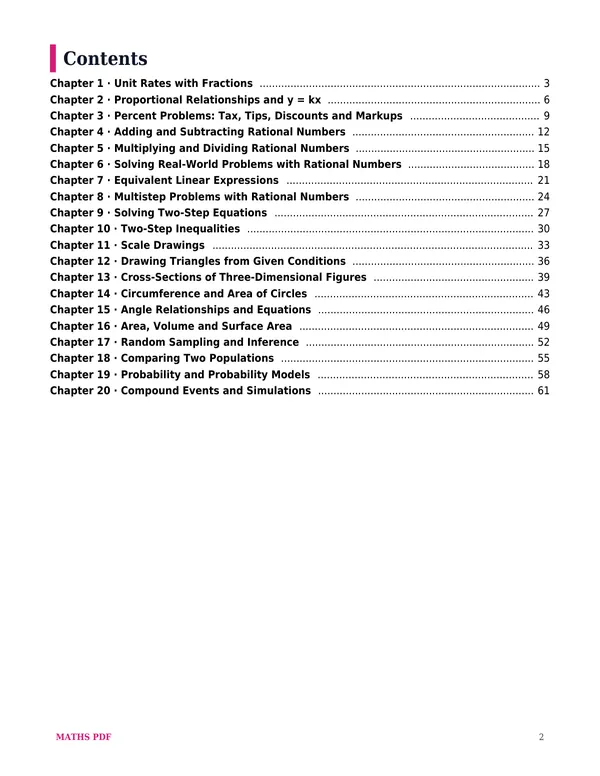
The 20 chapters of the Grade 7 lesson book, the sections of each lesson and the page where each chapter starts.
-
1
Unit Rates with Fractions
- What is a unit rate?
- How do you find a unit rate when the numbers are fractions?
- How do you compare two rates?
- Can the unit rate be flipped?
- Grade 7 unit rates lesson: questions and answers
-
2
Proportional Relationships and y = kx
- What does it mean for two quantities to be proportional?
- How can you tell from a graph?
- How do you write the equation y = kx?
- What does a point on the graph mean?
- Grade 7 proportional relationships lesson: questions and answers
-
3
Percent Problems: Tax, Tips, Discounts and Markups
- What is a percent of a number?
- How do you find tax, tips, markups and discounts?
- How do you solve a multistep percent problem?
- What are simple interest and percent error?
- Percent problems lesson: questions and answers
-
4
Adding and Subtracting Rational Numbers
- What are rational numbers and opposites?
- How do you add rational numbers on a number line?
- How do you subtract rational numbers?
- How is absolute value a distance?
- Which mistakes should you avoid?
- Add subtract rationals lesson: questions and answers
-
5
Multiplying and Dividing Rational Numbers
- How do you multiply signed numbers?
- How do you divide signed numbers?
- How do you turn a fraction into a decimal?
- Multiply divide rationals lesson: questions and answers
-
6
Solving Real-World Problems with Rational Numbers
- How do you choose the operation?
- How do you solve a multistep problem?
- How do you work with fractions and decimals in the same problem?
- What is a complex fraction?
- Rational number problems lesson: questions and answers
-
7
Equivalent Linear Expressions
- What are equivalent expressions?
- How do you combine like terms?
- How do you expand and factor?
- Why rewrite an expression in a different form?
- Grade 7 equivalent expressions lesson: questions and answers
-
8
Multistep Problems with Rational Numbers
- How do you solve a problem that mixes fractions, decimals and percents?
- What is a good plan for a multistep problem?
- How do you work with a budget?
- Grade 7 multistep problems lesson: questions and answers
-
9
Solving Two-Step Equations
- What is a two-step equation?
- How do you solve px + q = r?
- How do you solve p(x + q) = r?
- How is an arithmetic solution different from an algebraic one?
- Two step equations lesson: questions and answers
-
10
Two-Step Inequalities
- What is an inequality and what is its solution set?
- How do you solve
- When do you reverse the inequality symbol?
- How do you use inequalities in word problems?
- Grade 7 inequalities lesson: questions and answers
-
11
Scale Drawings
- What is a scale drawing?
- How do you find an actual length?
- What happens to area?
- How do you redraw at a different scale?
- Scale drawings lesson: questions and answers
-
12
Drawing Triangles from Given Conditions
- When can three lengths form a triangle?
- What do the angles of a triangle add up to?
- How many triangles does a set of conditions give?
- Triangle constructions lesson: questions and answers
-
13
Cross-Sections of Three-Dimensional Figures
- What is a cross-section?
- What do slices of a rectangular prism look like?
- What do slices of a rectangular pyramid look like?
- What if the plane is tilted?
- Grade 7 cross sections lesson: questions and answers
-
14
Circumference and Area of Circles
- What are the parts of a circle?
- What is pi?
- How do you find circumference and area?
- Where do the formulas come from?
- Circles lesson: questions and answers
-
15
Angle Relationships and Equations
- What are complementary and supplementary angles?
- What are vertical angles?
- How do you write an equation for an unknown angle?
- Grade 7 angle relationships lesson: questions and answers
-
16
Area, Volume and Surface Area
- How do you find the area of triangles and quadrilaterals?
- How do you find the area of a composite polygon?
- How do you find the volume of a right prism?
- How do you find the surface area of a prism?
- Area volume surface area lesson: questions and answers
-
17
Random Sampling and Inference
- What are a population and a sample?
- What makes a sample representative?
- How do you use a sample to estimate a population?
- Why do different samples give different results?
- Random sampling lesson: questions and answers
-
18
Comparing Two Populations
- How do you compare the centers of two data sets?
- How do you measure how spread out the data are?
- How do box plots help?
- How do you decide if a difference is meaningful?
- Comparing populations lesson: questions and answers
-
19
Probability and Probability Models
- What is probability?
- How do you find theoretical probability?
- What is relative frequency?
- What is a probability model?
- Probability models lesson: questions and answers
-
20
Compound Events and Simulations
- What is a compound event?
- How do you list the sample space?
- How do you use a table for two dice?
- What is a simulation?
- Compound events lesson: questions and answers
Sample pages
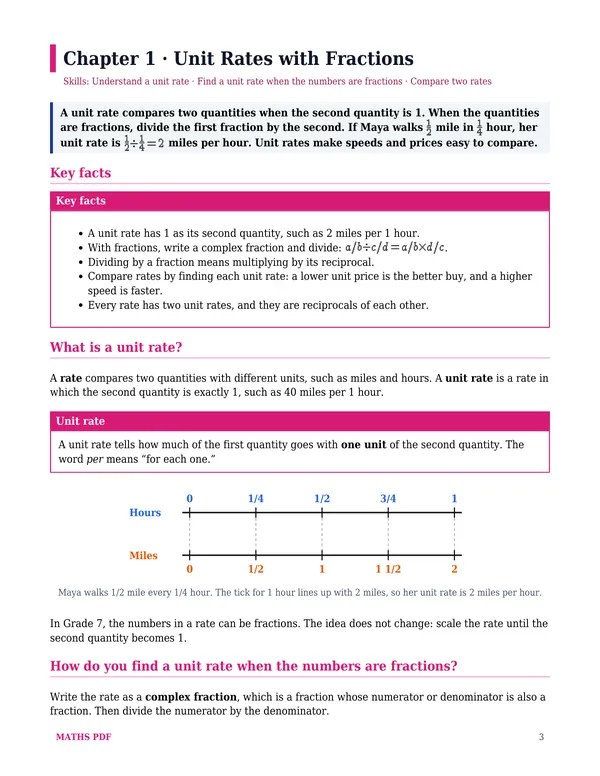
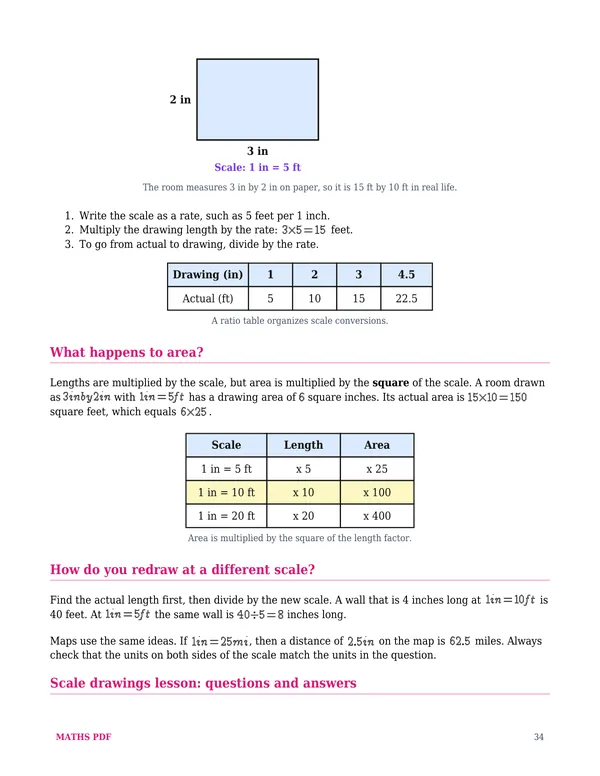
Three pages from the Grade 7 Math Lessons, exactly as you will print them. Click to enlarge.
How to use this lesson book
Read one chapter at a time
The 20 chapters follow the order of the seventh grade year; at about 3 pages each, a chapter is one short sitting.
Copy the key facts
Write the Key facts of Drawing Triangles from Given Conditions on an index card: a ready-made summary for the night before a quiz.
Try the closing questions
Cover the answers at the end of Area, Volume and Surface Area and answer first: the best way to check understanding.
Frequently asked questions
What is in the Grade 7 lesson book?
64 US Letter pages and 20 chapters, one lesson per chapter, with 97 lesson sections in all. The full contents are listed above on this page.
Does the Grade 7 lesson book include exercises?
Each chapter ends with a short set of questions and answers. For full practice, the Grade 7 Math Worksheets with Answers follows the same 20 chapters.
Do I need the Grade 7 Math Worksheets with Answers along with the lesson book?
No, the Grade 7 Math Lessons stands on its own. But both books follow the same 20 chapters of Grade 7; together they make a complete year, lesson then practice.
How do I receive the Grade 7 Math Lessons?
Right after paying with PayPal or a card, you reach your download page, where the Grade 7 Math Lessons is waiting. An email with the link is sent too.
Can I print the Grade 7 lesson book and open it on several devices?
Yes: the 64-page PDF of the Grade 7 Math Lessons prints as often as you need and opens on three devices (computer, tablet, phone). It carries your name at the bottom of the pages.
More answers on the shop page, or through our contact form.