

Algebra 1 Math Lessons
The Algebra 1 course in 19 lessons, from Structure of Algebraic Expressions to Scatter Plots, Lines of Fit and Two-Way Tables, each one with its Key facts and a closing set of questions and answers.
- 69 US Letter pages
- 19 chapters
- 106 lesson sections
- PDF to print
- Cards accepted without a PayPal account
- Instant download, up to 3 devices
About this book
Algebra 1 is where letters become tools. The lessons start with the structure of expressions and linear equations, then build functions, slope and systems, and finish with polynomials, factoring and quadratic functions.
Every chapter opens with the skills it builds; in Linear Inequalities in Two Variables and Systems, for instance: understand a linear inequality in two variables, graph a linear inequality, graph a system of inequalities. A Key facts box sums up what to remember. Most of the 106 lesson sections of the book are written as questions a student would ask, such as How do you graph a system of inequalities?
For a student taking Algebra 1 in middle or high school, a parent, or a tutor. Pair it with the Algebra 1 Math Worksheets with Answers to practice each chapter right after reading it.
Detailed contents
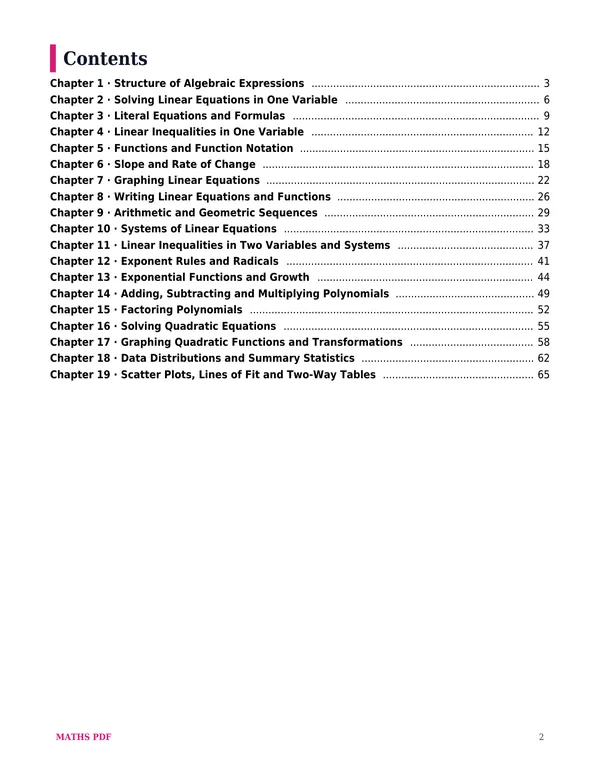
The 19 chapters of the Algebra 1 lesson book, the sections of each lesson and the page where each chapter starts.
-
1
Structure of Algebraic Expressions
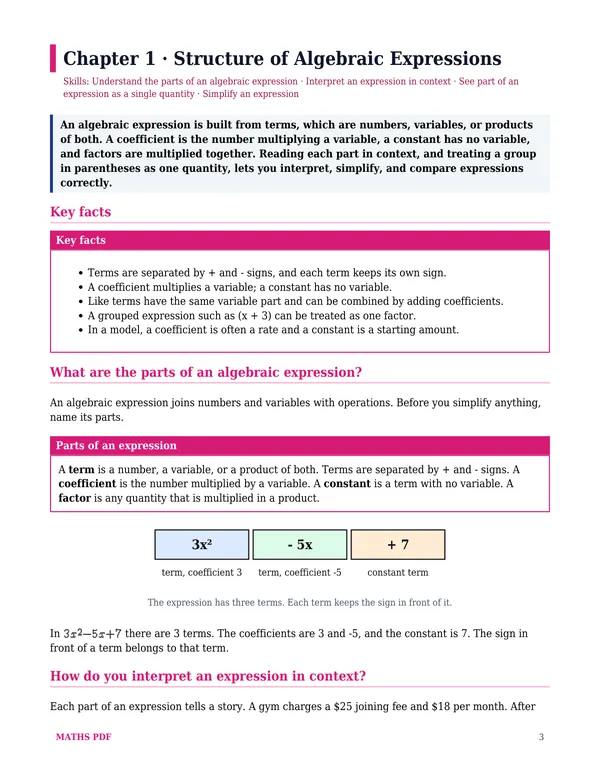
- What are the parts of an algebraic expression?
- - 5x
- How do you interpret an expression in context?
- How can you see part of an expression as a single quantity?
- How do you simplify an expression?
- Algebra 1 expressions lesson: questions and answers
-
2
Solving Linear Equations in One Variable
- What is a linear equation in one variable?
- How do you solve a two-step equation?
- How do you solve an equation with variables on both sides?
- Can an equation have no solution or infinitely many?
- How do you write an equation from a word problem?
- Algebra 1 linear equations lesson: questions and answers
-
3
Literal Equations and Formulas
- What is a literal equation?
- How do you solve a formula for one variable?
- Why rearrange a formula before using it?
- What if the variable appears in more than one term?
- Literal equations lesson: questions and answers
-
4
Linear Inequalities in One Variable
- What is a linear inequality?
- How do you solve an inequality?
- What is a compound inequality?
- How do you write an inequality from a situation?
- Linear inequalities lesson: questions and answers
-
5
Functions and Function Notation
- What is a function?
- How do you tell if a graph is a function?
- What does function notation mean?
- How do you find the domain and range in a real situation?
- Algebra 1 functions lesson: questions and answers
-
6
Slope and Rate of Change
- What is slope?
- What do positive, negative, zero, and undefined slopes mean?
- How is slope a rate of change?
- What is average rate of change?
- Slope rate of change lesson: questions and answers
-
7
Graphing Linear Equations
- What does the graph of an equation show?
- How do you graph from slope-intercept form?
- How do you graph standard form Ax + By = C?
- What about horizontal and vertical lines?
- How do you graph point-slope form?
- Graphing linear lesson: questions and answers
-
8
Writing Linear Equations and Functions
- How do you write the equation of a line?
- How do you write an equation from a table?
- How do parallel and perpendicular lines relate?
- How do you write a linear model from a situation?
- Writing linear lesson: questions and answers
-
9
Arithmetic and Geometric Sequences
- What is a sequence?
- What is an arithmetic sequence?
- What is a geometric sequence?
- How do you write a rule for a sequence?
- Sequences lesson: questions and answers
-
10
Systems of Linear Equations
- What is a system of linear equations?
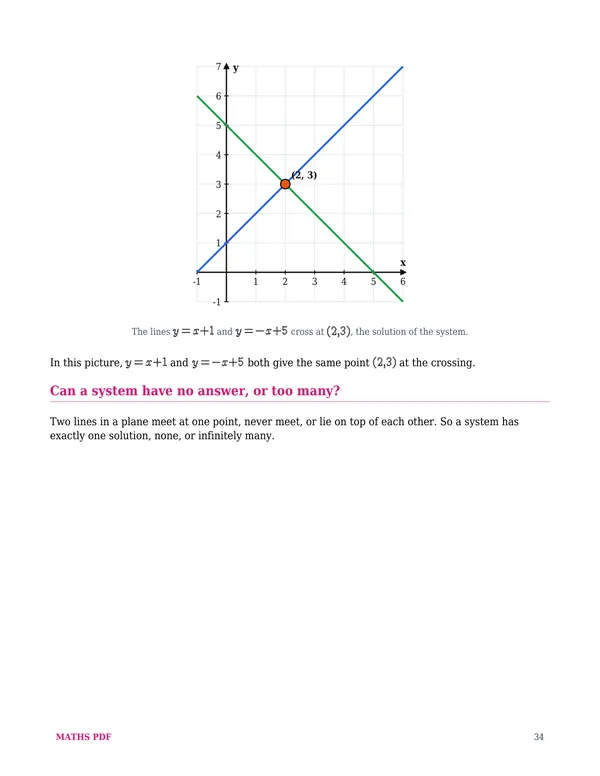
- How does graphing find a solution?
- Can a system have no answer, or too many?
- What is the substitution method?
- What is the elimination method?
- How do you set up a word problem as a system?
- Systems lesson: questions and answers
-
11
Linear Inequalities in Two Variables and Systems
- What is a linear inequality in two variables?
- How do you graph a linear inequality?
- Why is the line solid or dashed?
- How do you graph a system of inequalities?
- How do you use inequalities in a real situation?
- Linear inequalities two variables lesson: questions and answers
-
12
Exponent Rules and Radicals
- What do exponents mean?
- What are zero and negative exponents?
- What are rational exponents and radicals?
- What are rational and irrational numbers?
- Exponent rules lesson: questions and answers
-
13
Exponential Functions and Growth
- What is an exponential function?
- How do you tell linear from exponential?
- How do growth and decay rates become factors?
- How does compound interest work?
- Why does exponential growth beat linear growth?
- Algebra 1 exponential functions lesson: questions and answers
-
14
Adding, Subtracting and Multiplying Polynomials
- What is a polynomial?
- How do you add and subtract polynomials?
- How do you multiply polynomials?
- What are the special products?
- Why are polynomials closed under these operations?
- Algebra 1 polynomial operations lesson: questions and answers
-
15
Factoring Polynomials
- What does it mean to factor a polynomial?
- How do you factor out the greatest common factor?
- How do you factor a trinomial
- How do you factor when the leading coefficient is not 1?
- Why does factoring help?
- Factoring lesson: questions and answers
-
16
Solving Quadratic Equations
- What makes an equation quadratic?
- When can you use square roots?
- How does the zero product property help?
- What does completing the square do?
- When is the quadratic formula the best choice?
- Algebra 1 quadratic equations lesson: questions and answers
-
17
Graphing Quadratic Functions and Transformations
- What does the graph of a quadratic function look like?
- How do you find the vertex and intercepts?
- What does vertex form tell you?
- How do transformations change the graph?
- Quadratic functions lesson: questions and answers
-
18
Data Distributions and Summary Statistics
- How do you display data?
- How do you measure the center?
- What is an outlier?
- How do you describe a distribution?
- Data distributions lesson: questions and answers
-
19
Scatter Plots, Lines of Fit and Two-Way Tables
- What does a scatter plot show?
- How do you use a line of fit?
- What is a residual?
- What does the correlation coefficient measure?
- How do two-way tables work?
- Algebra 1 scatter plots lesson: questions and answers
Sample pages
Three pages from the Algebra 1 Math Lessons, exactly as you will print them. Click to enlarge.
How to use this lesson book
Read one chapter at a time
The 19 chapters follow the order of the Algebra 1 course; at about 3 pages each, a chapter is one short sitting.
Copy the key facts
Write the Key facts of Adding, Subtracting and Multiplying Polynomials on an index card: a ready-made summary for the night before a quiz.
Try the closing questions
Cover the answers at the end of Data Distributions and Summary Statistics and answer first: the best way to check understanding.

Frequently asked questions
What is in the Algebra 1 lesson book?
69 US Letter pages and 19 chapters, one lesson per chapter, with 106 lesson sections in all. The full contents are listed above on this page.
Does the Algebra 1 lesson book include exercises?
Each chapter ends with a short set of questions and answers. For full practice, the Algebra 1 Math Worksheets with Answers follows the same 19 chapters.
Do I need the Algebra 1 Math Worksheets with Answers along with the lesson book?
No, the Algebra 1 Math Lessons stands on its own. But both books follow the same 19 chapters of Algebra 1; together they make a complete course, lesson then practice.
How do I receive the Algebra 1 Math Lessons?
Right after paying with PayPal or a card, you reach your download page, where the Algebra 1 Math Lessons is waiting. An email with the link is sent too.
Can I print the Algebra 1 lesson book and open it on several devices?
Yes: the 69-page PDF of the Algebra 1 Math Lessons prints as often as you need and opens on three devices (computer, tablet, phone). It carries your name at the bottom of the pages.
More answers on the shop page, or through our contact form.