
Grade 5 Math Lessons
The fifth grade year in 19 lessons, from Numerical Expressions and Order of Operations to Classifying Two-Dimensional Figures, each one with its Key facts and a closing set of questions and answers.
- 64 US Letter pages
- 19 chapters
- 107 lesson sections
- PDF to print
- Cards accepted without a PayPal account
- Instant download, up to 3 devices
About this book
Fifth grade closes elementary school with a lot of fraction and decimal work. The lessons cover numerical expressions, place value and powers of ten, multiplying and dividing decimals, and dividing unit fractions.
Every chapter opens with the skills it builds; in Adding and Subtracting Decimals, for instance: add decimals, understand the steps for adding, subtract decimals. A Key facts box sums up what to remember. Most of the 107 lesson sections of the book are written as questions a student would ask, such as Where do we use decimal addition and subtraction?
For a fifth grader getting ready for middle school, a parent, or a tutor working on fractions and decimals. Pair it with the Grade 5 Math Worksheets with Answers to practice each chapter right after reading it.
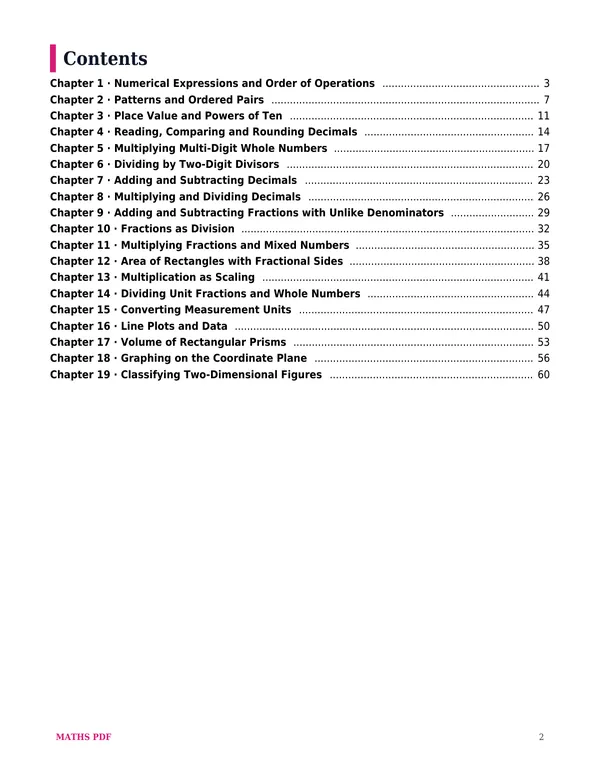
Detailed contents
The 19 chapters of the Grade 5 lesson book, the sections of each lesson and the page where each chapter starts.
-
1
Numerical Expressions and Order of Operations
- What is the order of operations?
- What do parentheses, brackets and braces do?
- How do you evaluate an expression step by step?
- How do you write an expression from words?
- Can you compare an expression without calculating?
- Grade 5 expressions lesson: questions and answers
-
2
Patterns and Ordered Pairs
- What is a numerical pattern?
- What are corresponding terms?
- How do you turn corresponding terms into ordered pairs?
- How do you find the relationship between two patterns?
- How do you graph the ordered pairs?
- Grade 5 patterns lesson: questions and answers
-
3
Place Value and Powers of Ten
- How are place values related?
- What is a power of 10?
- What happens when you multiply by a power of 10?
- What happens when you divide by a power of 10?
- How do you multiply 5.6 by 10³?
- Powers of ten lesson: questions and answers
-
4
Reading, Comparing and Rounding Decimals
- How do you read and write decimals?
- What is expanded form?
- How do you compare decimals?
- How do you round a decimal?
- Decimals compare round lesson: questions and answers
-
5
Multiplying Multi-Digit Whole Numbers
- What is the standard algorithm for multiplication?
- How do you multiply by a two-digit number?
- Why do we write a zero in the second row?
- How does an area model match the algorithm?
- How do you estimate a product?
- Multiply whole lesson: questions and answers
-
6
Dividing by Two-Digit Divisors
- What are the parts of a division problem?
- How do you divide with partial quotients?
- How does an area model show division?
- How do you estimate a quotient?
- What do you do with a remainder?
- Divide whole lesson: questions and answers
-
7
Adding and Subtracting Decimals
- How do you add decimals?
- What are the steps for adding?
- How do you subtract decimals?
- How do you estimate with decimals?
- Where do we use decimal addition and subtraction?
- Add subtract decimals lesson: questions and answers
-
8
Multiplying and Dividing Decimals
- How do you multiply decimals with a model?
- What are the steps for multiplying decimals?
- How do you divide a decimal by a whole number?
- How do you divide by a decimal?
- Multiply divide decimals lesson: questions and answers
-
9
Adding and Subtracting Fractions with Unlike Denominators
- How do you add fractions with different denominators?
- What are the steps for adding and subtracting fractions?
- How do you subtract mixed numbers?
- How can benchmark fractions check an answer?
- Grade 5 add subtract fractions lesson: questions and answers
-
10
Fractions as Division
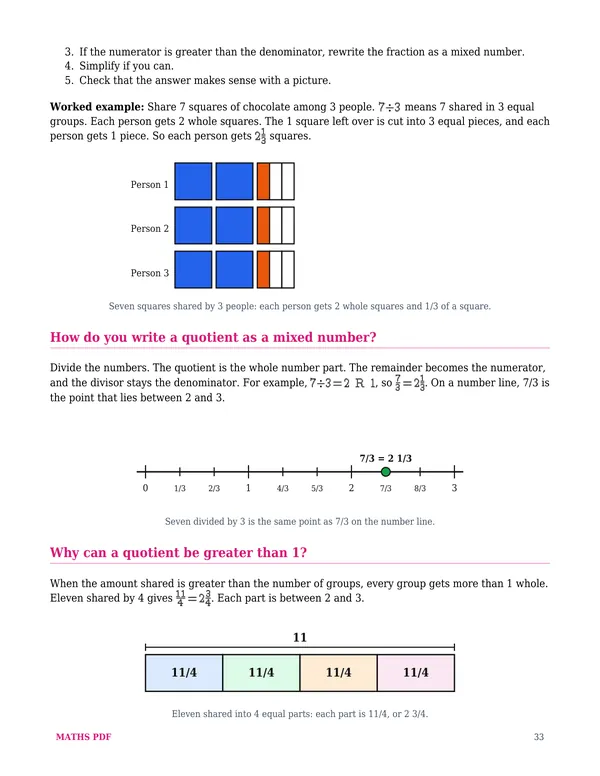
- What does a fraction mean as division?
- How do you share whole objects equally?
- How do you write a quotient as a mixed number?
- Why can a quotient be greater than 1?
- Fractions as division lesson: questions and answers
-
11
Multiplying Fractions and Mixed Numbers
- How do you multiply a fraction by a whole number?
- How do you multiply two fractions?
- How do you multiply mixed numbers?
- What are the steps for multiplying mixed numbers?
- Multiply fractions lesson: questions and answers
-
12
Area of Rectangles with Fractional Sides
- What is the area of a rectangle with fractional sides?
- Why does multiplying the side lengths work?
- How do you find the area step by step?
- What if a side is longer than 1 unit?
- Area fraction sides lesson: questions and answers
-
13
Multiplication as Scaling
- What does it mean to scale a number by multiplying?
- How can you tell if a product is larger or smaller without calculating?
- What happens when you multiply two fractions less than 1?
- What are the steps for predicting and checking?
- Scaling lesson: questions and answers
-
14
Dividing Unit Fractions and Whole Numbers
- What does it mean to divide a unit fraction by a whole number?
- What does it mean to divide a whole number by a unit fraction?
- How can a number line show the division?
- How do you check a division answer?
- What are the steps to solve a problem?
- Divide unit fractions lesson: questions and answers
-
15
Converting Measurement Units
- What is a conversion factor?
- How do you convert a larger unit to a smaller unit?
- How do you convert a smaller unit to a larger unit?
- How do metric conversions work?
- How do you solve a multistep problem?
- Grade 5 measurement conversions lesson: questions and answers
-
16
Line Plots and Data
- What is a line plot?
- How do you read a line plot?
- How do you add up all the measurements?
- What changes when the marks are eighths?
- How do you share the total equally?
- Grade 5 line plots lesson: questions and answers
-
17
Volume of Rectangular Prisms
- What is volume?
- How do you find volume by counting cubes?
- What formulas give the volume of a rectangular prism?
- How do you find the volume of a composite solid?
- Volume lesson: questions and answers
-
18
Graphing on the Coordinate Plane
- What is the coordinate plane?
- How do you plot an ordered pair?
- How do you find the distance between two points?
- How do graphs show real-world situations?
- Grade 5 coordinate plane lesson: questions and answers
-
19
Classifying Two-Dimensional Figures
- What is a quadrilateral?
- Square
- Rectangle
- RhombusParallelogram
- How are the quadrilaterals related?
- How does a Venn diagram show the groups?
- How do you classify triangles?
- Classify shapes lesson: questions and answers
Sample pages
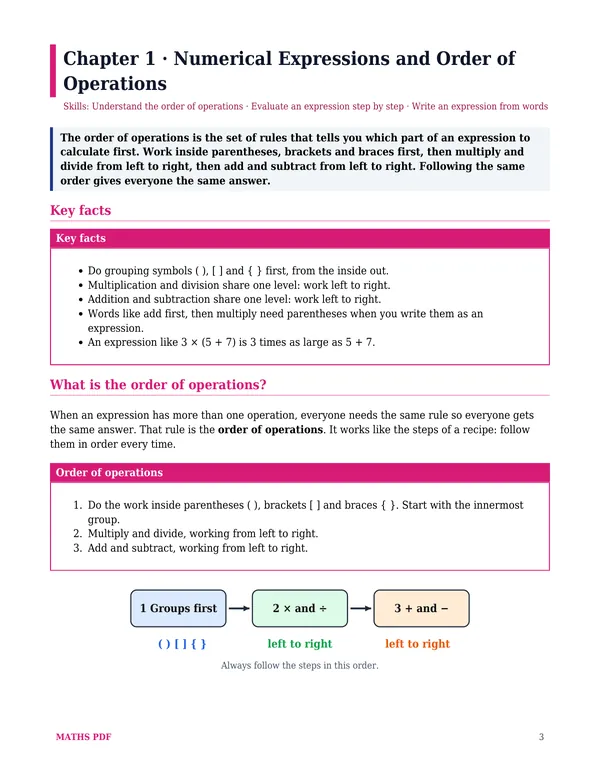
Three pages from the Grade 5 Math Lessons, exactly as you will print them. Click to enlarge.
How to use this lesson book
Read one chapter at a time
The 19 chapters follow the order of the fifth grade year; at about 3 pages each, a chapter is one short sitting.
Copy the key facts
Write the Key facts of Fractions as Division on an index card: a ready-made summary for the night before a quiz.
Try the closing questions
Cover the answers at the end of Dividing Unit Fractions and Whole Numbers and answer first: the best way to check understanding.
Frequently asked questions
What is in the Grade 5 lesson book?
64 US Letter pages and 19 chapters, one lesson per chapter, with 107 lesson sections in all. The full contents are listed above on this page.
Does the Grade 5 lesson book include exercises?
Each chapter ends with a short set of questions and answers. For full practice, the Grade 5 Math Worksheets with Answers follows the same 19 chapters.
Do I need the Grade 5 Math Worksheets with Answers along with the lesson book?
No, the Grade 5 Math Lessons stands on its own. But both books follow the same 19 chapters of Grade 5; together they make a complete year, lesson then practice.
How do I receive the Grade 5 Math Lessons?
Right after paying with PayPal or a card, you reach your download page, where the Grade 5 Math Lessons is waiting. An email with the link is sent too.
Can I print the Grade 5 lesson book and open it on several devices?
Yes: the 64-page PDF of the Grade 5 Math Lessons prints as often as you need and opens on three devices (computer, tablet, phone). It carries your name at the bottom of the pages.
More answers on the shop page, or through our contact form.