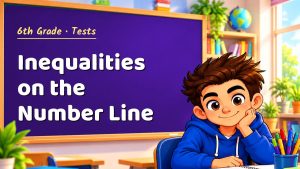
6th Grade Inequalities on the Number Line Lesson (Free PDF)
This grade 6 inequalities lesson for 6th Grade covers inequalities on the number line (Common Core 6.EE.B.5, 6.EE.B.8), with a free PDF to print.
An inequality compares values, and its solutions are all the numbers that make it true. The inequality x > 3 has infinitely many solutions. To graph it, draw an open circle at 3 and shade to the right. Use a closed circle when the number is included, as in “at least” or “no more than.”
Grade 6 · Common Core State Standards: 6.EE.B.5, 6.EE.B.8
Key facts in this grade 6 inequalities lesson
- An inequality uses <, >, ≤, or ≥ and usually has infinitely many solutions.
- Open circle: the number is not included (< or >).
- Closed circle: the number is included (≤ or ≥).
- Shade right for greater values and left for lesser values.
- At least means ≥ and at most or no more than means ≤.
What is an inequality?
An inequality compares two values that may not be equal. Instead of an equals sign it uses \(<\), \(>\), \(\le\), or \(\ge\). The inequality \(x > 3\) says that x is any number greater than 3.
How do you graph an inequality?
- Draw a number line and mark the number in the inequality.
- Use an open circle for \(<\) or \(>\); use a closed circle for \(\le\) or \(\ge\).
- Shade the side with the solutions: right for greater, left for less.
How do you write an inequality from words?
Look for key phrases. “More than” and “greater than” mean \(>\). “At least” and “no less than” mean \(\ge\). “Less than” means \(<\). "At most" and "no more than" mean \(\le\).
How do you use inequalities in real situations?
Inequalities describe limits and goals. A highway speed limit of 65 miles per hour gives \(s \le 65\). A child must be taller than 48 inches to ride, so \(h > 48\). To test a value, substitute it. Is 48 a solution of \(h > 48\)? No, because \(48 > 48\) is false.
Here is a quick way to avoid mistakes. Pick a test number on the shaded side of your graph and substitute it into the inequality. If the statement is true, the shading is correct. Then test the number at the circle. If the inequality uses \(\le\) or \(\ge\), the number at the circle makes the statement true, so the circle must be closed. If it uses \(<\) or \(>\), that number makes the statement false, so the circle must be open.
Remember that an inequality like \(x > 3\) is not a single answer. It describes a whole set of numbers, and the graph shows all of them at once.
Grade 6 inequalities lesson: questions and answers
What is the difference between an equation and an inequality?
An equation says two quantities are equal and usually has one solution. An inequality compares quantities and usually has infinitely many solutions.
When do you use an open circle on a number line?
Use an open circle for < or >, when the number itself is not a solution. Use a closed circle for ≤ or ≥.
What does at least mean in math?
At least means the number or anything greater, so it is written with ≥. For example, at least 8 points is p ≥ 8.
How do you check whether a number is a solution?
Substitute the number into the inequality and see whether the statement is true. For x + 3 > 9 and x = 6, 9 > 9 is false.
How many solutions does x > 5 have?
It has infinitely many solutions, because every number greater than 5, including decimals, makes it true.
How to use this grade 6 inequalities lesson
Read the definitions first, then follow the worked method line by line and redo the example on paper without looking. When every step makes sense, move on to the worksheet, then check yourself with the quiz.
Download the grade 6 inequalities lesson as a PDF with the button below and keep it with your notes.
All Grade 6 chapters: Grade 6 math.

More 6th Grade math
Lessons
See all


Worksheets
See all

Tests
See all Percent as a Rate per 100 Test with Point Values
- Independent and Dependent Variables Test with Point Values
- Exponents and Order of Operations Test with Point Values
- Inequalities on the Number Line Test with Point Values
- Solving One-Step Equations Test with Point Values
- Writing and Reading Algebraic Expressions Test with Point Values