5th Grade Volume of Rectangular Prisms Worksheets with Answers (Free PDF)
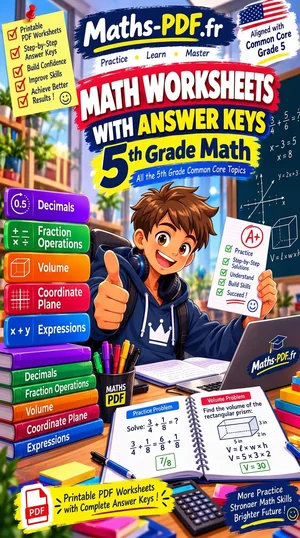
This 5th grade volume worksheet covers volume of rectangular prisms (Common Core 5.MD.C.3, 5.MD.C.4, 5.MD.C.5), with a free PDF to print.
Key takeaway: This worksheet helps fifth grade students practice finding the volume of rectangular prisms, missing edges, and solids made of two prisms.
- Topic: Volume of Rectangular Prisms (5th grade)
- Content: 20 worksheet problems, from easy to challenging
- Standards: 5.MD.C.3, 5.MD.C.4, 5.MD.C.5
- Answers: On a separate page, so you can try every worksheet problem first
- Format: Free printable PDF, US Letter, black and white
This worksheet helps fifth grade students practice finding the volume of rectangular prisms, missing edges, and solids made of two prisms. Also, cubes, layers, and real objects such as fish tanks, pools, and boxes show where volume matters.
There are 20 problems. The first two count cubes and layers, and the next five use formulas in feet, centimeters, and inches. Then, problems 8 and 9 find a missing edge, two more find the volume of a cube and a prism from a picture, and the last nine are stories and solids about a tank, boxes, solids made of two prisms, packing cubes, a pool, a bin, a planter, and a box of cubes. Also, allow about 40 minutes.
This worksheet has 20 problems on volume (5.MD.C.3, 5.MD.C.4 and 5.MD.C.5). You will count unit cubes, use V = l × w × h and V = B × h, find missing edges, and find the volume of solids made from two prisms.
The first problems use pictures and small numbers. The last six are word problems about tanks, boxes, pools and planters. Write cubic units in every answer.
Grade 5 · Common Core State Standards: 5.MD.C.3, 5.MD.C.4, 5.MD.C.5
5th grade volume worksheet: worksheet problems 1 to 10
1 – Count the cubes
First, solve. The prism is built from unit cubes. Find its volume in cubic units.
2 – Layers of cubes
Next, solve. A prism is 4 cubes long, 3 cubes wide and 3 cubes high. (a) How many cubes are in each layer? (b) How many layers are there? (c) What is the volume?
3 – Volume in cubic feet
Then, find the volume of a prism with length 5 ft, width 3 ft and height 2 ft.
4 – Volume in cubic centimeters
Now, find the volume of a prism that is 6 cm long, 4 cm wide and 5 cm high.
5 – Volume in cubic inches
Also, find the volume of a prism with length 8 in, width 2 in and height 7 in.
6 – Base area times height
First, solve. The area of the base of a prism is 24 square units and its height is 5 units. Find the volume.
7 – Using the base area
Next, solve. A prism has a base with an area of 18 square inches. Its height is 4 inches. Find its volume.
8 – Find the height
Then, solve. A prism has volume \(90\text{ cm}^{3}\), length 6 cm and width 5 cm. Find its height.
9 – Find the missing edge
Now, solve. The base of a box has an area of 15 square feet. The volume of the box is 105 cubic feet. Find the height.
Worksheet problem 10 and after
10 – Volume of a cube
Also, solve. A cube has edges that are 4 m long. Find its volume.
Worksheet problems 11 and up
11 – Prism from a picture
First, find the volume of the prism. Each small cube is 1 cubic unit.
12 – Fish tank
Next, solve. Maya’s fish tank is 20 inches long, 10 inches wide and 12 inches high. What is its volume?
13 – Compare two boxes
Then, solve. Box A is 3 in by 7 in by 4 in. Box B is 6 in by 5 in by 3 in. Which box has the greater volume, and by how much?
14 – Two prisms joined
Now, solve. A solid is made of two rectangular prisms, as shown. Find the volume of the whole solid.
15 – Step-shaped solid
Also, find the volume of the solid made of two rectangular prisms.
16 – Packing cubes
First, solve. Sofia’s shipping box is 12 in by 9 in by 6 in. She packs it with cubes that are 3 inches on each edge. How many cubes fit?
17 – Filling a pool
Next, solve. A pool is 20 ft long, 10 ft wide and 4 ft deep. It is filled with water to \(\frac{3}{4}\) of its volume. How many cubic feet of water are in the pool?
Worksheet problem 18 and after
18 – Storage bin
Then, solve. A storage bin holds 360 cubic inches. It is 12 inches long and 6 inches wide. How tall is the bin?
19 – Planter soil
Now, solve. Diego builds a planter from two boxes joined together: one is 6 ft by 3 ft by 2 ft, and the other is 3 ft by 3 ft by 1 ft. Soil costs $4 for each cubic foot. How much does it cost to fill the planter?
20 – Cubes in a box
Also, solve. Ethan fills a box that is 10 cm by 8 cm by 6 cm with cubes that are 2 cm on each edge. (a) How many cubes fit in one layer? (b) How many layers are there? (c) How many cubes fit in all?

Key facts behind this 5th grade volume worksheet
- A unit cube has volume 1 cubic unit.
- Volume is measured in cubic units such as cm³, in³ and ft³.
- V = l × w × h, and V = B × h where B is the base area.
- Then, a composite solid made of two prisms has volume equal to the sum of the two volumes.
- Volume = (cubes in one layer) × (number of layers).
Common mistakes with this 5th grade volume worksheet
- Students add the lengths of the edges. Also, volume uses multiplication of the three edges. Slow down at that step and check it twice.
- Students write square units for volume. Instead, use cubic units. Slow down at that step and check it twice.
- Students divide the volume by only one edge to find a missing edge. Also, divide by the product of the other two edges, or by the base area.
- Students skip one prism in a joined solid. Instead, find the volume of each part and add. Slow down at that step and check it twice.
Tips before you start the worksheet problems
- Draw the prism and label each edge before you multiply. Then, a labeled picture prevents mix ups. Repeat this habit on every problem for the best results.
- Check a missing edge by multiplying back. Finally, the three edges must give the volume. Repeat this habit on every problem for the best results.
- Teachers can ask students to explain one problem with layers of cubes. Repeat this habit on every problem for the best results.
Download the 5th grade volume worksheet as a PDF with the button below and keep it with your notes.
5th grade volume worksheet: frequently asked questions
How do you find a missing height from the volume?
Divide the volume by the base area. If a prism has a volume of 150 cubic centimeters and a base of 5 by 6, the base area is 30, so the height is 5 centimeters.
How many small cubes fit in a larger box?
Divide each edge of the box by the cube edge, then multiply the results. A box 8 by 6 by 4 packed with cubes of edge 2 holds 4 by 3 by 2 cubes, which is 24.
How do you find the volume of water in a partly full tank?
Multiply the length and width by the depth of the water. You can also take a fraction of the full volume. A tank holding 800 cubic feet filled to one half holds 400 cubic feet.
All Grade 5 chapters: Grade 5 math.

More 5th Grade math
Lessons
See all Adding and Subtracting Decimals Lesson: Notes and Examples
- Multiplying and Dividing Decimals Lesson: Notes and Examples
- Volume of Rectangular Prisms Lesson: Notes and Examples
- Classifying Two-Dimensional Figures Lesson: Notes and Examples
- Area of Rectangles with Fractional Sides Lesson: Notes and Examples
- Multiplication as Scaling Lesson: Notes and Examples




Worksheets
See all- Fractions as Division Worksheets with Answers
- Numerical Expressions and Order of Operations Worksheets with Answers
- Dividing Unit Fractions and Whole Numbers Worksheets with Answers
- Graphing on the Coordinate Plane Worksheets with Answers
- Adding and Subtracting Fractions with Unlike Denominators Worksheets with Answers
- Place Value and Powers of Ten Worksheets with Answers






Tests
See all- Multiplying Multi-Digit Whole Numbers Test with Answer Key
- Reading, Comparing and Rounding Decimals Test with Answer Key
- Numerical Expressions and Order of Operations Test with Answer Key
- Converting Measurement Units Test with Answer Key
- Dividing Unit Fractions and Whole Numbers Test with Answer Key
- Volume of Rectangular Prisms Test with Answer Key






Quizzes
See all- Multiplying Multi-Digit Whole Numbers Quiz: 10 Questions with Answers
- Reading, Comparing and Rounding Decimals Quiz: 10 Questions with Answers
- Adding and Subtracting Decimals Quiz: 10 Questions with Answers
- Patterns and Ordered Pairs Quiz: 10 Questions with Answers
- Classifying Two-Dimensional Figures Quiz: 10 Questions with Answers
- Area of Rectangles with Fractional Sides Quiz: 10 Questions with Answers