5th Grade Volume of Rectangular Prisms Test with Answer Key (Free PDF)

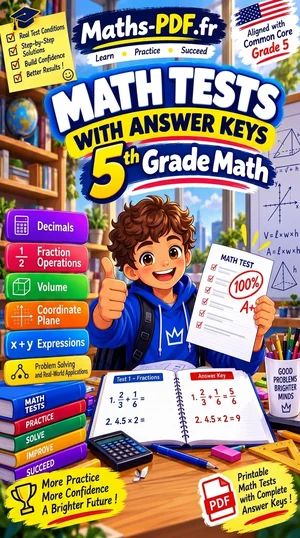
This 5th grade volume test covers volume of rectangular prisms (Common Core 5.MD.C.3, 5.MD.C.4, 5.MD.C.5), with a free PDF to print.
Key takeaway: This test helps fifth grade students show that they can find the volume of rectangular prisms, missing edges, and joined solids, and explain how volume changes.
- Topic: Volume of Rectangular Prisms (5th grade)
- Content: 9 questions with point values, about 45 minutes
- Standards: 5.MD.C.3, 5.MD.C.4, 5.MD.C.5
- Answers: On a separate page, so you can try every worksheet problem first
- Format: Free printable PDF, US Letter, black and white
This test helps fifth grade students show that they can find the volume of rectangular prisms, missing edges, and joined solids, and explain how volume changes. Also, it is worth 20 points and takes 45 minutes.
The nine questions begin with counting cubes in a layer and finding the volume, then use the edge formula and the base area formula. Then, later questions find a missing height, add the volumes of a solid made of two prisms, compare two packages, and use an aquarium. Also, the last questions test doubling edges and stacked cubes. Then, show your formulas and units for full credit.
This 45-minute test covers unit cubes, the volume formulas for rectangular prisms, missing dimensions, and composite solids (5.MD.C.3 to 5.MD.C.5). There are 9 questions worth 20 points. Show your work and write cubic units.
Time and points
- Grade: Grade 5
- Chapter: Volume of Rectangular Prisms
- Standards: 5.MD.C.3, 5.MD.C.4, 5.MD.C.5
- Time: 45 minutes
- Total: 20 points
5th grade volume test: questions
1 – Counting unit cubes [2 pts]
First, solve. The prism is built from unit cubes.
- How many cubes are in the bottom layer? (1 point)
- What is the volume of the prism? (1 point)
2 – Volume from edges [2 pts]
Next, find the volume of a rectangular prism with length 9 ft, width 4 ft and height 3 ft.
3 – Base area and height [2 pts]
Then, solve. The base of a prism has an area of 35 square centimeters. The prism is 6 centimeters high. Find its volume.
4 – Missing height [2 pts]
Now, solve. A prism has volume \(224\text{ in}^{3}\). Its length is 8 in and its width is 7 in. Find its height.
5 – Composite solid [3 pts]
Also, solve. The solid is made of two rectangular prisms, A and B. The numbers show length, width and height of each part.
- Find the volume of prism A. (1 point)
- Also, find the volume of prism B. (1 point)
- Find the volume of the whole solid. (1 point)
6 – Compare packages [2 pts]
First, solve. A cereal box is 8 cm by 2 cm by 12 cm. A juice box is 5 cm by 4 cm by 10 cm. Which has the greater volume, and by how much?
Question 7 and after
7 – Aquarium [3 pts]
Next, solve. An aquarium is 24 in long, 12 in wide and 10 in high.
- What is the volume of the aquarium? (1 point)
- The water is 8 in deep. What is the volume of the water? (1 point)
- How many more cubic inches of water would fill the aquarium? (1 point)
8 – Doubling edges [2 pts]
Then, solve. Jamal says that doubling only the height of a prism doubles its volume. Mei says that doubling the length, the width and the height all together also doubles the volume. Who is correct? Use a prism that is 2 by 3 by 4 to explain.
9 – Stacked cubes [2 pts]
Now, solve. A prism is built from 1-centimeter cubes. The base has 5 rows of 4 cubes, and there are 3 layers.
- Find the volume of the prism. (1 point)
- How many cubes are needed to add one more layer? (1 point)

Key facts behind this 5th grade volume test
- A unit cube has volume 1 cubic unit.
- Volume is measured in cubic units such as cm³, in³ and ft³.
- V = l × w × h, and V = B × h where B is the base area.
- Then, a composite solid made of two prisms has volume equal to the sum of the two volumes.
- Volume = (cubes in one layer) × (number of layers).
Common mistakes with this 5th grade volume test
- Students add the edges instead of multiplying. Instead, multiply length, width, and height. Slow down at that step and check it twice.
- Students use square units for volume. Also, write cubic units. Slow down at that step and check it twice.
- Students think doubling the length, width, and height doubles the volume. Instead, it makes eight times as many cubes.
- Students skip the second prism of a joined solid. Find each volume and add. Slow down at that step and check it twice.
Test-taking strategy
- Label each edge in a drawing before you multiply. Labels prevent mix ups. Repeat this habit on every problem for the best results.
- Write the formula, the substitution, and the answer with units. Each part can earn credit. Repeat this habit on every problem for the best results.
- Parents can review the night before by asking the child to find the volume of a shoe box.
Download the 5th grade volume test as a PDF with the button below and keep it with your notes.
5th grade volume test: frequently asked questions
How does doubling the edges change the volume?
Doubling one edge doubles the volume. Doubling all three edges makes the volume eight times as large, because 2 times 2 times 2 is 8. Test with a small cube of edge 1 and then of edge 2.
How do I compare the volumes of two boxes?
Find each volume by multiplying its three edges, then subtract the smaller from the larger. Write the answer with the greater box named and the difference in cubic units. A quick check like this takes only a few seconds and prevents most errors.
How should I show work for a missing edge?
Write the volume formula with the unknown, then divide the volume by the product of the known edges. Check by multiplying all three edges to get the volume again. A quick check like this takes only a few seconds and prevents most errors.
All Grade 5 chapters: Grade 5 math.

More 5th Grade math
Lessons
See all Reading, Comparing and Rounding Decimals Lesson: Notes and Examples
- Classifying Two-Dimensional Figures Lesson: Notes and Examples
- Multiplying Multi-Digit Whole Numbers Lesson: Notes and Examples
- Patterns and Ordered Pairs Lesson: Notes and Examples
- Numerical Expressions and Order of Operations Lesson: Notes and Examples
- Multiplying Fractions and Mixed Numbers Lesson: Notes and Examples






Worksheets
See all- Fractions as Division Worksheets with Answers
- Multiplying Fractions and Mixed Numbers Worksheets with Answers
- Adding and Subtracting Fractions with Unlike Denominators Worksheets with Answers
- Volume of Rectangular Prisms Worksheets with Answers
- Multiplication as Scaling Worksheets with Answers
- Reading, Comparing and Rounding Decimals Worksheets with Answers






Tests
See all- Multiplying Fractions and Mixed Numbers Test with Answer Key
- Patterns and Ordered Pairs Test with Answer Key
- Adding and Subtracting Decimals Test with Answer Key
- Converting Measurement Units Test with Answer Key
- Adding and Subtracting Fractions with Unlike Denominators Test with Answer Key
- Fractions as Division Test with Answer Key





Quizzes
See all- Converting Measurement Units Quiz: 10 Questions with Answers
- Adding and Subtracting Decimals Quiz: 10 Questions with Answers
- Adding and Subtracting Fractions with Unlike Denominators Quiz: 10 Questions with Answers
- Line Plots and Data Quiz: 10 Questions with Answers
- Fractions as Division Quiz: 10 Questions with Answers
- Classifying Two-Dimensional Figures Quiz: 10 Questions with Answers