AP Calculus AB Optimization Test Solutions and Scoring (PDF)

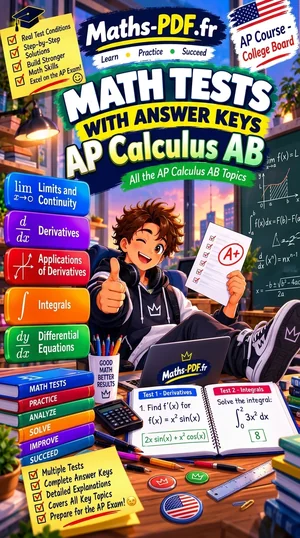
This optimization test answers for AP Calculus AB covers optimization (Common Core AP CALC AB 5.10, AP CALC AB 5.11), with a free PDF to print.
Use this answer key to score the optimization test out of 20 points. Each solution shows the work and a scoring guide that says how the points are awarded. Give partial credit for a correct setup, a correct derivative or integral, and a correct final statement with units where they apply.
AP Calculus AB · Common Core State Standards: AP CALC AB 5.10, AP CALC AB 5.11
Optimization test answers: worked solutions
Question 1 – Maximum product [2 pts]
\(P=x(30-x)\), \(P^{\prime}=30-2x=0\) gives \(x=15\). \(P^{\prime\prime}=-2 < 0\). Both numbers are \(15\) (product \(225\)).
Scoring: 1 point for the function and derivative; 1 point for the answer with justification.
Question 2 – Pen against a wall [3 pts]
\(2x+y=80\), \(y=80-2x\). \(A=x(80-2x)=80x-2x^{2}\), \(0 < x < 40\).
\(A^{\prime}=80-4x=0\) gives \(x=20\), \(y=40\). \(A^{\prime\prime}=-4 < 0\).
Final answer: 20 ft by 40 ft; maximum area 800 ft².
Scoring: 1 point for the area function with domain; 1 point for the critical number; 1 point for the justification and final answer.
Question 3 – Open box [3 pts]
\(V=x(18-2x)^{2}\), \(0 < x < 9\). \(V^{\prime}=(18-2x)^{2}-4x(18-2x)=(18-2x)(18-6x)\).
Critical numbers: \(x=9\) (endpoint) and \(x=3\). \(V^{\prime}\) goes from \(+\) to \(-\) at \(x=3\). \(V(3)=3\cdot 144=432\).
Final answer: \(x=3\) in, maximum volume 432 in³.
Scoring: 1 point for V(x); 1 point for the derivative and critical number; 1 point for justification and the volume.
Question 4 – Closest point [2 pts]
\(D^{2}=x^{2}+(x+3)^{2}=2x^{2}+6x+9\). \(4x+6=0\) gives \(x=-\frac{3}{2}\), \(y=\frac{3}{2}\).
Final answer: \(\left(-\frac{3}{2},\frac{3}{2}\right)\).
Scoring: 1 point for the distance function; 1 point for the point.
Question 5 – Revenue [3 pts]
- \(R(p)=p(300-6p)=300p-6p^{2}\).
- \(R^{\prime}=300-12p=0\) gives \(p=25\).
- \(R^{\prime\prime}=-12 < 0\), a maximum; \(R(25)=25\cdot 150=3750\) dollars per week.
Scoring: 1 point per part.
Question 6 – Can design [3 pts]
\(h=\frac{1000}{\pi r^{2}}\). \(S=2\pi r^{2}+2\pi rh=2\pi r^{2}+\frac{2000}{r}\).
\(S^{\prime}=4\pi r-\frac{2000}{r^{2}}=0\) gives \(r^{3}=\frac{500}{\pi}\), \(r\approx 5.42\) cm. \(S^{\prime\prime}=4\pi+\frac{4000}{r^{3}} > 0\): minimum.
Scoring: 1 point for S(r); 1 point for the critical number; 1 point for the justification.
Question 7 – Justifying an extremum [2 pts]
\(A^{\prime}=60-4x=0\) gives \(x=15\). \(A^{\prime} > 0\) for \(0 < x < 15\) and \(A^{\prime} < 0\) for \(15 < x < 30\).
So \(A\) increases then decreases: absolute maximum \(A(15)=15\cdot 30=450\).
Scoring: 1 point for the sign analysis; 1 point for the conclusion and value.
Question 8 – Ticket price [2 pts]
With \(n\) increases of \$2: price \(20+2n\) and tickets \(400-20n\). \(R(n)=(20+2n)(400-20n)=8000+400n-40n^{2}\).
\(R^{\prime}=400-80n=0\) gives \(n=5\). Price \(20+10=30\), revenue \(30\cdot 300=9000\).
Final answer: \$30 per ticket, revenue \$9000.
Scoring: 1 point for R(n); 1 point for the answer.
Total score
20 points
Key facts behind this optimization test answers
- Name the variables, write an objective function, and use a constraint to reduce it to one variable.
- Find critical numbers by solving f′ = 0 on the allowed domain.
- Justify the extreme with a sign change of f′, the sign of f″, or by comparing endpoint values.
- Check the domain and give the final answer in context with units.
How to use this optimization test answers
Score your test with the point values shown for each question. Then read the worked solution of every question where you lost points and note the method to review.
Download the optimization test answers as a PDF with the button below and keep it with your notes.
All AP Calculus AB chapters: AP Calculus AB math.

More AP Calculus AB math
Lessons
See all





Worksheets
See all




Tests
See all Average Value, Area and Volume Test with Point Values
- Concavity and the Second Derivative Test with Point Values
- Continuity and the Intermediate Value Theorem Test with Point Values
- Rates of Change in Context and Straight-Line Motion Test with Point Values
- Related Rates Test with Point Values
- Product Rule, Quotient Rule and Trig Derivatives Test with Point Values