2nd Grade Skip Counting and Comparing Numbers Lesson (Free PDF)
This skip counting lesson for 2nd Grade covers skip counting and comparing numbers (Common Core 2.NBT.A.2, 2.NBT.A.4), with a free PDF to print.
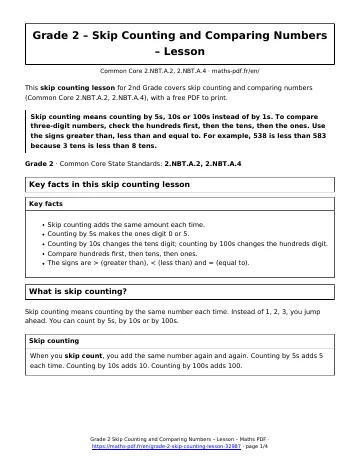
Skip counting means counting by 5s, 10s or 100s instead of by 1s. To compare three-digit numbers, check the hundreds first, then the tens, then the ones. Use the signs greater than, less than and equal to. For example, 538 is less than 583 because 3 tens is less than 8 tens.
Grade 2 · Common Core State Standards: 2.NBT.A.2, 2.NBT.A.4
Key facts in this skip counting lesson
- Skip counting adds the same amount each time.
- Counting by 5s makes the ones digit 0 or 5.
- Counting by 10s changes the tens digit; counting by 100s changes the hundreds digit.
- Compare hundreds first, then tens, then ones.
- The signs are > (greater than), < (less than) and = (equal to).
What is skip counting?
Skip counting means counting by the same number each time. Instead of 1, 2, 3, you jump ahead. You can count by 5s, by 10s or by 100s.
Look at the jumps. Each jump adds 5. Count by 5s and the ones digit is always 0 or 5.
How do you count by 10s and 100s?
When you count by 10s, only the tens digit changes. When you count by 100s, only the hundreds digit changes. You can also count backward by taking away.
Here the numbers go 120, 130, 140 and on to 200. The ones digit stays 0.
Now the hundreds digit goes up by 1 each jump: 300, 400, 500, 600, 700, 800. Counting by 10s past a hundred works the same way: 280, 290, 300, 310.
How do you compare three-digit numbers?
To compare, start with the hundreds. If the hundreds are the same, look at the tens. If the tens are also the same, look at the ones. Use these signs.
| Sign | Meaning | Example |
|---|---|---|
| \(>\) | is greater than | \(625 > 618\) |
| \(< \) | is less than | \(234 < 241\) |
| \(=\) | is equal to | \(300 = 300\) |
Here is a method. Compare 538 and 583.
- Line up the digits by place. 538 has 5 hundreds, 3 tens and 8 ones. 583 has 5 hundreds, 8 tens and 3 ones.
- Compare the hundreds. Both have 5, so they are the same.
- Compare the tens. 3 tens is less than 8 tens.
- Write the answer: \(538 < 583\).
The sign always opens toward the greater number, like a mouth that wants the bigger one.
Skip counting lesson: questions and answers
What is skip counting by 5s?
It means adding 5 each time: 5, 10, 15, 20, 25 and so on. The ones digit is always 0 or 5.
How do you count by 100s from 300?
Add 100 each time: 300, 400, 500, 600. Only the hundreds digit changes.
How do you compare two three-digit numbers?
Compare the hundreds first. If they match, compare the tens, then the ones. The first place that differs decides which number is greater.
What do the signs > and < mean?
The sign > means greater than and the sign < means less than. The small point of the sign faces the smaller number.
Can two different-looking numbers be equal?
Only if every digit matches. 245 and 245 are equal, but 245 and 254 are not.
How to use this skip counting lesson
Read the definitions first, then follow the worked method line by line and redo the example on paper without looking. When every step makes sense, move on to the worksheet, then check yourself with the quiz.
Download the skip counting lesson as a PDF with the button below and keep it with your notes.
All Grade 2 chapters: Grade 2 math.
Print this page
Download PDFDownload the 2nd Grade Skip Counting and Comparing Numbers Lesson (PDF, 62 KB)More 2nd Grade math
Lessons
See all




Worksheets
See all



Tests
See all Money: Dollars and Coins Test with Point Values
- Picture Graphs, Bar Graphs and Line Plots Test with Point Values
- Arrays and Equal Groups Test with Point Values
- One- and Two-Step Word Problems Test with Point Values
- Skip Counting and Comparing Numbers Test with Point Values
- Adding and Subtracting Within 1,000 Test with Point Values