3rd Grade Properties of Multiplication Worksheet Solutions (PDF)
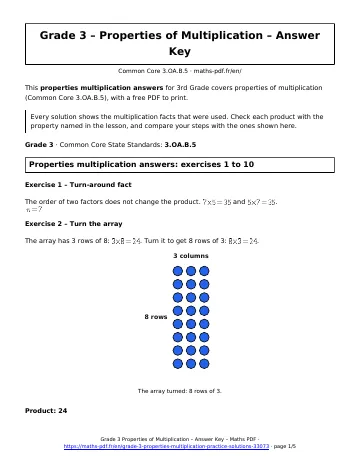
This properties multiplication answers for 3rd Grade covers properties of multiplication (Common Core 3.OA.B.5), with a free PDF to print.
Grade 3 · Common Core State Standards: 3.OA.B.5
Properties multiplication answers: exercises 1 to 10
Exercise 1 – Turn-around fact
\(n = 7\)
Exercise 2 – Turn the array
Product: 24
Exercise 3 – True or false
True
Exercise 4 – Use a known fact
\(9 \times 6 = 54\)
Exercise 5 – Move the parentheses
\(n = 3\)
Exercise 6 – Group first
24
Exercise 7 – Split the array
\(4 \times 7 = 4 \times 5 + 4 \times 2 = 28\)
Exercise 8 – Break apart a factor
\(n = 2\), product 42
Exercise 9 – Split a factor
48
Exercise 10 – Multiply by a sum
Multiply each part: \(7 \times 4 = 28\) and \(7 \times 3 = 21\), then \(28 + 21 = 49\).
Both ways give 49
Exercises 11 and up
Exercise 11 – Double a fact
56
Exercise 12 – Easier order
70
Exercise 13 – Two ways
Way 2: \(2 \times (4 \times 5) = 2 \times 20 = 40\).
40
Exercise 14 – Pick the true sentence
A
Exercise 15 – Muffin boxes
24 muffins
Exercise 16 – Theater seats
54 seats
Exercise 17 – Markers and crayons
Way 2: Each pair of packs holds \(6 + 3 = 9\), so \(4 \times 9 = 36\).
36 items
Exercise 18 – Cookie trays
(Check: each tray has \(3 \times 4 = 12\), and \(4 \times 12 = 48\).)
48 cookies
Exercise 19 – Orange bags
42 oranges
Exercise 20 – Egg cartons
60 eggs
Key facts behind this properties multiplication answers
- Commutative: \(3 \times 6 = 6 \times 3\). The order of two factors does not change the product.
- Associative: \((2 \times 3) \times 4 = 2 \times (3 \times 4)\). Regrouping three factors does not change the product.
- Distributive: \(6 \times 7 = 6 \times 5 + 6 \times 2\). Split a factor, multiply the parts, then add.
- An array turned on its side shows the commutative property.
- Known facts help you find unknown facts, such as 5s and 2s for 7s and 8s.
How to use this properties multiplication answers
Cover each solution, solve the exercise again, then uncover it and compare every line. If your answer differs, find the first step that changed and redo the exercise from there.
Download the properties multiplication answers as a PDF with the button below and keep it with your notes.
All Grade 3 chapters: Grade 3 math.
More 3rd Grade math
Lessons
See all

Worksheets
See all

Tests
See all Understanding Fractions Test with Point Values
- Adding and Subtracting Within 1,000 Test with Point Values
- Properties of Multiplication Test with Point Values
- Equivalent and Comparing Fractions Test with Point Values
- Rounding to the Nearest 10 and 100 Test with Point Values
- Multiplication and Division Facts Within 100 Test with Point Values