3rd Grade Properties of Multiplication Lesson (Free PDF)
This properties multiplication lesson for 3rd Grade covers properties of multiplication (Common Core 3.OA.B.5), with a free PDF to print.
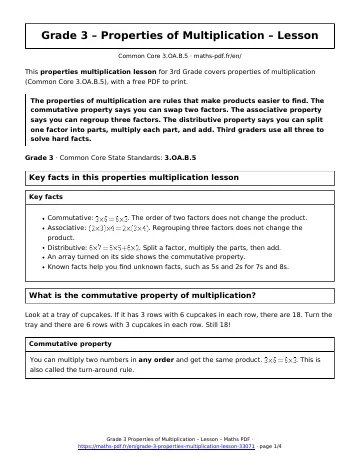
The properties of multiplication are rules that make products easier to find. The commutative property says you can swap two factors. The associative property says you can regroup three factors. The distributive property says you can split one factor into parts, multiply each part, and add. Third graders use all three to solve hard facts.
Grade 3 · Common Core State Standards: 3.OA.B.5
Key facts in this properties multiplication lesson
- Commutative: \(3 \times 6 = 6 \times 3\). The order of two factors does not change the product.
- Associative: \((2 \times 3) \times 4 = 2 \times (3 \times 4)\). Regrouping three factors does not change the product.
- Distributive: \(6 \times 7 = 6 \times 5 + 6 \times 2\). Split a factor, multiply the parts, then add.
- An array turned on its side shows the commutative property.
- Known facts help you find unknown facts, such as 5s and 2s for 7s and 8s.
What is the commutative property of multiplication?
Look at a tray of cupcakes. If it has 3 rows with 6 cupcakes in each row, there are 18. Turn the tray and there are 6 rows with 3 cupcakes in each row. Still 18!
This rule cuts your work in half. If you know \(4 \times 9 = 36\), you also know \(9 \times 4 = 36\).
What is the associative property of multiplication?
When you multiply three numbers, you can pick which two to multiply first. The parentheses show what goes first.
On the left, \(2 \times 3 = 6\), then \(6 \times 4 = 24\). On the right, \(3 \times 4 = 12\), then \(2 \times 12 = 24\). Pick the pair that is easiest for you.
What is the distributive property?
Hard fact? Break one factor into two smaller numbers that are easy to use. Multiply each part, then add the two products.
The picture shows it: \(6 \times 5 = 30\) dots in blue and \(6 \times 2 = 12\) dots in orange. Together, \(30 + 12 = 42\).
How can you use the properties to multiply?
Try \(7 \times 8\) when you do not remember the answer.
- Pick a factor to break apart. Split 8 into \(5 + 3\).
- Write two easy facts: \(7 \times 5 = 35\) and \(7 \times 3 = 21\).
- Add the two products: \(35 + 21 = 56\).
| Property | What it lets you do | Example |
|---|---|---|
| Commutative | Swap the order of two factors | \(8 \times 2 = 2 \times 8\) |
| Associative | Regroup three factors | \((5 \times 2) \times 3 = 5 \times (2 \times 3)\) |
| Distributive | Break a factor into parts | \(4 \times 6 = 4 \times 5 + 4 \times 1\) |
Properties multiplication lesson: questions and answers
What is the commutative property of multiplication?
It says that the order of two factors does not change the product. For example, \(4 \times 7 = 7 \times 4\). Both equal 28.
What is the difference between the commutative and associative properties?
The commutative property swaps the order of two factors. The associative property changes which two factors you multiply first when there are three factors. Parentheses show the grouping.
How does the distributive property help with hard facts?
It lets you split a hard fact into two easy facts. For \(6 \times 8\), think \(6 \times 5 = 30\) and \(6 \times 3 = 18\), then add to get 48.
Can I use properties with an array?
Yes. An array shows equal rows. Turn it to see the commutative property. Draw a line to split it into two smaller arrays to see the distributive property.
Do the properties work for division?
No. Order matters in division. \(12 \div 3 = 4\), but \(3 \div 12\) is not 4. Use these three properties for multiplication only.
How to use this properties multiplication lesson
Read the definitions first, then follow the worked method line by line and redo the example on paper without looking. When every step makes sense, move on to the worksheet, then check yourself with the quiz.
Download the properties multiplication lesson as a PDF with the button below and keep it with your notes.
Download the properties multiplication lesson as a PDF with the button below and keep it with your notes.
All Grade 3 chapters: Grade 3 math.
More 3rd Grade math
Lessons
See all



Worksheets
See all

Tests
See all Quadrilaterals and Partitioning Shapes Test with Point Values
- Scaled Graphs and Line Plots Test with Point Values
- Two-Step Word Problems and Patterns Test with Point Values
- Multiplication and Division Facts Within 100 Test with Point Values
- Multiplying by Multiples of 10 Test with Point Values
- Area Test with Point Values