AP Statistics Experimental Design and Random Assignment Worksheet Solutions (PDF)

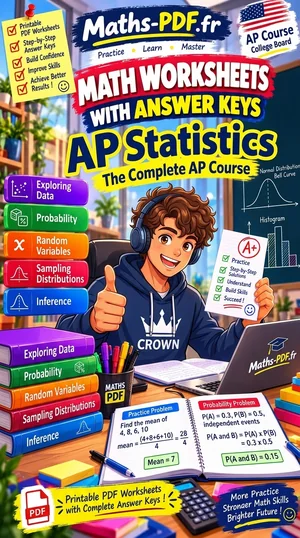
This experiments practice solutions for AP Statistics covers experimental design and random assignment (Common Core AP STAT 3.4, AP STAT 3.5, AP STAT 3.6, HSS-IC.B.3, HSS-IC.B.5), with a free PDF to print.
AP Statistics · Common Core State Standards: AP STAT 3.4, AP STAT 3.5, AP STAT 3.6, HSS-IC.B.3, HSS-IC.B.5
Experiments practice solutions: exercises 1 to 10
Exercise 1 – Study or experiment?
(a) No treatments are imposed: observational. (b) Treatments are assigned: experiment. (c) Runners chose their shoes: observational.
(a) observational; (b) experiment; (c) observational.
Exercise 2 – Name the parts
Units: the 60 students. Explanatory variable: study method. Treatments: flash cards, video lesson, no special method (control). Response: quiz score.
60 students; method of studying; 3 treatments; quiz score.
Exercise 3 – Confounding
Students who choose to take a course may be more motivated or have more resources.
Motivation (or family resources) is confounded with the course: it is associated with taking the course and also affects scores, so we cannot attribute the 80 points to the course.
Exercise 4 – Placebo and blinding
The inactive pill is a placebo (control group).
Placebo control; double-blind. Blinding prevents expectations from influencing reported or rated pain.
Exercise 5 – Random assignment
05 selected, 41 skipped (out of range), 12 selected, 07 selected, 98 skipped (out of range), 03 selected, 12 skipped (repeat), 11 selected, 77 skipped (out of range), 09 selected.
Fertilizer group: plants 03, 05, 07, 09, 11, 12. The other six plants are the control group.
Exercise 6 – Completely randomized design
Randomly assign 20 students to 8 hours and 20 to 5 hours (for example by drawing names), have every group do the same memory test the next day, and compare the mean scores.
Random assignment of 20 students per group, same test for all, compare the group means.
Exercise 7 – Why block?
Experience strongly affects running time. Blocking compares the shoes within similar runners.
Blocking removes the variation due to experience, making any shoe effect easier to see.
Exercise 8 – Matched pairs
Each student receives both treatments.
Matched pairs design (each student is their own control); it removes person-to-person differences in typing speed.
Exercise 9 – Replication
One cake per oven gives no information about the usual variation.
She needs replication: bake many cakes in each oven, randomly assigned.
Exercise 10 – Scope of inference
Random selection supports generalizing to the city. Random assignment supports cause and effect.
They can generalize to all adults in the city and conclude that the difference in results was caused by the diets.
Exercises 11 and up
Exercise 11 – Volunteers
Volunteers are not a random sample.
Cause and effect: yes (random assignment). Generalization to all teenagers: no (volunteers).
Exercise 12 – Statistical significance
A 2% chance is small.
The result is statistically significant: a difference of 6 points is unlikely if tutoring had no effect, so there is evidence tutoring helps.
Exercise 13 – Identify the flaw
Volunteering and class period are not random.
Groups were not formed by random assignment (volunteers differ), and the class period is confounded with the treatment.
Exercise 14 – Design a double-blind test
Randomly assign 25 volunteers to the energy drink and 25 to a look-alike placebo drink. A third person prepares the cups, so neither the volunteers nor the tester knows who got which. Compare mean reaction times.
Random assignment, placebo, double-blind, same test for both groups, compare the means.
Exercise 15 – Control group
Plants grow even without fertilizer.
A control group provides a baseline, so any difference can be attributed to the fertilizer.
Exercise 16 – Lurking variable
Coffee drinkers may differ in income, exercise, or health.
Confounding variables (such as lifestyle or income) could explain the longer life, so causation cannot be concluded.
Exercise 17 – Blocks or strata
Blocks: sprinters and distance runners.
Randomly assign 6 sprinters to plan 1 and 6 to plan 2; do the same for the distance runners. Compare the plans within each block.
Exercise 18 – Equal group sizes
\(\frac{60}{3}=20\) seeds per condition.
20 seeds per condition. Number the seeds 01 to 60, select 20 labels for condition 1, then 20 more for condition 2; the rest go to condition 3.
Exercise 19 – Evaluate a claim
Was there a comparison group, and was assignment random?
There is no control group and no random assignment, so we do not know what would have happened without the pill. Blinding is also not mentioned.
Exercise 20 – Multi-step
A: \(\frac{27}{45}=60\%\). B: \(\frac{36}{45}=80\%\). Difference: 20 percentage points.
B improved at 80% compared with 60% for A. We need to know how likely a 20-point difference is by chance (a significance test) to call it statistically significant.
Key facts behind this experiments practice solutions
- Experiments impose treatments; observational studies do not and cannot prove causation.
- Confounding occurs when the effects of two variables on the response cannot be separated.
- Good design: comparison, random assignment, control, replication; use blinding and placebos when needed.
- Designs: completely randomized, randomized block, matched pairs.
- Random assignment allows cause-and-effect; random selection allows generalization.
How to use this experiments practice solutions
Cover each solution, solve the exercise again, then uncover it and compare every line. If your answer differs, find the first step that changed and redo the exercise from there.
Download the experiments practice solutions as a PDF with the button below and keep it with your notes.
Download the experiments practice solutions as a PDF with the button below and keep it with your notes.
Download the experiments practice solutions as a PDF with the button below and keep it with your notes.
All AP Statistics chapters: AP Statistics math.
Free printable PDF
AP Statistics Experimental Design and Random Assignment Worksheet Solutions
Download PDF
More AP Statistics math
Lessons
See all


Worksheets
See all


Tests
See all Significance Tests for a Proportion Test with Point Values
- Variables and Categorical Data Displays Test with Point Values
- Five-Number Summary, Boxplots and Comparing Distributions Test with Point Values
- Experimental Design and Random Assignment Test with Point Values
- Probability Rules and Simulation Test with Point Values
- Chi-Square Tests Test with Point Values