AP Statistics Experimental Design and Random Assignment Worksheet (PDF)

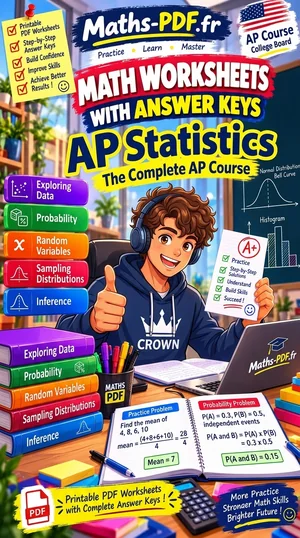
This experiments practice worksheet for AP Statistics covers experimental design and random assignment (Common Core AP STAT 3.4, AP STAT 3.5, AP STAT 3.6, HSS-IC.B.3, HSS-IC.B.5), with a free PDF to print.
AP Statistics · Common Core State Standards: AP STAT 3.4, AP STAT 3.5, AP STAT 3.6, HSS-IC.B.3, HSS-IC.B.5
Experiments practice worksheet: exercises 1 to 10
Exercise 1 – Study or experiment?
Decide whether each is an observational study or an experiment. (a) Researchers survey 500 teens about screen time and sleep. (b) Researchers randomly assign 60 teens to limit screens or not and compare sleep. (c) A coach records the finish times of runners who chose different shoes.
Exercise 2 – Name the parts
A teacher randomly assigns 60 students to use flash cards, a video lesson, or neither for a week and then records each student’s quiz score. Identify the experimental units, the explanatory variable, the treatments, and the response variable.
Exercise 3 – Confounding
A study finds that students who take a test-prep course score 80 points higher on average on a college exam. Explain how confounding could affect the conclusion that the course raises scores.
Exercise 4 – Placebo and blinding
In a headache study, one group takes a new pain reliever and another takes a pill with no medicine. Neither the patients nor the doctors who rate the pain know who got which pill. Name the control, and tell what blinding does.
Exercise 5 – Random assignment
Twelve plants numbered 01 to 12 will be split into two groups of 6: fertilizer and no fertilizer. Use the digits above in pairs to choose the fertilizer group.
Exercise 6 – Completely randomized design
Describe a completely randomized design to test whether 8 hours of sleep gives better memory scores than 5 hours for 40 volunteer students.
Exercise 7 – Why block?
A shoe company tests two running shoes with 30 runners, 15 experienced and 15 beginners. Explain why it blocks by experience.
Exercise 8 – Matched pairs
Each of 24 students takes a typing test with a standard keyboard and a split keyboard, in random order. Name the design and explain the benefit.
Exercise 9 – Replication
A baker compares two ovens using one cake in each. Why is this not good evidence? What should she change?
Exercise 10 – Scope of inference
Researchers randomly select 200 adults from a city and then randomly assign them to two diets. What conclusions are supported?
Exercises 11 and up
Exercise 11 – Volunteers
Volunteers are randomly assigned to two sleep schedules. Can the results be generalized to all teenagers? Can cause and effect be concluded?
Exercise 12 – Statistical significance
The mean score improved by 6 points more in the tutoring group than in the control group. A random assignment simulation shows a difference this large occurs about 2% of the time by chance alone. Interpret.
Exercise 13 – Identify the flaw
A teacher gives the new app to the volunteers in the first period class and the old method to the others in the last period. Name two problems.
Exercise 14 – Design a double-blind test
Design a double-blind experiment to test whether an energy drink improves reaction time in 50 volunteers.
Exercise 15 – Control group
Why include a control group in a study of a new fertilizer?
Exercise 16 – Lurking variable
An observational study finds that people who drink coffee live longer. A reporter writes that coffee extends life. Give a reason to be cautious.
Exercise 17 – Blocks or strata
A coach wants to test two training plans on 24 athletes: 12 sprinters and 12 distance runners. Explain how to randomize with blocks.
Exercise 18 – Equal group sizes
Sixty seeds are split evenly into three light conditions. How many seeds per condition? How would you assign them randomly?
Exercise 19 – Evaluate a claim
A company says a pill reduces colds because 70% of 100 users had fewer colds this winter. List two missing pieces of information.
Exercise 20 – Multi-step
In an experiment with 90 subjects, 45 are assigned to Treatment A and 45 to B. After the study, 27 of A and 36 of B improved. Compare the improvement percents and state what extra information is needed to call the difference significant.

Key facts behind this experiments practice worksheet
- Experiments impose treatments; observational studies do not and cannot prove causation.
- Confounding occurs when the effects of two variables on the response cannot be separated.
- Good design: comparison, random assignment, control, replication; use blinding and placebos when needed.
- Designs: completely randomized, randomized block, matched pairs.
- Random assignment allows cause-and-effect; random selection allows generalization.
How to use this experiments practice worksheet
Work through the exercises in order: they go from simple to challenging. Write every step on paper, then compare with the solutions page and redo any exercise you missed the next day.
Download the experiments practice worksheet as a PDF with the button below and keep it with your notes.
Download the experiments practice worksheet as a PDF with the button below and keep it with your notes.
All AP Statistics chapters: AP Statistics math.

More AP Statistics math
Lessons
See all





Worksheets
See all



Tests
See all Binomial and Geometric Distributions Test with Point Values
- Conditional Probability and Independence Test with Point Values
- Inference for the Difference of Two Proportions Test with Point Values
- t Intervals and t Tests for a Mean Test with Point Values
- Five-Number Summary, Boxplots and Comparing Distributions Test with Point Values
- Mean, Median, Standard Deviation and Outliers Test with Point Values