1st Grade Tens and Ones Lesson (Free PDF)

This grade 1 place value lesson for 1st Grade covers tens and ones (Common Core 1.NBT.B.2a, 1.NBT.B.2b, 1.NBT.B.2c), with a free PDF to print.
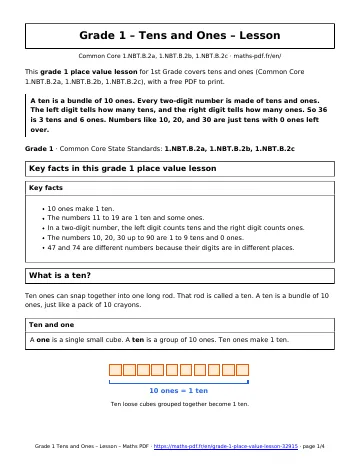
A ten is a bundle of 10 ones. Every two-digit number is made of tens and ones. The left digit tells how many tens, and the right digit tells how many ones. So 36 is 3 tens and 6 ones. Numbers like 10, 20, and 30 are just tens with 0 ones left over.
Grade 1 · Common Core State Standards: 1.NBT.B.2a, 1.NBT.B.2b, 1.NBT.B.2c
Key facts in this grade 1 place value lesson
- 10 ones make 1 ten.
- The numbers 11 to 19 are 1 ten and some ones.
- In a two-digit number, the left digit counts tens and the right digit counts ones.
- The numbers 10, 20, 30 up to 90 are 1 to 9 tens and 0 ones.
- 47 and 74 are different numbers because their digits are in different places.
What is a ten?
Ten ones can snap together into one long rod. That rod is called a ten. A ten is a bundle of 10 ones, just like a pack of 10 crayons.
How are the numbers 11 to 19 built?
Every number from 11 to 19 is 1 ten and some extra ones. Look at 14. A full ten frame shows the ten. Four more dots sit in the next frame.
So \(14\) means 1 ten and 4 ones. In the same way, \(17\) is 1 ten and 7 ones.
How do tens and ones make a two-digit number?
A two-digit number has two digits. The digit on the left tells how many tens. The digit on the right tells how many ones.
| Number | Tens | Ones |
|---|---|---|
| \(35\) | 3 | 5 |
| \(62\) | 6 | 2 |
| \(40\) | 4 | 0 |
What are 10, 20, 30, and the other tens?
The numbers 10, 20, 30, up to 90 have tens and no extra ones. So 3 tens is \(30\) and 6 tens is \(60\). The zero is a place keeper. It says there are 0 ones.
How do you read the blocks?
- Count the long rods. That number is the tens digit.
- Count the small cubes. That number is the ones digit.
- Write the tens digit first, then the ones digit.
Example. Sofia has 4 rods and 7 cubes. The tens digit is 4. The ones digit is 7. She writes \(47\).
Be careful with the order. \(47\) is 4 tens and 7 ones, but \(74\) is 7 tens and 4 ones. They are different numbers.
Grade 1 place value lesson: questions and answers
What is a ten in first grade math?
A ten is a group of 10 ones. You can see it as 10 loose cubes or as one long rod. Counting by tens is faster than counting every cube.
What do the two digits in a number like 58 mean?
The 5 is in the tens place, so it means 5 tens. The 8 is in the ones place, so it means 8 ones. Together 58 is 5 tens and 8 ones.
Why does the number 40 have a zero?
The zero shows that there are 0 ones. Without it, 4 would look like just 4 ones. The 4 tens and the 0 ones together make 40.
How are the teen numbers built?
Each number from 11 to 19 is 1 ten and some ones. For example, 16 is 1 ten and 6 ones. A ten frame that is full plus a few extra dots shows it well.
What is the fastest way to count base-ten blocks?
Count the rods by tens, then add the loose cubes. If you see 5 rods and 2 cubes, you say 10, 20, 30, 40, 50, then 51, 52. The number is 52.
How to use this grade 1 place value lesson
Read the definitions first, then follow the worked method line by line and redo the example on paper without looking. When every step makes sense, move on to the worksheet, then check yourself with the quiz.
Download the grade 1 place value lesson as a PDF with the button below and keep it with your notes.
All Grade 1 chapters: Grade 1 math.