5th Grade Graphing on the Coordinate Plane Lesson: Notes and Examples (Free PDF)

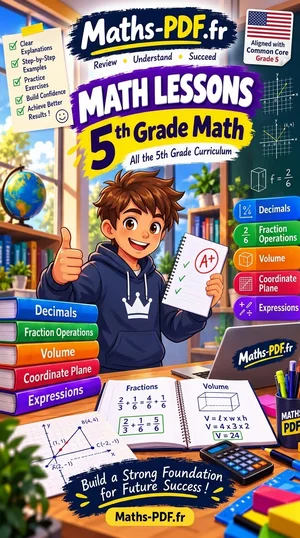
This 5th grade coordinate plane lesson covers graphing on the coordinate plane (Common Core 5.G.A.1, 5.G.A.2), with a free PDF to print.
Key takeaway: This lesson helps fifth grade students plot points, read ordered pairs, and solve problems on the first quadrant of the coordinate plane.
- Topic: Graphing on the Coordinate Plane (5th grade)
- Content: One-page lesson with a definition, a worked example and key facts
- Standards: 5.G.A.1, 5.G.A.2
- Answers: Explanations included
- Format: Free printable PDF, US Letter, black and white
The coordinate plane has two number lines that meet at right angles at the origin (0, 0). An ordered pair (x, y) names a point: start at the origin, move x units right along the x-axis, then y units up. In the first quadrant, both numbers are zero or greater. The order of the numbers matters.
This lesson helps fifth grade students plot points, read ordered pairs, and solve problems on the first quadrant of the coordinate plane. It explains the x-axis, the y-axis, and the origin, so every point has one clear address.
Students learn that the x-coordinate tells how far to move right and the y-coordinate tells how far to move up. They also find distances along grid lines, and they graph real data such as money earned over time. Also, plan about 20 minutes. Then, plot every example on grid paper as you read.
Grade 5 · Common Core State Standards: 5.G.A.1, 5.G.A.2
Key facts in this 5th grade coordinate plane lesson
- The x-axis is horizontal and the y-axis is vertical; they meet at the origin (0, 0).
- Next, an ordered pair (x, y) gives the move right first, then up.
- (2, 5) and (5, 2) are two different points.
- Points with the same x-coordinate or the same y-coordinate lie on a straight line, so subtract to find the distance.
- Axis labels explain what each coordinate means in a real-world graph.
What is the coordinate plane?
The coordinate plane is made from two number lines that cross at a right angle. The horizontal line is the x-axis. The vertical line is the y-axis. They meet at the origin, which is the point 0 on both lines. In Grade 5 we use the first quadrant, where all numbers are zero or greater. Think of a city map: the x-axis is a street running east and west, and the y-axis is an avenue running north and south. Every spot on the map can be named with two numbers.
Ordered pair: two numbers written \((x,y)\) that name a point. x-coordinate: how far to move right. y-coordinate: how far to move up.
How do you plot an ordered pair?
- Start at the origin \((0,0)\).
- Move right along the x-axis by the first number.
- Move up by the second number.
- Draw a dot and label it.
The order matters. The point \((2,5)\) is not the same as \((5,2)\). A point with y-coordinate 0 sits on the x-axis, and a point with x-coordinate 0 sits on the y-axis.
How do you find the distance between two points?
When two points have the same y-coordinate, they lie on a horizontal line. Subtract the smaller x-coordinate from the larger one. When they have the same x-coordinate, subtract the y-coordinates in the same way. Counting squares on the grid gives the same answer, but subtracting is faster. For \((2,2)\) and \((6,2)\) the distance is \(6-2=4\) units.
How do graphs show real-world situations?
Each ordered pair can tell a story. If Mei earns $8 per hour, the point \((3,24)\) means that after 3 hours she has earned $24. The labels on the axes tell what each number means. Points that rise by the same amount each step show a steady pattern, so you can predict the next point, such as \((5,40)\) for 5 hours.
5th grade coordinate plane lesson: questions and answers
What is an ordered pair?
An ordered pair is two numbers in parentheses, like \((4,3)\). The first number tells how far to move right from the origin and the second tells how far to move up. The order matters.
What is the origin?
The origin is the point where the x-axis and y-axis cross. Its coordinates are \((0,0)\). Every plot starts from the origin.
How do I remember which coordinate comes first?
Remember to run before you jump: move right along the x-axis first, then up the y-axis. The x-coordinate always comes first in an ordered pair.
How do I find the distance between \((1,4)\) and \((7,4)\)?
The y-coordinates are the same, so the points are on a horizontal line. Subtract the x-coordinates: \(7 – 1 = 6\) units.
What does a point on a real-world graph mean?
Each point pairs two quantities named by the axis labels. On a graph of hours and dollars, the point \((3,24)\) means 3 hours and $24.
Common mistakes with this 5th grade coordinate plane lesson
- Students swap the coordinates and move up before they move right. Remember that the first number tells the move along the x-axis.
- Students count the starting line as one step when they find a distance. Instead, count the spaces between the points, not the lines.
- Students write a point on an axis with the wrong zero. Also, a point on the x-axis has y equal to 0, and a point on the y-axis has x equal to 0.
How to study this chapter
- Say the move out loud as you plot a point, such as over 4, up 2. Then, the phrase keeps the order straight.
- Label both axes and include units on a graph of real data. Finally, a graph without labels is hard to read.
- Parents can draw a simple street grid at home and ask the child to give directions using ordered pairs.
Download the 5th grade coordinate plane lesson as a PDF with the button below and keep it with your notes.
More questions about 5th grade coordinate plane lesson
What are the four parts of a coordinate plane graph?
A graph in the first quadrant has an x-axis, a y-axis, an origin at (0, 0), and points shown as ordered pairs. Scales on the axes tell how much each space is worth. Labels tell what each axis measures.
How do you plot a point with a zero coordinate?
Start at the origin and move only along one axis. The point (5, 0) is 5 units right and no units up, so it sits on the x-axis. The point (0, 5) is 5 units up on the y-axis.
How do you use a graph to predict a value?
Look for the pattern in the points and continue it. If each hour adds the same amount to the y-values, extend the pattern one more step. Then plot or name the new ordered pair.
All Grade 5 chapters: Grade 5 math.

More 5th Grade math
Lessons
See all Volume of Rectangular Prisms Lesson: Notes and Examples
- Patterns and Ordered Pairs Lesson: Notes and Examples
- Fractions as Division Lesson: Notes and Examples
- Adding and Subtracting Decimals Lesson: Notes and Examples
- Place Value and Powers of Ten Lesson: Notes and Examples
- Area of Rectangles with Fractional Sides Lesson: Notes and Examples





Worksheets
See all- Reading, Comparing and Rounding Decimals Worksheets with Answers
- Dividing Unit Fractions and Whole Numbers Worksheets with Answers
- Converting Measurement Units Worksheets with Answers
- Numerical Expressions and Order of Operations Worksheets with Answers
- Multiplying and Dividing Decimals Worksheets with Answers
- Multiplication as Scaling Worksheets with Answers


Tests
See all- Line Plots and Data Test with Answer Key
- Reading, Comparing and Rounding Decimals Test with Answer Key
- Place Value and Powers of Ten Test with Answer Key
- Adding and Subtracting Decimals Test with Answer Key
- Multiplying Multi-Digit Whole Numbers Test with Answer Key
- Fractions as Division Test with Answer Key






Quizzes
See all- Classifying Two-Dimensional Figures Quiz: 10 Questions with Answers
- Dividing by Two-Digit Divisors Quiz: 10 Questions with Answers
- Multiplication as Scaling Quiz: 10 Questions with Answers
- Numerical Expressions and Order of Operations Quiz: 10 Questions with Answers
- Multiplying and Dividing Decimals Quiz: 10 Questions with Answers
- Adding and Subtracting Decimals Quiz: 10 Questions with Answers