Algebra 1 Exponent Rules and Radicals Lesson (Free PDF)

This exponent rules lesson for Algebra 1 covers exponent rules and radicals (Common Core N-RN.A.1, N-RN.A.2, N-RN.B.3), with a free PDF to print.
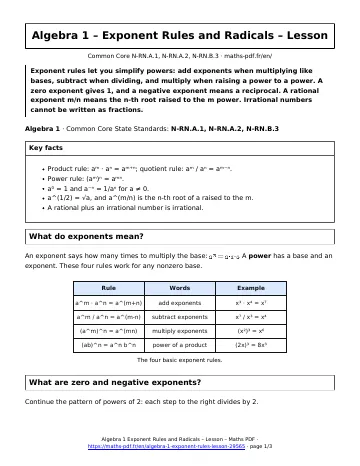
Exponent rules let you simplify powers: add exponents when multiplying like bases, subtract when dividing, and multiply when raising a power to a power. A zero exponent gives 1, and a negative exponent means a reciprocal. A rational exponent m/n means the n-th root raised to the m power. Irrational numbers cannot be written as fractions.
Algebra 1 · Common Core State Standards: N-RN.A.1, N-RN.A.2, N-RN.B.3
Key facts in this exponent rules lesson
- Product rule: aᵐ · aⁿ = aᵐ⁺ⁿ; quotient rule: aᵐ / aⁿ = aᵐ⁻ⁿ.
- Power rule: (aᵐ)ⁿ = aᵐⁿ.
- a⁰ = 1 and a⁻ⁿ = 1/aⁿ for a ≠ 0.
- a^(1/2) = √a, and a^(m/n) is the n-th root of a raised to the m.
- A rational plus an irrational number is irrational.
What do exponents mean?
An exponent says how many times to multiply the base: \(a^{n} = a \cdot a \cdot a\). A power has a base and an exponent. These four rules work for any nonzero base.
What are zero and negative exponents?
Continue the pattern of powers of 2: each step to the right divides by 2.
Example: Simplify \((x^{-2})^{3} \cdot x^{8}\). Use the power rule and the negative exponent: \(x^{-6} \cdot x^{8} = x^{2}\), and \(2^{-3} = \frac{1}{8}\).
What are rational exponents and radicals?
A square root \(\sqrt{a}\) asks which number squared gives \(a\). A cube root \(\sqrt[3]{a}\) asks which number cubed gives \(a\). The exponent \(a^{1/2}\) means the same as the square root.
To simplify a square root, factor out the greatest perfect square: \(\sqrt{48} = \sqrt{16 \cdot 3} = 4\sqrt{3}\).
What are rational and irrational numbers?
A rational number can be written as a fraction of integers, such as \(\frac{3}{4}\), \(0.5\), or \(\sqrt{9}\). An irrational number cannot, and its decimal never ends or repeats. Examples are \(\sqrt{2}\) and \(\pi\).
Square roots of perfect squares, such as 9 or 49, are rational. Square roots of other whole numbers, such as 2 or 10, are irrational. Estimate them by finding the two perfect squares on either side: \(\sqrt{10}\) lies between 3 and 4 because 9 < 10 < 16.
The sum of two rational numbers is rational. The sum of a rational number and an irrational number is irrational, and so is the product of a nonzero rational number and an irrational number.
Common mistake: \((2x)^{3}\) equals \(8x^{3}\), not \(2x^{3}\), and \(2^{-3}\) equals \(\frac{1}{8}\), not -8. Test any rule with small numbers first: \(2^{2} \cdot 2^{3} = 4 \cdot 8 = 32 = 2^{5}\).
Exponent rules lesson: questions and answers
What does a zero exponent mean?
Any nonzero number to the power 0 equals 1. For example 7⁰ = 1 and (5x)⁰ = 1. This keeps the pattern of dividing by the base.
What does a negative exponent mean?
A negative exponent means the reciprocal of the positive power. So 2⁻³ = 1/2³ = 1/8. The result is a fraction, not a negative number.
How do you simplify a square root?
Factor the number so that one factor is the greatest perfect square, then take its root. For √48 = √(16·3) = 4√3.
What is 8^(2/3)?
The denominator 3 is a cube root and the numerator 2 is a power. The cube root of 8 is 2, and 2² = 4.
Is the sum of a rational and an irrational number irrational?
Yes. If 1/2 + √2 were rational, then subtracting 1/2 would make √2 rational, which is false.
How to use this exponent rules lesson
Read the definitions first, then follow the worked method line by line and redo the example on paper without looking. When every step makes sense, move on to the worksheet, then check yourself with the quiz.
Download the exponent rules lesson as a PDF with the button below and keep it with your notes.
All Algebra 1 chapters: Algebra 1 math.
More Algebra 1 math
Lessons
See all

Worksheets
See all




Tests
See all Scatter Plots, Lines of Fit and Two-Way Tables Test with Point Values
- Adding, Subtracting and Multiplying Polynomials Test with Point Values
- Solving Quadratic Equations Test with Point Values
- Data Distributions and Summary Statistics Test with Point Values
- Literal Equations and Formulas Test with Point Values
- Slope and Rate of Change Test with Point Values