Algebra 1 Systems of Linear Equations Lesson (Free PDF)
This systems lesson for Algebra 1 covers systems of linear equations (Common Core A-REI.C.5, A-REI.C.6, A-REI.D.11, A-CED.A.3), with a free PDF to print.
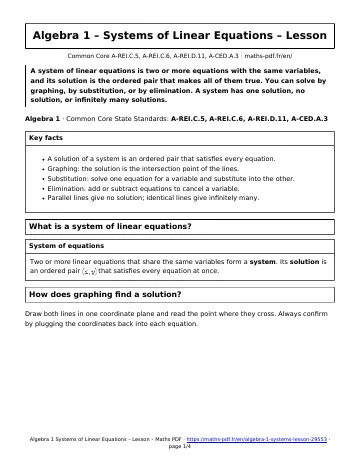
A system of linear equations is two or more equations with the same variables, and its solution is the ordered pair that makes all of them true. You can solve by graphing, by substitution, or by elimination. A system has one solution, no solution, or infinitely many solutions.
Algebra 1 · Common Core State Standards: A-REI.C.5, A-REI.C.6, A-REI.D.11, A-CED.A.3
Key facts in this systems lesson
- A solution of a system is an ordered pair that satisfies every equation.
- Graphing: the solution is the intersection point of the lines.
- Substitution: solve one equation for a variable and substitute into the other.
- Elimination: add or subtract equations to cancel a variable.
- Parallel lines give no solution; identical lines give infinitely many.
What is a system of linear equations?
How does graphing find a solution?
Draw both lines in one coordinate plane and read the point where they cross. Always confirm by plugging the coordinates back into each equation.
In this picture, \(y = x + 1\) and \(y = -x + 5\) both give the same point \((2, 3)\) at the crossing.
Can a system have no answer, or too many?
Two lines in a plane meet at one point, never meet, or lie on top of each other. So a system has exactly one solution, none, or infinitely many.
Parallel lines share a slope but have different intercepts. If your algebra ends with a false statement like \(0 = 5\), the lines are parallel. If it ends with a true statement like \(4 = 4\), the two equations describe the same line.
What is the substitution method?
- Isolate one variable in one equation.
- Replace that variable in the other equation with the expression you found.
- Solve the resulting one-variable equation, then back-substitute to get the second value.
What is the elimination method?
Add or subtract the two equations so that one variable drops out. If no variable cancels, scale one or both equations first. For example, adding \(2x + 3y = 12\) and \(4x – 3y = 6\) produces \(6x = 18\).
Worked example: From \(6x = 18\) we get \(x = 3\). Putting that into \(2x + 3y = 12\) gives \(2(3) + 3y = 12\), so \(y = 2\), and the solution is \((3, 2)\).
How do you set up a word problem as a system?
Name two unknowns, translate each fact into its own equation, and solve. Suppose a theater sold 8 tickets for $60, with adult tickets at $9 and student tickets at $6. With \(a + s = 8\) for the count and \(9a + 6s = 60\) for the money, the system is ready to solve.
Systems lesson: questions and answers
What is the solution of a system of equations?
It is the ordered pair (x, y) that makes both equations true. Graphically it is the point where the lines intersect.
When should you use substitution?
Use substitution when one equation is already solved for a variable or has a variable with coefficient 1, such as y = 3x or x + y = 12.
When should you use elimination?
Use elimination when both equations are in standard form Ax + By = C and the coefficients of a variable are equal or opposite, or can be made so by multiplying.
How can a system have no solution?
If the lines are parallel, they have the same slope but different intercepts and never meet. Algebra then gives a false statement like 0 = 5.
How do you check a solution?
Substitute the ordered pair into both original equations. If both are true, the pair is the solution.
How to use this systems lesson
Read the definitions first, then follow the worked method line by line and redo the example on paper without looking. When every step makes sense, move on to the worksheet, then check yourself with the quiz.
Download the systems lesson as a PDF with the button below and keep it with your notes.
All Algebra 1 chapters: Algebra 1 math.
More Algebra 1 math
Lessons
See all





Worksheets
See all





Tests
See all Exponential Functions and Growth Test with Point Values
- Systems of Linear Equations Test with Point Values
- Solving Linear Equations in One Variable Test with Point Values
- Literal Equations and Formulas Test with Point Values
- Writing Linear Equations and Functions Test with Point Values
- Exponent Rules and Radicals Test with Point Values