Algebra 1 Writing Linear Equations and Functions Lesson (Free PDF)

This writing linear lesson for Algebra 1 covers writing linear equations and functions (Common Core F-LE.A.2, F-BF.A.1a, A-CED.A.2), with a free PDF to print.
To write the equation of a line, find the slope m and the y-intercept b, then write y = mx + b. From two points, compute the slope as rise over run and substitute a point to find b. Parallel lines share a slope, and perpendicular lines have slopes that are negative reciprocals.
Algebra 1 · Common Core State Standards: F-LE.A.2, F-BF.A.1a, A-CED.A.2
Key facts in this writing linear lesson
- Slope from two points: m = (y₂ – y₁)/(x₂ – x₁).
- Find b by substituting a point into y = mx + b.
- Point-slope form: y – y₁ = m(x – x₁).
- Parallel lines have equal slopes; perpendicular slopes are negative reciprocals.
- In a model, the rate is the slope and the starting amount is the y-intercept.
How do you write the equation of a line?
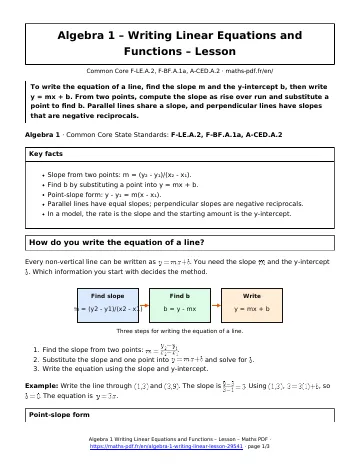
Every non-vertical line can be written as \(y = mx + b\). You need the slope \(m\) and the y-intercept \(b\). Which information you start with decides the method.
- Find the slope from two points: \(m = \frac{y_{2} – y_{1}}{x_{2} – x_{1}}\).
- Substitute the slope and one point into \(y = mx + b\) and solve for \(b\).
- Write the equation using the slope and y-intercept.
Example: Write the line through \((1, 3)\) and \((3, 9)\). The slope is \(\frac{9 – 3}{3 – 1} = 3\). Using \((1, 3)\), \(3 = 3(1) + b\), so \(b = 0\). The equation is \(y = 3x\).
How do you write an equation from a table?
Check that the change in \(y\) is the same for equal steps in \(x\). That change per step is the slope. Then find \(b\).
How do parallel and perpendicular lines relate?
Parallel lines have the same slope and never meet. Perpendicular lines meet at a right angle, and their slopes are negative reciprocals, such as \(2\) and \(-\frac{1}{2}\).
How do you write a linear model from a situation?
A linear model has a constant rate and a starting amount. The rate is the slope and the starting amount is the y-intercept. A plumber who charges a $45 trip fee and $60 per hour has the function \(C = 60h + 45\).
In function notation, you can write \(f(x) = mx + b\) for the line. If \(f(0) = -4\) and \(f(3) = 5\), the slope is \(\frac{5 – (-4)}{3 – 0} = 3\) and \(f(x) = 3x – 4\).
Writing linear lesson: questions and answers
How do you write an equation from two points?
Find the slope with rise over run, then substitute the slope and one point into y = mx + b to solve for b. Write the equation with m and b.
When do you use point-slope form?
Use it when you know the slope and one point that is not the y-intercept. Write y – y1 = m(x – x1), then simplify if needed.
How can you tell if a table is linear?
If the x-values change by a constant step and the y-values change by a constant amount, the function is linear and that amount per step gives the slope.
What is the slope of a perpendicular line?
It is the negative reciprocal of the original slope. A line with slope 2 has a perpendicular line with slope -1/2.
How do you write a linear function from a word problem?
Identify the rate of change and the starting value. For a $45 fee plus $60 per hour, the function is C = 60h + 45.
How to use this writing linear lesson
Read the definitions first, then follow the worked method line by line and redo the example on paper without looking. When every step makes sense, move on to the worksheet, then check yourself with the quiz.
Download the writing linear lesson as a PDF with the button below and keep it with your notes.
All Algebra 1 chapters: Algebra 1 math.
Print this page
Download PDFDownload the Algebra 1 Writing Linear Equations and Functions Lesson (PDF, 69 KB)More Algebra 1 math
Lessons
See all





Worksheets
See all





Tests
See all Slope and Rate of Change Test with Point Values
- Graphing Linear Equations Test with Point Values
- Solving Linear Equations in One Variable Test with Point Values
- Structure of Algebraic Expressions Test with Point Values
- Exponent Rules and Radicals Test with Point Values
- Factoring Polynomials Test with Point Values