Algebra 1 Literal Equations and Formulas Lesson (Free PDF)

This literal equations lesson for Algebra 1 covers literal equations and formulas (Common Core A-CED.A.4, A-REI.A.1), with a free PDF to print.
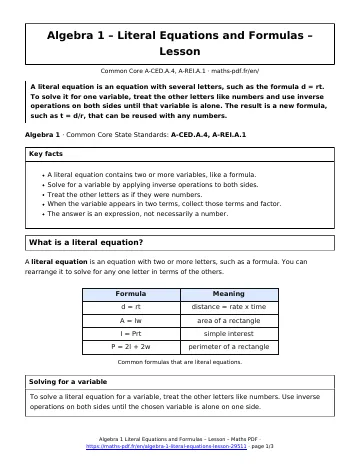
A literal equation is an equation with several letters, such as the formula d = rt. To solve it for one variable, treat the other letters like numbers and use inverse operations on both sides until that variable is alone. The result is a new formula, such as t = d/r, that can be reused with any numbers.
Algebra 1 · Common Core State Standards: A-CED.A.4, A-REI.A.1
Key facts in this literal equations lesson
- A literal equation contains two or more variables, like a formula.
- Solve for a variable by applying inverse operations to both sides.
- Treat the other letters as if they were numbers.
- When the variable appears in two terms, collect those terms and factor.
- The answer is an expression, not necessarily a number.
What is a literal equation?
A literal equation is an equation with two or more letters, such as a formula. You can rearrange it to solve for any one letter in terms of the others.
How do you solve a formula for one variable?
Take the line \(y = mx + b\). To solve for \(x\), you undo the addition of \(b\) and then the multiplication by \(m\).
- Circle the variable you want to isolate.
- Undo addition or subtraction by adding or subtracting the same term on both sides.
- Undo multiplication or division by dividing or multiplying both sides.
- Keep the answer as a fraction or expression; you do not need a number.
Why rearrange a formula before using it?
If you need the same unknown many times, rearrange once. A triangle has area \(A = \frac{1}{2}bh\). When you know the area and the base, solve for the height.
Example: A triangle has area 30 square feet and base 12 feet. Use \(h = \frac{2A}{b}\) to find the height: \(h = \frac{2(30)}{12} = 5\text{ ft}\).
What if the variable appears in more than one term?
Gather the terms that contain the variable on one side, factor the variable out, and divide by its coefficient. For \(ax – 3 = cx + d\), subtract \(cx\) and add 3 to get \(ax – cx = d + 3\). Then factor: \(x(a – c) = d + 3\), so \(x = \frac{d + 3}{a – c}\). This is valid when \(a \neq c\).
Tip: Treat letters like numbers. If you can solve \(3x + 2 = 11\) by subtracting 2 and dividing by 3, then \(ax + b = c\) takes the same two steps with letters. Keep the variable you want on one side, and never combine unlike letters.
Literal equations lesson: questions and answers
What is a literal equation?
A literal equation has two or more letters, usually a formula. Examples are A = lw and I = Prt. You can rewrite it to isolate any one letter.
How do you solve d = rt for t?
Divide both sides by r. This gives t = d/r, the formula for time when you know distance and rate.
Do the steps differ from solving a numeric equation?
No. You use the same inverse operations, but the answer contains letters instead of a single number.
What if the variable appears twice?
Collect all terms with that variable on one side, factor the variable out, and divide by the remaining factor.
Why is it useful to rearrange a formula?
Rearranging once lets you substitute many different values quickly, such as finding the base of several triangles with the same area formula.
How to use this literal equations lesson
Read the definitions first, then follow the worked method line by line and redo the example on paper without looking. When every step makes sense, move on to the worksheet, then check yourself with the quiz.
Download the literal equations lesson as a PDF with the button below and keep it with your notes.
All Algebra 1 chapters: Algebra 1 math.
Print this page
Download PDFDownload the Algebra 1 Literal Equations and Formulas Lesson (PDF, 64 KB)More Algebra 1 math
Lessons
See all





Worksheets
See all Adding, Subtracting and Multiplying Polynomials Worksheet
- Structure of Algebraic Expressions Worksheet
- Graphing Quadratic Functions and Transformations Worksheet
- Functions and Function Notation Worksheet
- Linear Inequalities in Two Variables and Systems Worksheet
- Linear Inequalities in One Variable Worksheet






Tests
See all- Exponent Rules and Radicals Test with Point Values
- Literal Equations and Formulas Test with Point Values
- Functions and Function Notation Test with Point Values
- Graphing Linear Equations Test with Point Values
- Graphing Quadratic Functions and Transformations Test with Point Values
- Exponential Functions and Growth Test with Point Values