Algebra 1 Linear Inequalities in One Variable Lesson (Free PDF)

This linear inequalities lesson for Algebra 1 covers linear inequalities in one variable (Common Core A-REI.B.3, A-CED.A.1), with a free PDF to print.
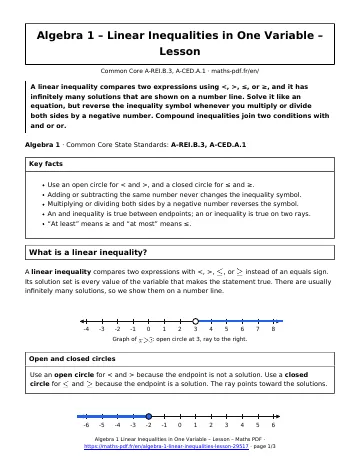
A linear inequality compares two expressions using <, >, ≤, or ≥, and it has infinitely many solutions that are shown on a number line. Solve it like an equation, but reverse the inequality symbol whenever you multiply or divide both sides by a negative number. Compound inequalities join two conditions with and or or.
Algebra 1 · Common Core State Standards: A-REI.B.3, A-CED.A.1
Key facts in this linear inequalities lesson
- Use an open circle for < and >, and a closed circle for ≤ and ≥.
- Adding or subtracting the same number never changes the inequality symbol.
- Multiplying or dividing both sides by a negative number reverses the symbol.
- An and inequality is true between endpoints; an or inequality is true on two rays.
- “At least” means ≥ and “at most” means ≤.
What is a linear inequality?
A linear inequality compares two expressions with <, >, \(\le\), or \(\ge\) instead of an equals sign. Its solution set is every value of the variable that makes the statement true. There are usually infinitely many solutions, so we show them on a number line.
How do you solve an inequality?
Solve it like an equation, with one important exception. Adding or subtracting the same number on both sides never changes the symbol. Multiplying or dividing both sides by a negative number reverses the symbol.
- Distribute and combine like terms on each side.
- Move variable terms to one side and constants to the other.
- Divide or multiply to isolate the variable. If the number is negative, flip the symbol.
- Graph the solution and check one test value.
Example: Solve \(-2x + 3 > 11\). Subtract 3: \(-2x > 8\). Divide by \(-2\) and reverse the symbol: \(x < -4\). Test \(x = -5\): \(-2(-5) + 3 = 13 > 11\), which is true.
Why does the symbol flip? Start with the true statement \(2 < 5\). Multiply both sides by \(-1\): you get \(-2 > -5\), so the order reversed. Negative numbers sit in the opposite order on the number line, which is why a negative multiplier or divisor reverses the symbol. Always check your answer with a test value.
What is a compound inequality?
A compound inequality joins two inequalities. An and inequality, such as \(-1 < x \le 4\), is true between the endpoints. An or inequality, such as \(x < -2 \text{ or } x \ge 4\), is true on either of two separate rays.
How do you write an inequality from a situation?
Look for phrases. “At most” and “no more than” mean \(\le\). “At least” means \(\ge\). If a student has $60 and each smoothie costs $4.50, the number of smoothies \(s\) satisfies \(4.50s \le 60\).
Tip: Always test one value from your solution set in the original inequality, and test the endpoint too. This catches a forgotten sign reversal right away.
Linear inequalities lesson: questions and answers
When do you flip the inequality sign?
Flip the sign only when you multiply or divide both sides by a negative number. For -2x > 8, dividing by -2 gives x < -4.
What is the difference between an open and a closed circle?
An open circle means the endpoint is not part of the solution (< or >). A closed circle means it is included (≤ or ≥).
How can you check an inequality solution?
Pick a test value from the solution set and substitute it into the original inequality. If the statement is true, the set is likely correct. Also test the endpoint.
What does ‘at least’ mean?
At least means greater than or equal to. If you need at least $200, then the amount satisfies amount ≥ 200.
How is an and inequality different from an or inequality?
An and inequality such as -1 < x ≤ 4 requires both conditions at once and gives a segment. An or inequality needs only one condition and gives two separate rays.
How to use this linear inequalities lesson
Read the definitions first, then follow the worked method line by line and redo the example on paper without looking. When every step makes sense, move on to the worksheet, then check yourself with the quiz.
Download the linear inequalities lesson as a PDF with the button below and keep it with your notes.
All Algebra 1 chapters: Algebra 1 math.
More Algebra 1 math
Lessons
See all





Worksheets
See all





Tests
See all Literal Equations and Formulas Test with Point Values
- Linear Inequalities in Two Variables and Systems Test with Point Values
- Functions and Function Notation Test with Point Values
- Factoring Polynomials Test with Point Values
- Solving Linear Equations in One Variable Test with Point Values
- Slope and Rate of Change Test with Point Values