Algebra 1 Factoring Polynomials Lesson (Free PDF)

This factoring lesson for Algebra 1 covers factoring polynomials (Common Core A-SSE.A.2, A-SSE.B.3a, A-APR.B.3), with a free PDF to print.
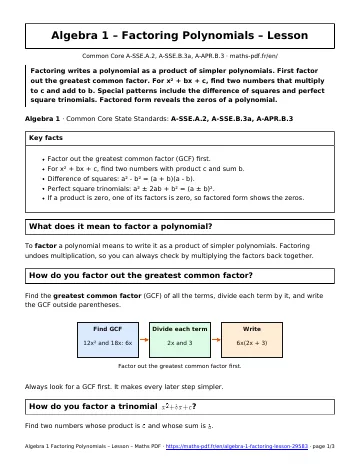
Factoring writes a polynomial as a product of simpler polynomials. First factor out the greatest common factor. For x² + bx + c, find two numbers that multiply to c and add to b. Special patterns include the difference of squares and perfect square trinomials. Factored form reveals the zeros of a polynomial.
Algebra 1 · Common Core State Standards: A-SSE.A.2, A-SSE.B.3a, A-APR.B.3
Key facts in this factoring lesson
- Factor out the greatest common factor (GCF) first.
- For x² + bx + c, find two numbers with product c and sum b.
- Difference of squares: a² – b² = (a + b)(a – b).
- Perfect square trinomials: a² ± 2ab + b² = (a ± b)².
- If a product is zero, one of its factors is zero, so factored form shows the zeros.
What does it mean to factor a polynomial?
To factor a polynomial means to write it as a product of simpler polynomials. Factoring undoes multiplication, so you can always check by multiplying the factors back together.
How do you factor out the greatest common factor?
Find the greatest common factor (GCF) of all the terms, divide each term by it, and write the GCF outside parentheses.
Always look for a GCF first. It makes every later step simpler.
How do you factor a trinomial \(x^{2} + bx + c\)?
Find two numbers whose product is \(c\) and whose sum is \(b\).
- List the factor pairs of the constant \(c\).
- Choose the pair that adds to \(b\).
- Write \((x + p)(x + q)\) and check with FOIL.
Example: Factor \(x^{2} + 7x + 12\). The pair with product \(12\) and sum \(7\) is \(3 \text{ and } 4\), so \(x^{2} + 7x + 12 = (x + 3)(x + 4)\).
How do you factor when the leading coefficient is not 1?
For \(2x^{2} + 7x + 3\), multiply \(2 \cdot 3\) to get 6, then find two numbers with product 6 and sum 7, which are 1 and 6. Split the middle term: \(2x^{2} + x + 6x + 3\). Group and factor: \(x(2x + 1) + 3(2x + 1) = (2x + 1)(x + 3)\).
Why does factoring help?
If a product is 0, one of the factors must be 0. So the zeros of \((x – 7)(x + 2)\) are \(7 \text{ and } -2\). Factoring also reveals the structure of an expression, such as seeing \(x^{4} – 16\) as a difference of squares.
Factoring lesson: questions and answers
What is the first step in factoring?
Look for a greatest common factor of all the terms. Factor it out before trying any other method.
How do you factor x² + 7x + 12?
Find two numbers that multiply to 12 and add to 7, which are 3 and 4. Then x² + 7x + 12 = (x + 3)(x + 4).
What is a difference of squares?
It is an expression a² – b² that factors as (a + b)(a – b). For example x² – 49 = (x – 7)(x + 7).
How can you check a factorization?
Multiply the factors back together using FOIL or the distributive property. The result should match the original polynomial.
How does factoring help find zeros?
A product is zero only if a factor is zero. Setting each factor equal to 0 gives the zeros. For (x – 7)(x + 2) the zeros are 7 and -2.
How to use this factoring lesson
Read the definitions first, then follow the worked method line by line and redo the example on paper without looking. When every step makes sense, move on to the worksheet, then check yourself with the quiz.
Download the factoring lesson as a PDF with the button below and keep it with your notes.
All Algebra 1 chapters: Algebra 1 math.
More Algebra 1 math
Lessons
See all





Worksheets
See all





Tests
See all Solving Quadratic Equations Test with Point Values
- Adding, Subtracting and Multiplying Polynomials Test with Point Values
- Data Distributions and Summary Statistics Test with Point Values
- Linear Inequalities in One Variable Test with Point Values
- Structure of Algebraic Expressions Test with Point Values
- Functions and Function Notation Test with Point Values