Algebra 1 Solving Quadratic Equations Lesson (Free PDF)

This algebra 1 quadratic equations lesson for Algebra 1 covers solving quadratic equations (Common Core A-REI.B.4a, A-REI.B.4b, A-SSE.B.3a, A-CED.A.1), with a free PDF to print.
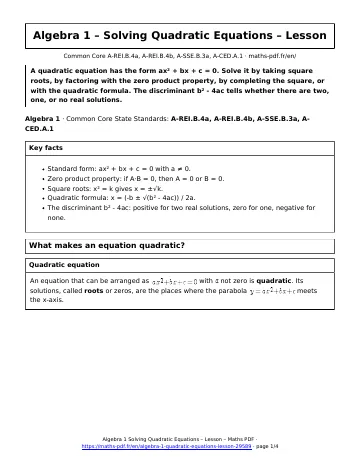
A quadratic equation has the form ax² + bx + c = 0. Solve it by taking square roots, by factoring with the zero product property, by completing the square, or with the quadratic formula. The discriminant b² – 4ac tells whether there are two, one, or no real solutions.
Algebra 1 · Common Core State Standards: A-REI.B.4a, A-REI.B.4b, A-SSE.B.3a, A-CED.A.1
Key facts in this algebra 1 quadratic equations lesson
- Standard form: ax² + bx + c = 0 with a ≠ 0.
- Zero product property: if A·B = 0, then A = 0 or B = 0.
- Square roots: x² = k gives x = ±√k.
- Quadratic formula: x = (-b ± √(b² – 4ac)) / 2a.
- The discriminant b² – 4ac: positive for two real solutions, zero for one, negative for none.
What makes an equation quadratic?
When can you use square roots?
If the squared term stands alone, as in \(x^{2} = k\), take the square root of both sides and keep both the positive and the negative result. For \(x^{2} = 20\) this gives \(x = \pm\sqrt{20} = \pm 2\sqrt{5}\).
How does the zero product property help?
Move every term to one side, factor, and use this fact: when \(A \cdot B = 0\), at least one of the factors must be zero, that is \(A = 0 \text{ or } B = 0\).
- Get zero on one side.
- Factor the other side.
- Set each factor equal to zero and solve each small equation.
- Substitute your answers into the original equation to verify them.
What does completing the square do?
It rewrites the equation so that one side is a perfect square. Starting from \(x^{2} + 6x = 7\), add \(9\), because half of the x-coefficient, squared, is \(\left(\frac{6}{2}\right)^{2} = 9\). The left side becomes \((x + 3)^{2} = 16\), so \(x + 3 = \pm 4\), and finally \(x = 1 \text{ or } x = -7\).
When is the quadratic formula the best choice?
It works for every quadratic. For \(ax^{2} + bx + c = 0\), the solutions are \(x = \frac{-b \pm \sqrt{b^{2} – 4ac}}{2a}\), where the radicand \(b^{2} – 4ac\) is called the discriminant.
Example: To solve \(x^{2} + 4x + 1 = 0\), read off \(a = 1, b = 4, c = 1\). The discriminant is \(16 – 4 = 12\), which gives \(x = \frac{-4 \pm \sqrt{12}}{2} = -2 \pm \sqrt{3}\).
In applications such as areas and falling objects, test each answer against the story. A negative length or time is not acceptable.
Algebra 1 quadratic equations lesson: questions and answers
What are the solutions of a quadratic equation?
They are the values of x that make the equation true. They are also the x-intercepts of the graph, and they are called roots or zeros.
When should you use the quadratic formula?
Use it when the quadratic does not factor easily, or when you want a method that always works. Write the equation in standard form to identify a, b, and c first.
What is the discriminant?
It is b² – 4ac, the expression under the square root in the quadratic formula. Positive means two real solutions, zero means one, and negative means no real solutions.
Why do you get two solutions when you take a square root?
Both a positive and a negative number square to the same value. For x² = 9, both 3 and -3 work.
How do you complete the square?
Add the square of half the coefficient of x to both sides. For x² + 6x, add 9 to get (x + 3)².
How to use this algebra 1 quadratic equations lesson
Read the definitions first, then follow the worked method line by line and redo the example on paper without looking. When every step makes sense, move on to the worksheet, then check yourself with the quiz.
Download the algebra 1 quadratic equations lesson as a PDF with the button below and keep it with your notes.
All Algebra 1 chapters: Algebra 1 math.
More Algebra 1 math
Lessons
See all




Worksheets
See all




Tests
See all Data Distributions and Summary Statistics Test with Point Values
- Literal Equations and Formulas Test with Point Values
- Solving Quadratic Equations Test with Point Values
- Structure of Algebraic Expressions Test with Point Values
- Adding, Subtracting and Multiplying Polynomials Test with Point Values
- Linear Inequalities in One Variable Test with Point Values