Algebra 1 Linear Inequalities in Two Variables and Systems Quiz: 10 Questions with Explanations

This linear inequalities two variables quiz for Algebra 1 covers linear inequalities in two variables and systems (Common Core A-REI.D.12, A-CED.A.3), with a free PDF to print.
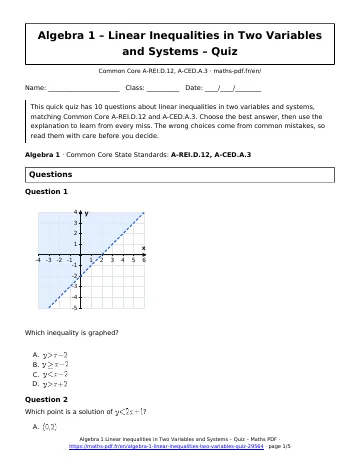
This quick quiz has 10 questions about linear inequalities in two variables and systems, matching Common Core A-REI.D.12 and A-CED.A.3. Choose the best answer, then use the explanation to learn from every miss. The wrong choices come from common mistakes, so read them with care before you decide.
Algebra 1 · Common Core State Standards: A-REI.D.12, A-CED.A.3
Linear inequalities two variables quiz: 10 questions
Remember
Remember
- A solution of an inequality in two variables is an ordered pair that makes it true.
- The boundary line is solid for ≤ and ≥, and dashed for < and >.
- Test a point not on the line to decide which side to shade.
- For y > mx + b, shade above; for y < mx + b, shade below.
- The solution of a system is the overlap of the shaded regions.
How to use this linear inequalities two variables quiz
Answer each question, read the explanation that appears, and keep track of your score. A score of 8 out of 10 or more means you are ready for the test.
Download the linear inequalities two variables quiz as a PDF with the button below and keep it with your notes.
Download the linear inequalities two variables quiz as a PDF with the button below and keep it with your notes.
All Algebra 1 chapters: Algebra 1 math.
Print this page
Download PDFDownload the Algebra 1 Linear Inequalities in Two Variables and Systems Quiz: 10 Questions with Explanations (PDF, 81 KB)More Algebra 1 math
Lessons
See all





Worksheets
See all





Tests
See all Linear Inequalities in One Variable Test with Point Values
- Exponent Rules and Radicals Test with Point Values
- Factoring Polynomials Test with Point Values
- Literal Equations and Formulas Test with Point Values
- Adding, Subtracting and Multiplying Polynomials Test with Point Values
- Functions and Function Notation Test with Point Values