AP Statistics Probability Rules and Simulation Worksheet Solutions (PDF)

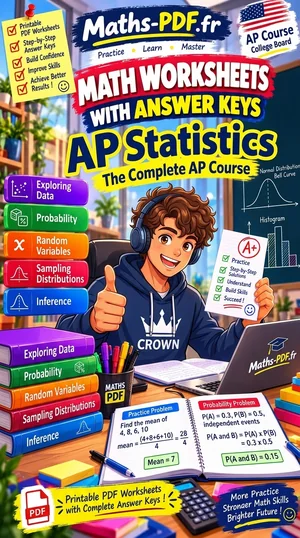
This probability simulation answers for AP Statistics covers probability rules and simulation (Common Core AP STAT 4.1, AP STAT 4.2, AP STAT 4.3, AP STAT 4.4, HSS-CP.A.1, HSS-CP.B.7), with a free PDF to print.
AP Statistics · Common Core State Standards: AP STAT 4.1, AP STAT 4.2, AP STAT 4.3, AP STAT 4.4, HSS-CP.A.1, HSS-CP.B.7
Probability simulation answers: exercises 1 to 10
Exercise 1 – Interpret a probability
Probability describes long-run frequency.
In many days with conditions like tomorrow’s, it rains on about 30% of them.
Exercise 2 – Law of large numbers
With few flips, chance variation is large; with many flips, the proportion is close to the true probability 0.5.
The law of large numbers: the relative frequency approaches the true probability as flips increase.
Exercise 3 – Gambler's fallacy
Coin flips are independent; the coin has no memory.
No: P(heads) is still 0.5. The long-run proportion balances out through many more flips, not by compensation.
Exercise 4 – Equally likely outcomes
Total 10. \(P(\text{red})=\frac{5}{10}=0.5\). \(P(\text{blue or green})=\frac{3+2}{10}=0.5\).
0.5 and 0.5.
Exercise 5 – Sample space of two coins
HH, HT, TH, TT are equally likely. Exactly one head: HT, TH.
\(P=\frac{2}{4}=0.5\).
0.5.
Exercise 6 – Two dice
Sum 7: 6 outcomes. Sum 11: (5,6), (6,5), 2 outcomes.
\(\frac{6}{36}=\frac{1}{6}\) and \(\frac{2}{36}=\frac{1}{18}\).
1/6 and 1/18.
Exercise 7 – Complement rule
\(1-0.82=0.18\).
0.18.
Exercise 8 – At least one
No 6 on either die: \(\frac{5}{6}\times\frac{5}{6}=\frac{25}{36}\). Complement: \(1-\frac{25}{36}=\frac{11}{36}\).
11/36, about 0.306.
Exercise 9 – Mutually exclusive events
A card cannot be both a king and a queen.
\(\frac{4}{52}+\frac{4}{52}=\frac{8}{52}=\frac{2}{13}\).
2/13, about 0.154.
Exercise 10 – General addition rule
\(P(\text{heart})=\frac{13}{52},\; P(\text{king})=\frac{4}{52},\; P(\text{king of hearts})=\frac{1}{52}\).
\(\frac{13+4-1}{52}=\frac{16}{52}=\frac{4}{13}\).
4/13, about 0.308.
Exercises 11 and up
Exercise 11 – Read a Venn diagram
Honor roll: \(\frac{40+15}{200}=0.275\). Sports: \(\frac{15+35}{200}=0.25\). Both: \(\frac{15}{200}=0.075\).
0.275, 0.25, and 0.075.
Exercise 12 – Neither
Or: \(0.275+0.25-0.075=0.45\). Neither: \(1-0.45=0.55\), which matches \(\frac{110}{200}\).
0.45 and 0.55.
Exercise 13 – Are they mutually exclusive?
\(P(A\text{ and }B)=0.5+0.3-0.6=0.2\).
P(A and B) = 0.2, which is not 0, so A and B are not mutually exclusive.
Exercise 14 – Run a simulation
Trials: 0 3 8 -> 2; 1 5 6 -> 3; 4 9 2 -> 2; 7 6 1 -> 2; 0 5 8 -> 2; 2 3 4 -> 3; 9 6 7 -> 1; 1 5 2 -> 3; 8 3 0 -> 2; 6 4 9 -> 2 made shots.
Trials with at least 2 made: 9 of 10.
Estimated probability 0.9 (more trials give a better estimate).
Exercise 15 – Compare with the exact value
Exact: \(3(0.7)^{2}(0.3)+(0.7)^{3}=0.441+0.343=0.784\).
The estimate (0.9) differs from 0.784 because only 10 trials were run. A simulation with hundreds of trials would be closer.
Exercise 16 – Design a simulation
Use a random digit generator. Digits 1 to 25 are not available as single digits, so use two-digit pairs 00 to 99: 00 to 24 means prize, 25 to 99 means no prize.
Read pairs until the first prize, record how many boxes, and repeat many times; average the counts.
Assign 00-24 as prize, read pairs until a prize, record the count, repeat many trials and average.
Exercise 17 – Probability of a union
\(P(A\text{ or }B)=0.4+0.35=0.75\). Neither: \(1-0.75=0.25\).
0.75 and 0.25.
Exercise 18 – Raffle
First prize: \(\frac{8}{200}=0.04\).
Win none in 3 draws: \(\frac{192}{200}\times\frac{191}{199}\times\frac{190}{198}\approx 0.8842\).
0.04; about 0.884 chance of winning nothing.
Exercise 19 – Multi-step
\(0.60+0.45-0.25=0.80\). Neither: \(1-0.80=0.20\).
80% have at least one; 20% have neither.
Exercise 20 – At least one six
No 6 in a roll has probability 5/6, and the rolls are independent: \(\left(\frac{5}{6}\right)^{4}=\frac{625}{1296}\approx 0.482\).
Complement: \(1-0.482=0.518\).
About 0.518.
Key facts behind this probability simulation answers
- Probability = long-run relative frequency; always between 0 and 1.
- Law of large numbers: more trials bring the relative frequency closer to the probability.
- Complement rule: P(A not happening) = 1 – P(A).
- General addition rule: P(A or B) = P(A) + P(B) – P(A and B); subtract nothing if A and B are mutually exclusive.
- Simulation: assign digits, simulate trials, repeat many times, then estimate.
How to use this probability simulation answers
Cover each solution, solve the exercise again, then uncover it and compare every line. If your answer differs, find the first step that changed and redo the exercise from there.
Download the probability simulation answers as a PDF with the button below and keep it with your notes.
Download the probability simulation answers as a PDF with the button below and keep it with your notes.
Download the probability simulation answers as a PDF with the button below and keep it with your notes.
All AP Statistics chapters: AP Statistics math.

More AP Statistics math
Lessons
See all





Worksheets
See all



Tests
See all Graphs of Quantitative Data and Shape Test with Point Values
- Probability Rules and Simulation Test with Point Values
- t Intervals and t Tests for a Mean Test with Point Values
- Conditional Probability and Independence Test with Point Values
- Sampling Methods and Bias in Surveys Test with Point Values
- Mean, Median, Standard Deviation and Outliers Test with Point Values