AP Statistics Experimental Design and Random Assignment Test Solutions and Scoring (PDF)

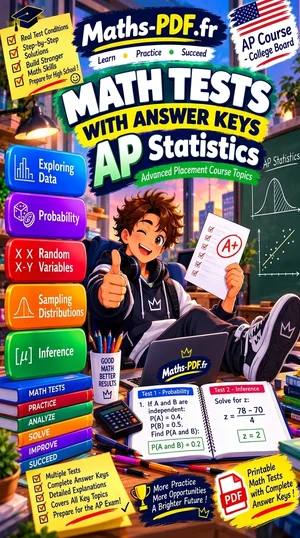
This experiments test answers for AP Statistics covers experimental design and random assignment (Common Core AP STAT 3.4, AP STAT 3.5, AP STAT 3.6, HSS-IC.B.3, HSS-IC.B.5), with a free PDF to print.
AP Statistics · Common Core State Standards: AP STAT 3.4, AP STAT 3.5, AP STAT 3.6, HSS-IC.B.3, HSS-IC.B.5
Experiments test answers: worked solutions
Question 1 – Identify the design parts [3 pts]
(a) Completely randomized design.
(b) Explanatory: type of fertilizer; response: height gain.
(c) \(\frac{30}{2}=15\).
Completely randomized; fertilizer and height gain; 15 plants.
Scoring: 1 point per part.
Question 2 – Confounding [2 pts]
Families who pay for lessons may also support academic work in other ways.
Family resources (or motivation) are confounded with taking lessons, so the study cannot show that lessons raise grades.
Scoring: 1 point for naming a confounding variable, 1 point for explaining its link to both variables.
Question 3 – Random assignment [3 pts]
07 selected, 41 skipped (out of range), 15 selected, 22 skipped (out of range), 03 selected, 38 skipped (out of range), 09 selected.
Treatment group: students 07, 15, 03, 09.
Scoring: 1 point for pair reading, 1 point for skipping out-of-range values, 1 point for the correct four.
Question 4 – Blocking [3 pts]
(a) A randomized block design, blocking by grade.
(b) Within grade 3, randomly assign 10 students to app 1 and 10 to app 2; do the same within grade 6. Compare the apps within each grade.
Randomized block design with 10 per app per grade.
Scoring: 1 point for blocking by grade; 2 points for randomizing within each block.
Question 5 – Placebo [2 pts]
A placebo gives the control group the experience of a treatment without the active ingredient. Blinding keeps subjects and evaluators from letting expectations affect responses.
Placebo controls for the psychological effect; blinding prevents bias in reporting and measurement.
Scoring: 1 point for each purpose.
Question 6 – Scope of inference [2 pts]
Random assignment allows cause and effect; volunteers are not a random sample.
Cause and effect for these volunteers; not generalizable to all adults.
Scoring: 1 point for each conclusion.
Question 7 – Significance [2 pts]
1% is small, so chance alone is unlikely to explain the difference.
The difference of 14 points is statistically significant, which gives evidence the treatment works better than the placebo.
Scoring: 1 point for ‘unlikely due to chance’, 1 point for the conclusion in context.
Question 8 – Evaluate a study [3 pts]
Teachers differ and the classes may differ in ability, so the policy is confounded with the teacher.
Students were not randomly assigned to policies.
Confounding with teacher and class, and no random assignment; improve by randomly assigning students (or sections) to the policies.
Scoring: 1 point for each problem; 1 point for an improvement involving random assignment.
Total score
20 points
Key facts behind this experiments test answers
- Experiments impose treatments; observational studies do not and cannot prove causation.
- Confounding occurs when the effects of two variables on the response cannot be separated.
- Good design: comparison, random assignment, control, replication; use blinding and placebos when needed.
- Designs: completely randomized, randomized block, matched pairs.
- Random assignment allows cause-and-effect; random selection allows generalization.
How to use this experiments test answers
Score your test with the point values shown for each question. Then read the worked solution of every question where you lost points and note the method to review.
All AP Statistics chapters: AP Statistics math.
Free printable PDF
AP Statistics Experimental Design and Random Assignment Test Solutions and Scoring
Download PDF
More AP Statistics math
Lessons
See all




Worksheets
See all


Tests
See all t Intervals and t Tests for a Mean Test with Point Values
- Variables and Categorical Data Displays Test with Point Values
- Five-Number Summary, Boxplots and Comparing Distributions Test with Point Values
- Probability Rules and Simulation Test with Point Values
- Experimental Design and Random Assignment Test with Point Values
- Inference for the Difference of Two Proportions Test with Point Values