1st Grade Addition Within 20 Lesson (Free PDF)

This addition within 20 lesson for 1st Grade covers addition within 20 (Common Core 1.OA.A.1, 1.OA.B.3, 1.OA.C.6, 1.OA.C.5), with a free PDF to print.
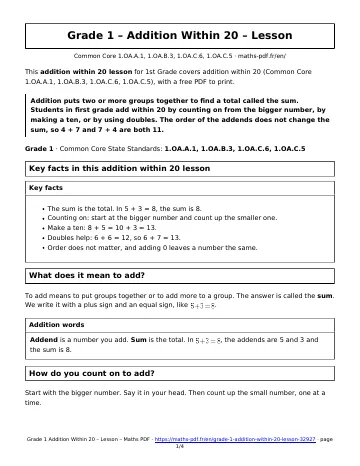
Addition puts two or more groups together to find a total called the sum. Students in first grade add within 20 by counting on from the bigger number, by making a ten, or by using doubles. The order of the addends does not change the sum, so 4 + 7 and 7 + 4 are both 11.
Grade 1 · Common Core State Standards: 1.OA.A.1, 1.OA.B.3, 1.OA.C.6, 1.OA.C.5
Key facts in this addition within 20 lesson
- The sum is the total. In 5 + 3 = 8, the sum is 8.
- Counting on: start at the bigger number and count up the smaller one.
- Make a ten: 8 + 5 = 10 + 3 = 13.
- Doubles help: 6 + 6 = 12, so 6 + 7 = 13.
- Order does not matter, and adding 0 leaves a number the same.
What does it mean to add?
To add means to put groups together or to add more to a group. The answer is called the sum. We write it with a plus sign and an equal sign, like \(5 + 3 = 8\).
How do you count on to add?
Start with the bigger number. Say it in your head. Then count up the small number, one at a time.
Counting on 1 gives the next number. Counting on 2 gives the number two steps up.
How do you make a ten?
Ten is an easy number to work with. Fill a ten frame first, then add what is left.
- Look at the bigger number. How many more make 10?
- Take that many from the other number.
- Add 10 and the leftover.
Example: \(8 + 5\). Two more make 10 from 8. Take 2 from 5, and 3 is left. \(10 + 3 = 13\).
What are doubles?
A doubles fact adds a number to itself. Doubles are easy to remember. Then you can use them for near doubles. If \(6 + 6 = 12\), then \(6 + 7\) is one more, so it is 13.
Does the order matter?
No. You can add in any order and the sum stays the same. Adding zero changes nothing. With three numbers, look for two that make 10 first.
Addition within 20 lesson: questions and answers
What is the sum in addition?
The sum is the answer to an addition problem. It tells how many there are in all. In 6 + 2 = 8, the sum is 8.
Why start counting on from the bigger number?
You have fewer steps to count. For 2 + 9, start at 9 and count on 2 to get 11. That is faster than starting at 2.
What does make a ten mean?
It means you move some counters so that one ten frame is full. Then you add the leftover ones. For 9 + 4, move 1 to make 10, and 3 are left, so the sum is 13.
Can I switch the numbers when I add?
Yes. The sum stays the same in any order. So 3 + 8 = 8 + 3 = 11. This is a big help when one order is easier.
How is counting on 2 like adding 2?
Both give the same answer. To add 2 to 15, say 16, 17. You land on 17, so 15 + 2 = 17.
How to use this addition within 20 lesson
Read the definitions first, then follow the worked method line by line and redo the example on paper without looking. When every step makes sense, move on to the worksheet, then check yourself with the quiz.
Download the addition within 20 lesson as a PDF with the button below and keep it with your notes.
All Grade 1 chapters: Grade 1 math.