3rd Grade Multiplying by Multiples of 10 Lesson (Free PDF)
This multiply tens lesson for 3rd Grade covers multiplying by multiples of 10 (Common Core 3.NBT.A.3), with a free PDF to print.
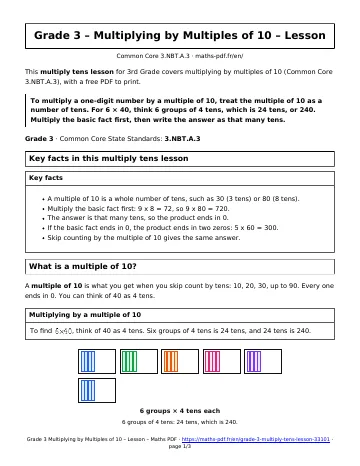
To multiply a one-digit number by a multiple of 10, treat the multiple of 10 as a number of tens. For 6 × 40, think 6 groups of 4 tens, which is 24 tens, or 240. Multiply the basic fact first, then write the answer as that many tens.
Grade 3 · Common Core State Standards: 3.NBT.A.3
Key facts in this multiply tens lesson
- A multiple of 10 is a whole number of tens, such as 30 (3 tens) or 80 (8 tens).
- Multiply the basic fact first: 9 x 8 = 72, so 9 x 80 = 720.
- The answer is that many tens, so the product ends in 0.
- If the basic fact ends in 0, the product ends in two zeros: 5 x 60 = 300.
- Skip counting by the multiple of 10 gives the same answer.
What is a multiple of 10?
A multiple of 10 is what you get when you skip count by tens: 10, 20, 30, up to 90. Every one ends in 0. You can think of 40 as 4 tens.
Each box holds 4 rods. A rod is worth 10, so each box is worth 40. Six boxes make \(6 \times 40 = 240\).
How do you multiply a one-digit number by a multiple of 10?
- Look at the multiple of 10 and name its tens. For example, 40 is 4 tens.
- Multiply the two small numbers with a basic fact: \(6 \times 4 = 24\).
- The answer is that many tens. Write the product with a 0 on the end: 24 tens is 240.
Worked example: \(7 \times 50\). 50 is 5 tens. \(7 \times 5 = 35\), so the answer is 35 tens. 35 tens is \(350\). So \(7 \times 50 = 350\).
Why does the product get an extra zero?
Ten times any number moves its digits one place to the left, and a 0 fills the ones place. In \(6 \times 40\), the basic fact \(6 \times 4 = 24\) becomes 240. If the basic fact already ends in 0, the product ends in two zeros: \(5 \times 60 = 300\) because \(5 \times 6 = 30\).
| Basic fact | Same fact with tens |
|---|---|
| \(3 \times 2 = 6\) | \(3 \times 20 = 60\) |
| \(8 \times 5 = 40\) | \(8 \times 50 = 400\) |
| \(9 \times 7 = 63\) | \(9 \times 70 = 630\) |
What other ways show the same answer?
You can skip count by the multiple of 10. Six jumps of 40 is 40, 80, 120, 160, 200, 240.
You can also break the number apart: \(6 \times 40 = 6 \times 4 \times 10 = 24 \times 10 = 240\). In a tape diagram, five equal parts of 70 show \(5 \times 70 = 350\).
Multiply tens lesson: questions and answers
How do you multiply 9 x 80?
Think of 80 as 8 tens. Multiply 9 x 8 = 72, so the answer is 72 tens, or 720. Write the basic fact answer and add a zero.
Why does 5 x 60 have two zeros?
The basic fact 5 x 6 = 30 already ends in 0. Then you write 30 tens, which is 300. The product 300 has two zeros.
What is a multiple of 10?
A multiple of 10 is a number you reach by counting by tens, such as 20, 50, or 90. Each one is a whole number of tens.
Can I just add a zero to the end?
Only after you multiply the basic fact. For 4 x 30, first find 4 x 3 = 12, then write 120. Adding a zero to the 30 first would give the wrong number.
How can I check my answer?
Skip count by the multiple of 10, or use estimating. For 7 x 40, seven jumps of 40 land on 280, and 7 x 4 = 28 tens matches.
How to use this multiply tens lesson
Read the definitions first, then follow the worked method line by line and redo the example on paper without looking. When every step makes sense, move on to the worksheet, then check yourself with the quiz.
Download the multiply tens lesson as a PDF with the button below and keep it with your notes.
All Grade 3 chapters: Grade 3 math.
More 3rd Grade math
Lessons
See all





Worksheets
See all




Tests
See all Two-Step Word Problems and Patterns Test with Point Values
- Area Test with Point Values
- Understanding Division Test with Point Values
- Multiplication and Division Facts Within 100 Test with Point Values
- Equivalent and Comparing Fractions Test with Point Values
- Understanding Multiplication Test with Point Values