3rd Grade Perimeter Worksheet Solutions (PDF)

This perimeter practice solutions for 3rd Grade covers perimeter (Common Core 3.MD.D.8), with a free PDF to print.
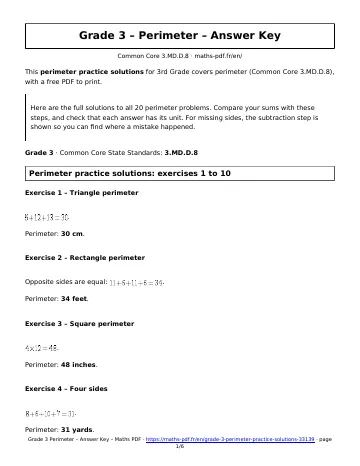
Here are the full solutions to all 20 perimeter problems. Compare your sums with these steps, and check that each answer has its unit. For missing sides, the subtraction step is shown so you can find where a mistake happened.
Grade 3 · Common Core State Standards: 3.MD.D.8
Perimeter practice solutions: exercises 1 to 10
Exercise 1 – Triangle perimeter
\(5 + 12 + 13 = 30\).
Perimeter: 30 cm.
Exercise 2 – Rectangle perimeter
Opposite sides are equal: \(11 + 6 + 11 + 6 = 34\).
Perimeter: 34 feet.
Exercise 3 – Square perimeter
\(4 \times 12 = 48\).
Perimeter: 48 inches.
Exercise 4 – Four sides
\(8 + 6 + 10 + 7 = 31\).
Perimeter: 31 yards.
Exercise 5 – Regular pentagon
\(5 \times 7 = 35\).
Perimeter: 35 meters.
Exercise 6 – Regular hexagon
\(6 \times 9 = 54\).
Perimeter: 54 centimeters.
Exercise 7 – Figure with right angles
\(8 + 2 + 3 + 2 + 5 + 4 = 24\).
Perimeter: 24 cm.
Exercise 8 – Missing width
Two lengths: \(9 + 9 = 18\). Two widths make \(30 – 18 = 12\). One width is \(12 \div 2 = 6\).
Width: 6 feet.
Exercise 9 – Missing triangle side
\(13 + 15 = 28\) and \(40 – 28 = 12\).
Third side: 12 inches.
Exercise 10 – Side of a square
\(36 \div 4 = 9\).
Each side: 9 centimeters.
Exercises 11 and up
Exercise 11 – Equilateral triangle
\(51 \div 3 = 17\).
One side: 17 feet.
Exercise 12 – Missing side of a quadrilateral
\(10 + 7 + 8 = 25\) and \(34 – 25 = 9\).
Missing side: 9 inches.
Exercise 13 – Unlabeled sides
The top step is \(10 – 6 = 4\) meters and the vertical step is \(7 – 3 = 4\) meters.
\(10 + 3 + 4 + 4 + 6 + 7 = 34\).
Perimeter: 34 meters.
Exercise 14 – Same perimeter
A: perimeter \(2 \times (2 + 8) = 20\), area \(2 \times 8 = 16\). B: perimeter \(2 \times (4 + 6) = 20\), area \(4 \times 6 = 24\).
Both perimeters are 20 units. The areas are 16 and 24 square units.
Exercise 15 – Walking around the park
\(120 + 80 + 120 + 80 = 400\).
She walks 400 yards.
Exercise 16 – Fence for a dog pen
Perimeter: \(2 \times (7 + 5) = 24\) feet.
Cost: \(24 \times \$3 = \$72\).
The fence costs $72.
Exercise 17 – Ribbon around a frame
Perimeter: \(2 \times (14 + 10) = 48\) inches.
Left over: \(60 – 48 = 12\).
12 inches of ribbon are left.
Exercise 18 – Garden with fencing
Two lengths: \(11 + 11 = 22\). Two widths: \(36 – 22 = 14\). One width: \(14 \div 2 = 7\).
Area: \(11 \times 7 = 77\).
Width: 7 feet. Area: 77 square feet.
Exercise 19 – Twelve square tiles
1 by 12: \(2 \times (1 + 12) = 26\). 2 by 6: \(2 \times (2 + 6) = 16\). 3 by 4: \(2 \times (3 + 4) = 14\).
Perimeters: 26 ft, 16 ft, 14 ft. The 3 by 4 rectangle has the smallest perimeter.
Exercise 20 – Poster border
Two widths: \(7 + 7 = 14\). Two lengths: \(38 – 14 = 24\). One length: \(24 \div 2 = 12\).
Length: 12 inches.
Key facts behind this perimeter practice solutions
- Perimeter is the sum of the lengths of all the sides of a polygon.
- It is measured in plain units, such as inches, feet, or centimeters.
- A rectangle has two lengths and two widths: P = 2 × (length + width).
- To find a missing side, subtract the known sides from the perimeter.
- Rectangles with the same perimeter can have different areas.
How to use this perimeter practice solutions
Cover each solution, solve the exercise again, then uncover it and compare every line. If your answer differs, find the first step that changed and redo the exercise from there.
All Grade 3 chapters: Grade 3 math.
More 3rd Grade math
Lessons
See all




Worksheets
See all


Tests
See all Rounding to the Nearest 10 and 100 Test with Point Values
- Scaled Graphs and Line Plots Test with Point Values
- Equivalent and Comparing Fractions Test with Point Values
- Adding and Subtracting Within 1,000 Test with Point Values
- Properties of Multiplication Test with Point Values
- Multiplication and Division Facts Within 100 Test with Point Values