Algebra 1 Exponent Rules and Radicals Worksheet Solutions (PDF)

This exponent rules answers for Algebra 1 covers exponent rules and radicals (Common Core N-RN.A.1, N-RN.A.2, N-RN.B.3), with a free PDF to print.
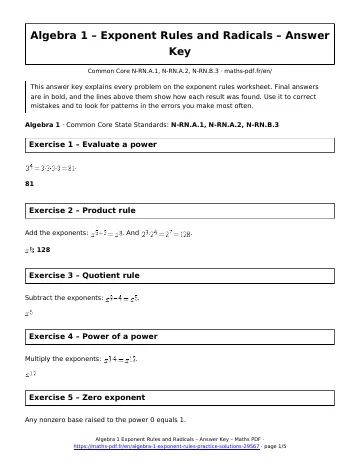
Algebra 1 · Common Core State Standards: N-RN.A.1, N-RN.A.2, N-RN.B.3
Exponent rules answers: exercises 1 to 10
Exercise 1 – Evaluate a power
\(3^{4} = 3 \cdot 3 \cdot 3 \cdot 3 = 81\).
81
Exercise 2 – Product rule
Add the exponents: \(x^{5 + 3} = x^{8}\). And \(2^{3} \cdot 2^{4} = 2^{7} = 128\).
\(x^{8}\); 128
Exercise 3 – Quotient rule
Subtract the exponents: \(x^{9 – 4} = x^{5}\).
\(x^{5}\)
Exercise 4 – Power of a power
Multiply the exponents: \(x^{3 \cdot 4} = x^{12}\).
\(x^{12}\)
Exercise 5 – Zero exponent
Any nonzero base raised to the power 0 equals 1.
1, 1, and 1
Exercise 6 – Negative exponent
\(3^{-2} = \frac{1}{3^{2}} = \frac{1}{9}\).
\(\frac{1}{9}\)
Exercise 7 – Power of a product
Apply the power to each factor: \(2^{3} \cdot (x^{4})^{3} = 8x^{12}\).
\(8x^{12}\)
Exercise 8 – Negative exponent in a term
Only \(x\) has the negative exponent: \(4x^{-2} = \frac{4}{x^{2}}\).
\(\frac{4}{x^{2}}\)
Exercise 9 – Quotient of monomials
Divide coefficients: \(6 \div 2 = 3\). Subtract exponents: \(x^{5-2} = x^{3}\), \(y^{2-1} = y\).
\(3x^{3}y\)
Exercise 10 – Several rules
Square each factor: \(2^{2}x^{6}y^{-4} = 4x^{6}y^{-4}\).
Move \(y^{-4}\) to the denominator.
\(\frac{4x^{6}}{y^{4}}\)
Exercises 11 and up
Exercise 11 – Simplify a radical
The greatest perfect square factor is 16: \(\sqrt{48} = \sqrt{16 \cdot 3}\).
\(= 4\sqrt{3}\).
\(4\sqrt{3}\)
Exercise 12 – Simplify another radical
The greatest perfect square factor is 100: \(\sqrt{200} = \sqrt{100 \cdot 2} = 10\sqrt{2}\).
\(10\sqrt{2}\)
Exercise 13 – Rational exponents
\(25^{1/2} = \sqrt{25} = 5\).
\(27^{2/3} = (\sqrt[3]{27})^{2} = 3^{2} = 9\).
\(16^{3/4} = (\sqrt[4]{16})^{3} = 2^{3} = 8\).
5, 9, and 8
Exercise 14 – Radical and exponent forms
The exponent \(\frac{1}{2}\) means a square root: \(5^{1/2} = \sqrt{5}\).
The cube root of \(x^{2}\) is \(x^{2/3}\).
\(\sqrt{5}\); \(x^{2/3}\)
Exercise 15 – Rational or irrational
\(\sqrt{9} = 3\) is rational. \(\sqrt{10}\) is not a perfect square, so it is irrational. \(0.\overline{3} = \frac{1}{3}\) is rational. \(\pi\) is irrational.
rational, irrational, rational, irrational
Exercise 16 – Bacteria
\(P = 100 \cdot 2^{6} = 100 \cdot 64 = 6400\).
6,400 bacteria
Exercise 17 – Computer memory
\(2^{10} \cdot 2^{10} = 2^{20}\).
\(2^{20} = 1{,}048{,}576\).
\(2^{20}\) = 1,048,576 bytes
Exercise 18 – Square garden
Side = \(\sqrt{75} = \sqrt{25 \cdot 3} = 5\sqrt{3}\).
Since \(\sqrt{3} \approx 1.732\), the side is about \(5(1.732) \approx 8.66\).
\(5\sqrt{3}\) ft ≈ 8.66 ft
Exercise 19 – Falling object
\(t = \frac{\sqrt{64}}{4} = \frac{8}{4} = 2\) seconds.
\(t = \frac{\sqrt{50}}{4} = \frac{5\sqrt{2}}{4}\) seconds, about 1.77 seconds.
2 s; \(\frac{5\sqrt{2}}{4}\) s
Exercise 20 – Explain irrational sums
Suppose the sum were a rational number \(r\). Then \(\sqrt{2} = r – \frac{1}{2}\).
A difference of two rational numbers is rational, so \(\sqrt{2}\) would be rational. But \(\sqrt{2}\) is irrational. This contradiction shows the sum is irrational.
The sum is irrational
Exercise 21 – Sunlight travel time
\(\frac{9.3 \times 10^{7}}{1.86 \times 10^{5}} = \frac{9.3}{1.86} \times 10^{7-5}\).
\(= 5 \times 10^{2} = 500\).
500 seconds
Key facts behind this exponent rules answers
- Product rule: aᵐ · aⁿ = aᵐ⁺ⁿ; quotient rule: aᵐ / aⁿ = aᵐ⁻ⁿ.
- Power rule: (aᵐ)ⁿ = aᵐⁿ.
- a⁰ = 1 and a⁻ⁿ = 1/aⁿ for a ≠ 0.
- a^(1/2) = √a, and a^(m/n) is the n-th root of a raised to the m.
- A rational plus an irrational number is irrational.
How to use this exponent rules answers
Cover each solution, solve the exercise again, then uncover it and compare every line. If your answer differs, find the first step that changed and redo the exercise from there.
Download the exponent rules answers as a PDF with the button below and keep it with your notes.
All Algebra 1 chapters: Algebra 1 math.
Print this page
Download PDFDownload the Algebra 1 Exponent Rules and Radicals Worksheet Solutions (PDF, 94 KB)More Algebra 1 math
Lessons
See all





Worksheets
See all





Tests
See all Data Distributions and Summary Statistics Test with Point Values
- Writing Linear Equations and Functions Test with Point Values
- Adding, Subtracting and Multiplying Polynomials Test with Point Values
- Linear Inequalities in Two Variables and Systems Test with Point Values
- Slope and Rate of Change Test with Point Values
- Exponential Functions and Growth Test with Point Values