Algebra 1 Graphing Quadratic Functions and Transformations Worksheet Solutions (PDF)
This quadratic functions answers for Algebra 1 covers graphing quadratic functions and transformations (Common Core F-IF.C.7a, F-IF.C.8a, F-BF.B.3, A-SSE.B.3b), with a free PDF to print.
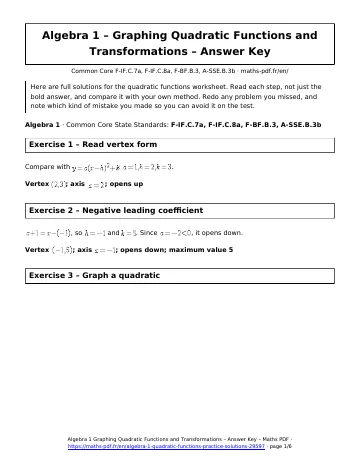
Algebra 1 · Common Core State Standards: F-IF.C.7a, F-IF.C.8a, F-BF.B.3, A-SSE.B.3b
Quadratic functions answers: exercises 1 to 10
Exercise 1 – Read vertex form
Compare with \(y = a(x – h)^{2} + k\): \(a = 1, h = 2, k = 3\).
Vertex \((2, 3)\); axis \(x = 2\); opens up
Exercise 2 – Negative leading coefficient
\(x + 1 = x – (-1)\), so \(h = -1\) and \(k = 5\). Since \(a = -2 < 0\), it opens down.
Vertex \((-1, 5)\); axis \(x = -1\); opens down; maximum value 5
Exercise 3 – Graph a quadratic
Axis: \(x = -\frac{-4}{2(1)} = 2\). Vertex: \(y = 4 – 8 + 3 = -1\), so \((2, -1)\).
y-intercept: \((0, 3)\). x-intercepts: \((x – 1)(x – 3) = 0\), so 1 and 3.
Vertex (2, -1); intercepts (1, 0), (3, 0), (0, 3)
Exercise 4 – Vertex from standard form
\(x = -\frac{6}{2(1)} = -3\). Then \(y = 9 – 18 + 5 = -4\).
Axis \(x = -3\); vertex \((-3, -4)\)
Exercise 5 – Zeros and vertex
Factor: \(y = -x(x – 4)\), so the zeros are 0 and 4.
The vertex is halfway between them at \(x = 2\): \(y = -4 + 8 = 4\).
Zeros 0 and 4; vertex (2, 4)
Exercise 6 – Intercepts
y-intercept: \(y = -8\) at \((0, -8)\).
Factor: \((x – 4)(x + 2) = 0\).
(0, -8); (4, 0) and (-2, 0)
Exercise 7 – Shift up
Adding 3 to every output moves each point up 3 units.
Shifted up 3 units; vertex moves from (0, 0) to (0, 3)
Exercise 8 – Shift right
Replacing \(x\) with \(x – 4\) shifts the graph to the right by 4. The vertex is \((4, 0)\).
Shifted right 4 units
Exercise 9 – Stretch and reflect
\(y = -x^{2}\) is reflected over the x-axis (opens down). \(y = 3x^{2}\) is narrower (vertical stretch by 3). \(y = \frac{1}{2}x^{2}\) is wider (vertical shrink).
Reflection; narrower; wider
Exercise 10 – Write a transformation
Left 2: replace \(x\) with \(x + 2\). Down 5: subtract 5.
\(y = (x + 2)^{2} – 5\)
Exercises 11 and up
Exercise 11 – Complete the square
Take half of 6 and square it: 9. \(y = (x^{2} + 6x + 9) – 9 + 5\).
\(y = (x + 3)^{2} – 4\); vertex \((-3, -4)\)
Exercise 12 – Vertex form with a harder constant
Half of \(-8\) is \(-4\), and its square is 16: \(y = (x^{2} – 8x + 16) – 16 + 10\).
\(y = (x – 4)^{2} – 6\); vertex \((4, -6)\)
Exercise 13 – Compare minimum values
The minimum of \(f\) is \(k = 2\). For \(g\): \(x = -2\), so \(g(-2) = 4 – 8 + 1 = -3\).
\(f\) (minimum 2 versus \(-3\))
Exercise 14 – Domain and range
The vertex is at \(x = 3\): \(y = -9 + 18 – 5 = 4\). The parabola opens down.
Domain: all real numbers. Range: \(y \le 4\).
Domain: all real numbers; range \(y \le 4\)
Exercise 15 – Symmetric points
\(f(1) = 1 – 6 + 8 = 3\) and \(f(5) = 25 – 30 + 8 = 3\).
Equal outputs at equal distances from 3 mean the axis is \(x = 3\).
3 and 3; axis x = 3
Exercise 16 – Ball height
Time: \(t = -\frac{64}{2(-16)} = 2\) seconds.
Height: \(h(2) = -16(4) + 64(2) + 5 = -64 + 128 + 5 = 69\).
At 2 seconds; 69 feet
Exercise 17 – Maximum revenue
Price: \(p = -\frac{100}{2(-5)} = 10\).
Revenue: \(R(10) = -500 + 1000 = 500\).
$10; $500
Exercise 18 – Fence for a pen
\(A = -x^{2} + 20x\). Vertex: \(x = -\frac{20}{2(-1)} = 10\).
\(A(10) = 10 \cdot 10 = 100\).
10 feet by 10 feet; 100 square feet
Exercise 19 – Arch
The vertex is \((6, 4)\), so the greatest height is 4 feet.
Set \(y = 0\): \((x – 6)^{2} = 36\), so \(x – 6 = \pm 6\) and \(x = 0\) or \(x = 12\).
Height 4 ft; ground at x = 0 and x = 12
Exercise 20 – Maximum profit
Items must be whole numbers, so test 12 and 13, which are equally close to 12.5.
\(P(12) = -288 + 600 – 100 = 212\) and \(P(13) = -338 + 650 – 100 = 212\).
$212 with 12 or 13 items
Exercise 21 – Describe all the changes
Start with \(x^{2}\). Replace \(x\) by \(x – 1\) (right 1). Multiply by \(-2\) (stretch by 2 and reflect over the x-axis). Add 3 (up 3).
Right 1, stretch by 2, reflect, up 3; vertex (1, 3)
Key facts behind this quadratic functions answers
- Standard form f(x) = ax² + bx + c; vertex form f(x) = a(x – h)² + k.
- The axis of symmetry is x = -b/(2a), and the vertex lies on it.
- If a > 0 the parabola opens up (minimum); if a < 0 it opens down (maximum).
- f(x) + k shifts up/down; f(x – h) shifts right/left; a·f(x) stretches or reflects.
- The vertex gives the maximum or minimum value in a model.
How to use this quadratic functions answers
Cover each solution, solve the exercise again, then uncover it and compare every line. If your answer differs, find the first step that changed and redo the exercise from there.
Download the quadratic functions answers as a PDF with the button below and keep it with your notes.
Download the quadratic functions answers as a PDF with the button below and keep it with your notes.
All Algebra 1 chapters: Algebra 1 math.
Free printable PDF
Algebra 1 Graphing Quadratic Functions and Transformations Worksheet Solutions
Download PDFMore Algebra 1 math
Lessons
See all





Worksheets
See all





Tests
See all Structure of Algebraic Expressions Test with Point Values
- Solving Linear Equations in One Variable Test with Point Values
- Exponent Rules and Radicals Test with Point Values
- Exponential Functions and Growth Test with Point Values
- Factoring Polynomials Test with Point Values
- Writing Linear Equations and Functions Test with Point Values