4th Grade Factors, Multiples, Prime and Composite Lesson (Free PDF)

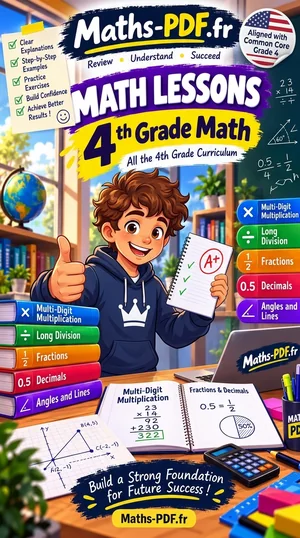
This factors multiples lesson for 4th Grade covers factors, multiples, prime and composite (Common Core 4.OA.B.4), with a free PDF to print.
A factor is a whole number that divides another whole number with no remainder. A multiple is the product of a number and 1, 2, 3, and so on. A prime number has exactly two factors, 1 and itself. A composite number has more than two factors. The number 1 is neither prime nor composite.
Grade 4 · Common Core State Standards: 4.OA.B.4
Key facts in this factors multiples lesson
- A factor pair multiplies to make the number, such as 3 and 8 for 24.
- A number has a limited list of factors but endless multiples.
- A prime number has exactly two factors; a composite number has more than two.
- The number 1 is neither prime nor composite, and 2 is the only even prime.
- Last-digit patterns: 2 for even numbers, 5 for 0 or 5, 10 for 0.
What are factors and multiples?
A factor is a whole number that divides another whole number with nothing left over. A multiple is what you get when you multiply a number by 1, 2, 3, 4, and so on.
Two factors that multiply to make a number. Because \(4 \times 6 = 24\), the numbers 4 and 6 are a factor pair of 24, and 24 is a multiple of both 4 and 6.
How do you find all the factors of a number?
Look for factor pairs, starting with 1 and counting up. Stop when a factor you find is already in your list.
Example: Find all the factors of 24.
- Try 1: \(1 \times 24 = 24\). Write 1 and 24.
- Try 2: \(2 \times 12 = 24\). Write 2 and 12.
- Try 3: \(3 \times 8 = 24\). Write 3 and 8.
- Try 4: \(4 \times 6 = 24\). Write 4 and 6.
- Try 5: 24 does not divide evenly by 5. Next is 6, and 6 is already in the list, so stop.
The factors of 24 are 1, 2, 3, 4, 6, 8, 12 and 24.
How do you list the multiples of a number?
Skip count. The multiples of 6 are 6, 12, 18, 24, 30, and they never stop. A number has only a few factors but endless multiples. The smallest multiple of a number is the number itself.
What are prime and composite numbers?
A prime number has exactly two factors: 1 and itself. A composite number has more than two factors. The number 1 has only one factor, so it is neither.
The number 2 is the only even prime number. Every other even number has 2 as a third factor.
What are the divisibility patterns?
You can check the last digit instead of dividing.
| Divisible by | Pattern | Example |
|---|---|---|
| 2 | Last digit is 0, 2, 4, 6 or 8 | 358 |
| 5 | Last digit is 0 or 5 | 745 |
| 10 | Last digit is 0 | 360 |
Factors multiples lesson: questions and answers
What is the difference between a factor and a multiple?
A factor divides a number evenly and is never larger than the number. A multiple is found by multiplying and is never smaller than the number. For example, 4 is a factor of 12, and 12 is a multiple of 4.
Is 1 a prime number?
No. A prime number needs exactly two different factors, and 1 has only one factor, itself. The number 1 is also not composite, so it is in a group of its own.
How do you know when you have found every factor?
Test 1, 2, 3, and so on, writing each factor pair as you go. When the next factor you find is already on your list, you have them all. For 36 the last pair is \(6 \times 6\).
Why is 2 the only even prime number?
Every even number is divisible by 2. Any even number greater than 2 has the factors 1, 2 and itself, which makes at least three factors, so it is composite. The number 2 has exactly two factors.
How can you tell quickly if a number is a multiple of 5 or 10?
Look at the last digit. A number ending in 0 or 5 is a multiple of 5. A number ending in 0 is a multiple of 10. For example, 745 is a multiple of 5 but not of 10.
How to use this factors multiples lesson
Read the definitions first, then follow the worked method line by line and redo the example on paper without looking. When every step makes sense, move on to the worksheet, then check yourself with the quiz.
Download the factors multiples lesson as a PDF with the button below and keep it with your notes.
Download the factors multiples lesson as a PDF with the button below and keep it with your notes.
All Grade 4 chapters: Grade 4 math.

More 4th Grade math
Lessons
See all



Worksheets
See all





Tests
See all Lines, Rays and Classifying Shapes Test with Point Values
- Multiplying a Fraction by a Whole Number Test with Point Values
- Equivalent Fractions Test with Point Values
- Place Value to One Million Test with Point Values
- Factors, Multiples, Prime and Composite Test with Point Values
- Adding and Subtracting Multi-Digit Numbers Test with Point Values