Algebra 1 Functions and Function Notation Lesson (Free PDF)

This algebra 1 functions lesson for Algebra 1 covers functions and function notation (Common Core F-IF.A.1, F-IF.A.2, F-IF.B.5), with a free PDF to print.
A function is a rule that gives exactly one output for each input. The inputs form the domain and the outputs form the range. A graph is a function if no vertical line crosses it more than once. Function notation f(x) names the output for input x, so f(5) means replace x with 5 and simplify.
Algebra 1 · Common Core State Standards: F-IF.A.1, F-IF.A.2, F-IF.B.5
Key facts in this algebra 1 functions lesson
- A function assigns exactly one output to each input.
- The domain is the set of inputs; the range is the set of outputs.
- The vertical line test: a graph is a function if no vertical line meets it twice.
- f(x) is read “f of x” and means the output when the input is x.
- In context, the domain is limited to the inputs that make sense.
What is a function?
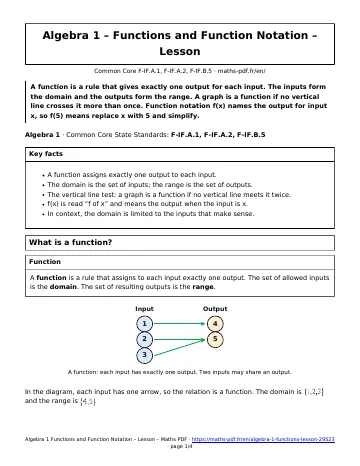
In the diagram, each input has one arrow, so the relation is a function. The domain is \(\{1, 2, 3\}\) and the range is \(\{4, 5\}\).
How do you tell if a graph is a function?
Use the vertical line test. If any vertical line crosses the graph more than once, one input has more than one output, so the graph is not a function.
What does function notation mean?
The notation \(f(x)\) is read “f of x.” It names the output of the function \(f\) when the input is \(x\). It does not mean f times x. If \(f(x) = 2x + 3\), then \(f(5) = 2(5) + 3 = 13\) by replacing every \(x\) with 5.
- Write the function rule.
- Replace the variable with the input, using parentheses around negative numbers.
- Follow the order of operations.
Example: For \(g(x) = x^{2} – 4x\), find \(g(-3)\). Substitute: \(g(-3) = (-3)^{2} – 4(-3)\). Then \(9 + 12 = 21\).
How do you find the domain and range in a real situation?
Ask which inputs make sense. If \(C(g) = 3.25g\) gives the cost in dollars of \(g\) gallons of gas at $3.25 per gallon, and the tank holds 15 gallons, the domain is \(0 \le g \le 15\). The range then runs from \(\$0\) to \(\$48.75\) dollars.
Tip: When a relation is given as a list of ordered pairs, check the inputs. If one input appears twice with different outputs, the relation is not a function. An equation such as \(y = x^{2} + 1\) is a function of x because each x gives exactly one y, but \(x = y^{2}\) is not, since x = 4 gives both y = 2 and y = -2.
Algebra 1 functions lesson: questions and answers
What is the difference between a relation and a function?
A relation is any set of input-output pairs. A function is a relation in which each input has exactly one output.
Can two different inputs have the same output?
Yes. A function only forbids one input having two outputs. The mapping 2 → 5 and 3 → 5 is allowed.
What does f(3) mean?
It is the output of the function f when the input is 3. Replace every x in the rule with 3 and simplify.
How do you find the domain of a graph?
Read the x-values the graph covers from left to right. For a segment from x = -3 to x = 4, the domain is -3 ≤ x ≤ 4.
How do you solve f(x) = 15?
Set the rule equal to 15 and solve for x. If f(x) = 2x + 1, then 2x + 1 = 15 gives x = 7.
How to use this algebra 1 functions lesson
Read the definitions first, then follow the worked method line by line and redo the example on paper without looking. When every step makes sense, move on to the worksheet, then check yourself with the quiz.
Download the algebra 1 functions lesson as a PDF with the button below and keep it with your notes.
All Algebra 1 chapters: Algebra 1 math.
More Algebra 1 math
Lessons
See all





Worksheets
See all





Tests
See all Linear Inequalities in Two Variables and Systems Test with Point Values
- Arithmetic and Geometric Sequences Test with Point Values
- Graphing Quadratic Functions and Transformations Test with Point Values
- Systems of Linear Equations Test with Point Values
- Linear Inequalities in One Variable Test with Point Values
- Adding, Subtracting and Multiplying Polynomials Test with Point Values