Algebra 1 Slope and Rate of Change Worksheet Solutions (PDF)

This slope rate of change answers for Algebra 1 covers slope and rate of change (Common Core F-IF.B.4, F-IF.B.6, F-LE.A.1b), with a free PDF to print.
Algebra 1 · Common Core State Standards: F-IF.B.4, F-IF.B.6, F-LE.A.1b
Slope rate of change answers: exercises 1 to 10
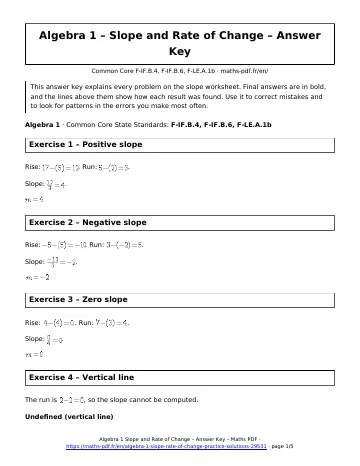
Exercise 1 – Positive slope
Rise: \(17 – (5) = 12\). Run: \(5 – (2) = 3\).
Slope: \(\frac{12}{3} = 4\).
\(m = 4\)
Exercise 2 – Negative slope
Rise: \(-5 – (5) = -10\). Run: \(3 – (-2) = 5\).
Slope: \(\frac{-10}{5} = -2\).
\(m = -2\)
Exercise 3 – Zero slope
Rise: \(4 – (4) = 0\). Run: \(7 – (3) = 4\).
Slope: \(\frac{0}{4} = 0\).
\(m = 0\)
Exercise 4 – Vertical line
The run is \(2 – 2 = 0\), so the slope cannot be computed.
Undefined (vertical line)
Exercise 5 – Slope from a graph
Read two points: \((-2, -3)\) and \((2, 3)\). Rise: \(3 – (-3) = 6\). Run: \(2 – (-2) = 4\).
Slope: \(\frac{6}{4} = \frac{3}{2}\).
\(m = \frac{3}{2}\)
Exercise 6 – Slope from a table
Use two rows: \((0, 5)\) and \((2, 11)\). Rise: 6. Run: 2.
Check another pair: \((4, 17)\) to \((6, 23)\) also gives \(\frac{6}{2}\).
\(m = 3\)
Exercise 7 – Classify the slope
(a) Same y-value: rise 0, slope 0. (b) Same x-value: run 0, undefined. (c) Rise \(-3\), run 3, slope \(-1\). (d) Rise 6, run 6, slope 1.
(a) zero; (b) undefined; (c) negative; (d) positive
Exercise 8 – Ramp
Slope is rise over run: \(\frac{2}{24} = \frac{1}{12}\).
\(\frac{1}{12}\)
Exercise 9 – Missing coordinate
Set up \(\frac{y – 3}{6 – 2} = 2\), so \(\frac{y – 3}{4} = 2\).
Multiply by 4: \(y – 3 = 8\). Add 3.
\(y = 11\)
Exercise 10 – Is it linear?
Rates between consecutive rows: \(\frac{7 – 3}{1} = 4\), \(\frac{12 – 7}{1} = 5\), \(\frac{18 – 12}{1} = 6\).
The rate is not constant.
Not linear
Exercises 11 and up
Exercise 11 – Fraction coordinates
Rise: \(5 – 1 = 4\). Run: \(\frac{3}{2} – \left(-\frac{1}{2}\right) = 2\).
Slope: \(\frac{4}{2} = 2\).
\(m = 2\)
Exercise 12 – Savings rate
\(\frac{95 – 50}{5 – 2} = \frac{45}{3} = 15\).
$15 per week
Exercise 13 – Road trip graph
Use \((2, 110)\) and \((4, 220)\): \(\frac{220 – 110}{4 – 2} = \frac{110}{2} = 55\).
For every hour, the car travels 55 more miles.
55 miles per hour
Exercise 14 – Meaning of the intercept
The slope 8 means the cost increases by $8 for each additional hour.
The y-intercept 15 is the cost when \(x = 0\): a $15 entry fee.
$8 per hour; $15 entry fee
Exercise 15 – Average rate of change
\(h(2) = 2(4) – 2 = 6\) and \(h(5) = 2(25) – 5 = 45\).
\(\frac{45 – 6}{5 – 2} = \frac{39}{3} = 13\).
13 inches per foot
Exercise 16 – Falling temperature
\(\frac{44 – 68}{6 – 2} = \frac{-24}{4} = -6\).
The temperature fell about 6°F each hour.
\(-6\) °F per hour
Exercise 17 – Plant growth
From week 1 to week 4: \(\frac{9 – 3}{4 – 1} = \frac{6}{3} = 2\).
The plant grows 2 inches each week, and every pair of consecutive rows agrees.
2 inches per week
Exercise 18 – Compare speeds
Car A: \(\frac{150}{3} = 50\) mph. Car B: \(\frac{220}{5} = 44\) mph.
Car A, 50 mph versus 44 mph
Exercise 19 – Hiker's trip
0 to 1: \(\frac{3 – 0}{1 – 0} = 3\) mi/h (walking away). 1 to 2: \(\frac{3 – 3}{1} = 0\) (resting). 2 to 3: \(\frac{0 – 3}{1} = -3\) mi/h (walking back).
3, 0, and -3 miles per hour
Exercise 20 – Projectile
\(h(0) = 0\), \(h(2) = 64\): \(\frac{64 – 0}{2 – 0} = 32\) ft/s.
\(h(1) = 48\), \(h(3) = 48\): \(\frac{48 – 48}{3 – 1} = 0\) ft/s. The ball rises and falls back to the same height, so the average change is 0.
32 ft/s; 0 ft/s
Exercise 21 – Not constant growth
\(\frac{4 – 2}{1} = 2\), \(\frac{8 – 4}{1} = 4\), \(\frac{16 – 8}{1} = 8\).
The rate doubles each step, so it is not constant and the function is not linear.
2, 4, 8; not constant
Key facts behind this slope rate of change answers
- Slope = rise ÷ run = (y₂ – y₁)/(x₂ – x₁).
- Positive slope rises, negative slope falls, horizontal lines have slope 0, vertical lines are undefined.
- In a context, slope is a rate of change with units like dollars per hour.
- A linear function has the same rate of change between any two points.
- Average rate of change over [a, b] is (f(b) – f(a))/(b – a).
How to use this slope rate of change answers
Cover each solution, solve the exercise again, then uncover it and compare every line. If your answer differs, find the first step that changed and redo the exercise from there.
Download the slope rate of change answers as a PDF with the button below and keep it with your notes.
Download the slope rate of change answers as a PDF with the button below and keep it with your notes.
All Algebra 1 chapters: Algebra 1 math.
More Algebra 1 math
Lessons
See all





Worksheets
See all





Tests
See all Factoring Polynomials Test with Point Values
- Solving Linear Equations in One Variable Test with Point Values
- Exponent Rules and Radicals Test with Point Values
- Literal Equations and Formulas Test with Point Values
- Slope and Rate of Change Test with Point Values
- Graphing Quadratic Functions and Transformations Test with Point Values