Algebra 1 Adding, Subtracting and Multiplying Polynomials Lesson (Free PDF)

This algebra 1 polynomial operations lesson for Algebra 1 covers adding, subtracting and multiplying polynomials (Common Core A-APR.A.1), with a free PDF to print.
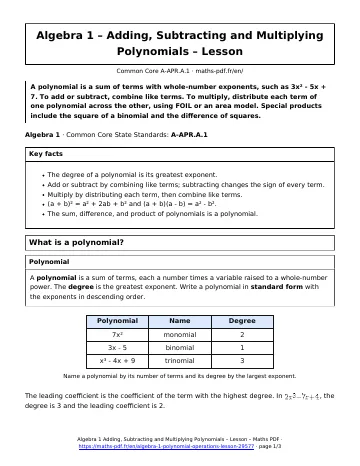
A polynomial is a sum of terms with whole-number exponents, such as 3x² – 5x + 7. To add or subtract, combine like terms. To multiply, distribute each term of one polynomial across the other, using FOIL or an area model. Special products include the square of a binomial and the difference of squares.
Algebra 1 · Common Core State Standards: A-APR.A.1
Key facts in this algebra 1 polynomial operations lesson
- The degree of a polynomial is its greatest exponent.
- Add or subtract by combining like terms; subtracting changes the sign of every term.
- Multiply by distributing each term, then combine like terms.
- (a + b)² = a² + 2ab + b² and (a + b)(a – b) = a² – b².
- The sum, difference, and product of polynomials is a polynomial.
What is a polynomial?
The leading coefficient is the coefficient of the term with the highest degree. In \(2x^{3} – 7x + 4\), the degree is 3 and the leading coefficient is 2.
How do you add and subtract polynomials?
Combine like terms, which have the same variable and exponent. To subtract, change the sign of every term in the second polynomial first.
Example: Subtract \((5x^{2} + 3x – 2) – (2x^{2} – x + 6)\). Distribute the negative: \(5x^{2} + 3x – 2 – 2x^{2} + x – 6\). Combine: \(3x^{2} + 4x – 8\).
How do you multiply polynomials?
Multiply every term of one polynomial by every term of the other, then combine like terms. For two binomials, you can use FOIL (First, Outer, Inner, Last) or an area model.
- Multiply each term in the first factor by each term in the second.
- Write all the partial products.
- Combine like terms and write in standard form.
What are the special products?
Two patterns save time. The square of a binomial is \((a + b)^{2} = a^{2} + 2ab + b^{2}\). The product of a sum and a difference is \((a + b)(a – b) = a^{2} – b^{2}\).
The middle term of a square is twice the product of the two terms, so \((x + 5)^{2} = x^{2} + 2(x)(5) + 25\). Note that \((x + 5)^{2}\) is not equal to \(x^{2} + 25\).
Why are polynomials closed under these operations?
The sum, difference, and product of two polynomials is always another polynomial, just as the sum and product of integers is an integer. Division does not always give a polynomial.
Algebra 1 polynomial operations lesson: questions and answers
What is the degree of a polynomial?
It is the highest exponent of the variable. The polynomial 2x³ – 7x + 4 has degree 3.
What is FOIL?
FOIL is a memory aid for multiplying two binomials: multiply the First terms, Outer terms, Inner terms, and Last terms, then add the products.
How do you subtract polynomials?
Distribute the negative sign to every term in the second polynomial, then combine like terms.
Why is (x + 5)² not x² + 25?
Squaring a binomial means multiplying it by itself, which creates the middle term 2(5)x = 10x. So (x + 5)² = x² + 10x + 25.
What does closed mean for polynomials?
It means adding, subtracting, or multiplying polynomials always gives another polynomial, just as adding integers always gives an integer.
How to use this algebra 1 polynomial operations lesson
Read the definitions first, then follow the worked method line by line and redo the example on paper without looking. When every step makes sense, move on to the worksheet, then check yourself with the quiz.
Download the algebra 1 polynomial operations lesson as a PDF with the button below and keep it with your notes.
All Algebra 1 chapters: Algebra 1 math.
More Algebra 1 math
Lessons
See all




Worksheets
See all




Tests
See all Writing Linear Equations and Functions Test with Point Values
- Solving Linear Equations in One Variable Test with Point Values
- Arithmetic and Geometric Sequences Test with Point Values
- Solving Quadratic Equations Test with Point Values
- Systems of Linear Equations Test with Point Values
- Adding, Subtracting and Multiplying Polynomials Test with Point Values