Algebra 1 Exponential Functions and Growth Worksheet Solutions (PDF)

This algebra 1 exponential functions answers for Algebra 1 covers exponential functions and growth (Common Core F-LE.A.1, F-LE.A.2, F-LE.A.3, F-IF.C.7e, F-IF.C.8b), with a free PDF to print.
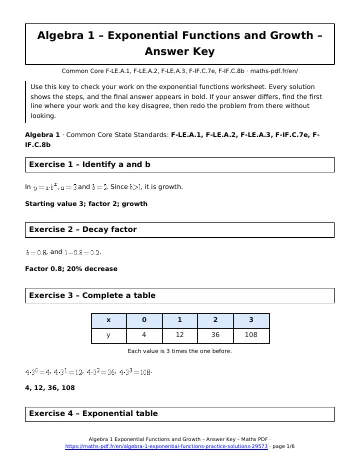
Algebra 1 · Common Core State Standards: F-LE.A.1, F-LE.A.2, F-LE.A.3, F-IF.C.7e, F-IF.C.8b
Algebra 1 exponential functions answers: exercises 1 to 10
Exercise 1 – Identify a and b
In \(y = a \cdot b^{x}\), \(a = 3\) and \(b = 2\). Since \(b > 1\), it is growth.
Starting value 3; factor 2; growth
Exercise 2 – Decay factor
\(b = 0.8\), and \(1 – 0.8 = 0.2\).
Factor 0.8; 20% decrease
Exercise 3 – Complete a table
\(4 \cdot 3^{0} = 4\), \(4 \cdot 3^{1} = 12\), \(4 \cdot 3^{2} = 36\), \(4 \cdot 3^{3} = 108\).
4, 12, 36, 108
Exercise 4 – Exponential table
Ratios: \(\frac{6}{2} = 3\), \(\frac{18}{6} = 3\), \(\frac{54}{18} = 3\).
Exponential with ratio 3
Exercise 5 – Linear table
Differences: \(9 – 5 = 4\), \(13 – 9 = 4\), \(17 – 13 = 4\). The ratios are not constant (\(\frac{9}{5}\), \(\frac{13}{9}\)).
Linear, adding 4 each step
Exercise 6 – Write from a table
The starting value is \(a = 5\) and each step doubles: \(b = 2\).
\(y = 5 \cdot 2^{x}\)
Exercise 7 – Graph a growth function
Compute \(2^{-2} = \frac{1}{4}\), \(2^{-1} = \frac{1}{2}\), \(2^{0} = 1\), \(2^{1} = 2\), \(2^{2} = 4\), \(2^{3} = 8\).
Plot the points and draw a smooth curve that approaches the x-axis on the left.
Curve through (0, 1), (1, 2), (2, 4), (3, 8)
Exercise 8 – Graph a decay function
Values: \(4, 2, 1, \frac{1}{2}, \frac{1}{4}, \frac{1}{8}\).
The curve falls from left to right and gets close to the x-axis.
Decreasing curve through (0, 1)
Exercise 9 – Rate to factor
(a) \(1 + 0.12 = 1.12\). (b) \(1 – 0.08 = 0.92\).
1.12 and 0.92
Exercise 10 – Evaluate with a calculator
\(1.05^{10} \approx 1.62889\).
\(100(1.62889) \approx 162.89\).
162.89
Exercises 11 and up
Exercise 11 – Intercept and asymptote
At \(x = 0\), \(y = 1\). Any real number can be an exponent, and the output is always positive. As \(x\) decreases, \(2^{x}\) gets closer to 0.
(0, 1); all real numbers; \(y > 0\); approaches the x-axis
Exercise 12 – Solve an exponential equation
\(32 = 2^{5}\), so \(x = 5\).
\(81 = 3^{4}\), so \(x = 4\).
\(x = 5\) and \(x = 4\)
Exercise 13 – Linear versus exponential
\(f(10) = 10(10) + 5 = 105\) and \(g(10) = 2^{10} = 1024\).
f(10) = 105; g(10) = 1024; g is larger
Exercise 14 – Domain and range
Any real number can be an exponent, so the domain is all real numbers.
The output is always positive, so the range is \(y > 0\).
Domain: all real numbers; range: \(y > 0\)
Exercise 15 – Rewrite the base
\(2^{3t} = (2^{3})^{t} = 8^{t}\).
\(y = 8^{t}\); factor 8
Exercise 16 – Town population
Growth factor \(1 + 0.04 = 1.04\): \(P = 20000(1.04)^{t}\).
\(P = 20000(1.04)^{5} \approx 20000(1.21665) \approx 24333\).
\(P = 20000(1.04)^{t}\); about 24,333 people
Exercise 17 – Car value
Decay factor \(1 – 0.15 = 0.85\): \(V = 24000(0.85)^{t}\).
\(V = 24000(0.85)^{3} = 24000(0.614125) = 14739\).
\(V = 24000(0.85)^{t}\); $14,739
Exercise 18 – Compound interest
\(A = 1500(1.06)^{8}\).
\(1.06^{8} \approx 1.593848\), so \(A \approx 1500(1.593848) = 2390.77\).
$2,390.77
Exercise 19 – Medicine half-life
Substitute \(t = 18\): \(A = 80\left(\frac{1}{2}\right)^{3}\).
\(= 80 \cdot \frac{1}{8} = 10\).
10 mg
Exercise 20 – Viral video
Day 2: \(50 \cdot 3^{2} = 450\) and \(50 + 200(2) = 450\) (equal).
Day 3: \(50 \cdot 3^{3} = 1350\) and \(50 + 200(3) = 650\).
From day 3 on, Video A is ahead and the gap grows.
Equal on day 2; A is larger from day 3
Exercise 21 – Doubling time
Solve \(2000 \cdot 2^{t/12} = 8000\): \(2^{t/12} = 4 = 2^{2}\).
\(\frac{t}{12} = 2\), so \(t = 24\).
24 years
Key facts behind this algebra 1 exponential functions answers
- Exponential form: f(x) = a·bˣ with a the starting value and b the factor.
- Growth: b = 1 + r. Decay: b = 1 – r.
- Linear functions add a constant; exponential functions multiply by a constant.
- Compound interest: A = P(1 + r)ᵗ.
- An exponential function eventually exceeds any linear function.
How to use this algebra 1 exponential functions answers
Cover each solution, solve the exercise again, then uncover it and compare every line. If your answer differs, find the first step that changed and redo the exercise from there.
Download the algebra 1 exponential functions answers as a PDF with the button below and keep it with your notes.
Download the algebra 1 exponential functions answers as a PDF with the button below and keep it with your notes.
All Algebra 1 chapters: Algebra 1 math.
Print this page
Download PDFDownload the Algebra 1 Exponential Functions and Growth Worksheet Solutions (PDF, 105 KB)More Algebra 1 math
Lessons
See all





Worksheets
See all Linear Inequalities in Two Variables and Systems Worksheet
- Graphing Quadratic Functions and Transformations Worksheet
- Exponent Rules and Radicals Worksheet
- Linear Inequalities in One Variable Worksheet
- Writing Linear Equations and Functions Worksheet
- Scatter Plots, Lines of Fit and Two-Way Tables Worksheet






Tests
See all- Solving Quadratic Equations Test with Point Values
- Adding, Subtracting and Multiplying Polynomials Test with Point Values
- Slope and Rate of Change Test with Point Values
- Writing Linear Equations and Functions Test with Point Values
- Solving Linear Equations in One Variable Test with Point Values
- Data Distributions and Summary Statistics Test with Point Values