Algebra 1 Solving Linear Equations in One Variable Lesson (Free PDF)
This algebra 1 linear equations lesson for Algebra 1 covers solving linear equations in one variable (Common Core A-REI.A.1, A-REI.B.3, A-CED.A.1), with a free PDF to print.
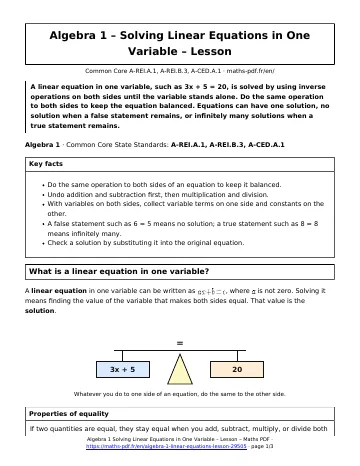
A linear equation in one variable, such as 3x + 5 = 20, is solved by using inverse operations on both sides until the variable stands alone. Do the same operation to both sides to keep the equation balanced. Equations can have one solution, no solution when a false statement remains, or infinitely many solutions when a true statement remains.
Algebra 1 · Common Core State Standards: A-REI.A.1, A-REI.B.3, A-CED.A.1
Key facts in this algebra 1 linear equations lesson
- Do the same operation to both sides of an equation to keep it balanced.
- Undo addition and subtraction first, then multiplication and division.
- With variables on both sides, collect variable terms on one side and constants on the other.
- A false statement such as 6 = 5 means no solution; a true statement such as 8 = 8 means infinitely many.
- Check a solution by substituting it into the original equation.
What is a linear equation in one variable?
A linear equation in one variable can be written as \(ax + b = c\), where \(a\) is not zero. Solving it means finding the value of the variable that makes both sides equal. That value is the solution.
How do you solve a two-step equation?
Undo the operations in the reverse order of the order of operations. First undo addition or subtraction, then undo multiplication or division.
How do you solve an equation with variables on both sides?
- Distribute and combine like terms on each side.
- Move the variable terms to one side by adding or subtracting.
- Move the constants to the other side.
- Divide by the coefficient of the variable.
- Check by substituting the solution into the original equation.
Example: Solve \(5x – 3 = 2x + 12\). Subtract \(2x\) from both sides: \(3x – 3 = 12\). Add 3: \(3x = 15\). Divide by 3: \(x = 5\). Check: \(5(5) – 3 = 22 \text{ and } 2(5) + 12 = 22\), so the solution is correct.
Can an equation have no solution or infinitely many?
Yes. If the variable terms cancel and a false statement remains, such as \(6 = 5\), there is no solution. If a true statement remains, such as \(8 = 8\), every real number is a solution.
How do you write an equation from a word problem?
Define the variable, translate the words into an expression for each side, and set the sides equal. A savings plan that starts with $40 and adds $15 each week reaches $190 when \(40 + 15w = 190\).
Algebra 1 linear equations lesson: questions and answers
What does it mean to solve an equation?
Solving means finding every value of the variable that makes the equation true. For 2x + 1 = 9 the only solution is x = 4, because 2(4) + 1 = 9.
Why do you do the same thing to both sides?
An equation says two quantities are equal. Applying the same operation to both keeps them equal, like keeping a balance scale level.
How do you solve an equation with a fraction coefficient?
Multiply both sides by the reciprocal of the fraction. For (2/3)x = 12, multiply both sides by 3/2 to get x = 18.
What does it mean when the variable disappears?
If a false statement such as 6 = 5 remains, there is no solution. If a true statement such as 8 = 8 remains, every real number is a solution.
How can you check your answer?
Substitute the solution into the original equation and simplify both sides. If the two sides are equal, the solution is correct.
How to use this algebra 1 linear equations lesson
Read the definitions first, then follow the worked method line by line and redo the example on paper without looking. When every step makes sense, move on to the worksheet, then check yourself with the quiz.
Download the algebra 1 linear equations lesson as a PDF with the button below and keep it with your notes.
All Algebra 1 chapters: Algebra 1 math.
More Algebra 1 math
Lessons
See all




Worksheets
See all




Tests
See all Solving Linear Equations in One Variable Test with Point Values
- Exponent Rules and Radicals Test with Point Values
- Graphing Linear Equations Test with Point Values
- Adding, Subtracting and Multiplying Polynomials Test with Point Values
- Solving Quadratic Equations Test with Point Values
- Writing Linear Equations and Functions Test with Point Values