Algebra 1 Exponential Functions and Growth Lesson (Free PDF)

This algebra 1 exponential functions lesson for Algebra 1 covers exponential functions and growth (Common Core F-LE.A.1, F-LE.A.2, F-LE.A.3, F-IF.C.7e, F-IF.C.8b), with a free PDF to print.
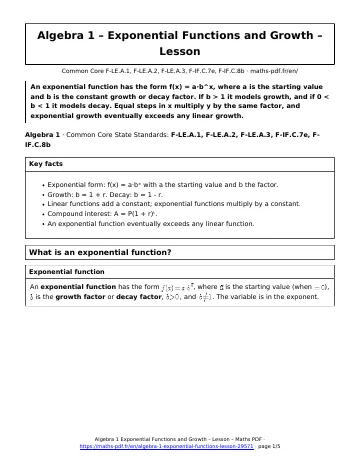
An exponential function has the form f(x) = a·b^x, where a is the starting value and b is the constant growth or decay factor. If b > 1 it models growth, and if 0 < b < 1 it models decay. Equal steps in x multiply y by the same factor, and exponential growth eventually exceeds any linear growth.
Algebra 1 · Common Core State Standards: F-LE.A.1, F-LE.A.2, F-LE.A.3, F-IF.C.7e, F-IF.C.8b
Key facts in this algebra 1 exponential functions lesson
- Exponential form: f(x) = a·bˣ with a the starting value and b the factor.
- Growth: b = 1 + r. Decay: b = 1 – r.
- Linear functions add a constant; exponential functions multiply by a constant.
- Compound interest: A = P(1 + r)ᵗ.
- An exponential function eventually exceeds any linear function.
What is an exponential function?
When \(b > 1\), the function grows. When \(0 < b < 1\), it decays. The graph has a y-intercept at \((0, a)\) and approaches the x-axis without touching it. The domain is all real numbers and the range is \(y > 0\) when \(a > 0\).
How do you tell linear from exponential?
Look at the table. If equal steps in \(x\) add the same amount to \(y\), the function is linear. If they multiply \(y\) by the same factor, it is exponential.
How do growth and decay rates become factors?
A growth rate \(r\) gives the factor \(b = 1 + r\). A decay rate \(r\) gives \(b = 1 – r\). A population of 20,000 growing 4% per year is modeled by \(P = 20000(1.04)^{t}\). A car losing 15% of its value each year has \(V = 24000(0.85)^{t}\).
How does compound interest work?
With principal \(P\), annual rate \(r\), and \(t\) years, the amount is \(A = P(1 + r)^{t}\). For $1,500 at 6% for 8 years, \(A = 1500(1.06)^{8} \approx 2390.77\). Half-life problems use the factor \(\frac{1}{2}\), because the amount halves at each period.
- Identify the starting value \(a\).
- Find the factor \(b\) from the rate or the table ratio.
- Write \(f(x) = a \cdot b^{x}\) and evaluate at the needed value of \(x\).
Why does exponential growth beat linear growth?
A linear function adds a fixed amount each step. An exponential function multiplies, so the added amount keeps getting bigger. Sooner or later it passes every linear function.
Tip: To choose between a linear and an exponential model, ask whether the quantity changes by a fixed amount or by a fixed percent. A gym fee that rises $5 each month is linear. A savings account that grows 5% each month is exponential.
Algebra 1 exponential functions lesson: questions and answers
What is the difference between linear and exponential growth?
Linear growth adds the same amount each step. Exponential growth multiplies by the same factor each step, so the amount added keeps getting larger.
How do you find the growth factor from a percent?
Add the rate to 1 for growth, so 4% growth gives 1.04. Subtract it from 1 for decay, so 15% decay gives 0.85.
What does the number a mean in a·b^x?
It is the starting value, the output when x = 0. In y = 3·2ˣ the graph crosses the y-axis at (0, 3).
Does an exponential graph ever touch the x-axis?
No. For a > 0 the output is always positive, and the graph gets closer to the x-axis without touching it.
How do you solve an equation like 2^x = 32?
Write both sides with the same base: 32 = 2⁵, so 2ˣ = 2⁵ and x = 5.
How to use this algebra 1 exponential functions lesson
Read the definitions first, then follow the worked method line by line and redo the example on paper without looking. When every step makes sense, move on to the worksheet, then check yourself with the quiz.
Download the algebra 1 exponential functions lesson as a PDF with the button below and keep it with your notes.
All Algebra 1 chapters: Algebra 1 math.
More Algebra 1 math
Lessons
See all





Worksheets
See all





Tests
See all Graphing Linear Equations Test with Point Values
- Solving Linear Equations in One Variable Test with Point Values
- Systems of Linear Equations Test with Point Values
- Data Distributions and Summary Statistics Test with Point Values
- Linear Inequalities in One Variable Test with Point Values
- Scatter Plots, Lines of Fit and Two-Way Tables Test with Point Values