Algebra 1 Linear Inequalities in Two Variables and Systems Worksheet Solutions (PDF)

This linear inequalities two variables answers for Algebra 1 covers linear inequalities in two variables and systems (Common Core A-REI.D.12, A-CED.A.3), with a free PDF to print.
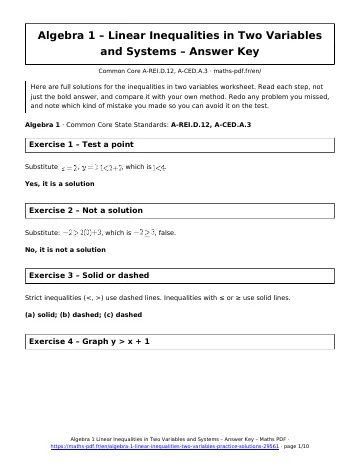
Algebra 1 · Common Core State Standards: A-REI.D.12, A-CED.A.3
Linear inequalities two variables answers: exercises 1 to 10
Exercise 1 – Test a point
Substitute \(x = 2\), \(y = 1\): \(1 < 2 + 2\), which is \(1 < 4\).
Yes, it is a solution
Exercise 2 – Not a solution
Substitute: \(-2 \ge 2(0) + 3\), which is \(-2 \ge 3\), false.
No, it is not a solution
Exercise 3 – Solid or dashed
Strict inequalities (<, >) use dashed lines. Inequalities with ≤ or ≥ use solid lines.
(a) solid; (b) dashed; (c) dashed
Exercise 4 – Graph y > x + 1
Boundary \(y = x + 1\) is dashed. Test \((0, 0)\): \(0 > 1\) is false, so shade the side without the origin, above the line.
Dashed line through (0, 1) with slope 1; shade above
Exercise 5 – Graph with a solid line
Intercepts: \((1, 0)\) and \((0, 4)\). The line is solid. Test \((0, 0)\): \(0 \ge 4\) is false.
So shade the side that does not contain the origin.
Solid line through (1, 0) and (0, 4); shade above the line, away from the origin
Exercise 6 – Vertical boundary
The boundary is the vertical line \(x = 2\), solid. Solutions have \(x\) at least 2, so shade to the right.
Solid vertical line at x = 2; shade right
Exercise 7 – Horizontal boundary
The boundary \(y = 3\) is dashed. Solutions have \(y\) less than 3, so shade below.
Dashed horizontal line at y = 3; shade below
Exercise 8 – Write from a graph
The boundary passes through \((0, -2)\) with slope 1, so it is \(y = x – 2\). It is dashed, and the shading is above.
\(y > x – 2\)
Exercise 9 – Standard form inequality
Intercepts: \((6, 0)\) and \((0, 4)\). Draw a solid line. Test \((0, 0)\): \(0 \le 12\) is true, so shade the side with the origin.
Solid line through (6, 0) and (0, 4); shade toward the origin
Exercise 10 – Negative coefficient
Solve for \(y\): \(-y > -3x + 3\), so \(y < 3x - 3\) (reverse the symbol).
Dashed line through \((0, -3)\) with slope 3. Shade below.
Dashed line \(y = 3x – 3\); shade below
Exercises 11 and up
Exercise 11 – Which points work?
\((0, 0): 0 \le 4\) true. \((3, 1): 3 + 2 = 5 \le 4\) false. \((-2, 5): -2 + 10 = 8 \le 4\) false.
\((0, 0)\) only
Exercise 12 – System of two inequalities
Graph the solid line \(y = \frac{1}{2}x – 2\) and shade above. Graph the dashed line \(y = -x + 4\) and shade below. The solution is the overlap.
The lines meet where \(\frac{1}{2}x – 2 = -x + 4\), so \(1.5x = 6\), at \(x = 4\), \(y = 0\).
Overlap region with corner (4, 0)
Exercise 13 – Triangular region
The region is the triangle with corners \((0, 0)\), \((5, 0)\), \((0, 5)\).
Check \((2, 2)\): \(2 \ge 0\), \(2 \ge 0\), \(2 + 2 = 4 \le 5\), all true.
Triangle with corners (0, 0), (5, 0), (0, 5); yes
Exercise 14 – Check a system
First: \(2 > 3 – 2\), which is \(2 > 1\), true. Second: \(2 \le 2(3)\), which is \(2 \le 6\), true.
Yes
Exercise 15 – Write a system from a graph
The solid boundary through \((0, -3)\) with slope 1 has shading above: \(y \ge x – 3\).
The dashed horizontal boundary has shading below: \(y < 2\).
\(y \ge x – 3\) and \(y < 2\)
Exercise 16 – Lunch budget
Total cost: \(5x + 3y \le 30\).
For \((3, 5)\): \(5(3) + 3(5) = 30 \le 30\), which is true.
\(5x + 3y \le 30\); yes, exactly $30
Exercise 17 – Two jobs
Hours: \(x + y \le 12\). Pay: \(10x + 8y \ge 90\).
\((6, 5)\): \(11 \le 12\) and \(60 + 40 = 100 \ge 90\), so yes.
\((4, 4)\): \(40 + 32 = 72 \ge 90\) is false.
(6, 5) works; (4, 4) does not
Exercise 18 – Whole-number combinations
For each \(x\) from 0 to 6, count the whole numbers \(y\) with \(3y \le 12 – 2x\).
- \(x = 0\): \(y = 0, 1, 2, 3, 4\) gives 5
- \(x = 1\): \(y \le 3.33\) gives 4
- \(x = 2\): \(y \le 2.67\) gives 3
- \(x = 3\): \(y \le 2\) gives 3
- \(x = 4\): \(y \le 1.33\) gives 2
- \(x = 5\): \(y \le 0.67\) gives 1
- \(x = 6\): \(y = 0\) gives 1
Total: \(5 + 4 + 3 + 3 + 2 + 1 + 1 = 19\).
19 pairs
Exercise 19 – Truck load
\(25x + 40y \le 280\).
\((4, 4)\): \(100 + 160 = 260 \le 280\), yes.
\((6, 4)\): \(150 + 160 = 310 \le 280\) is false, no.
(4, 4) yes; (6, 4) no
Exercise 20 – School store
\((6, 4)\): \(6 + 4 = 10 \ge 10\) true; \(6 + 12 = 18 \le 24\) true. Yes.
\((2, 8)\): \(2 + 8 = 10 \ge 10\) true; \(2 + 24 = 26 \le 24\) false. No.
(6, 4) yes; (2, 8) no
Exercise 21 – Corner of the region
Subtract the first equation from the second: \(2n = 14\), so \(n = 7\).
Then \(p = 10 – 7 = 3\).
\((3, 7)\): 3 pencils and 7 notebooks
Key facts behind this linear inequalities two variables answers
- A solution of an inequality in two variables is an ordered pair that makes it true.
- The boundary line is solid for ≤ and ≥, and dashed for < and >.
- Test a point not on the line to decide which side to shade.
- For y > mx + b, shade above; for y < mx + b, shade below.
- The solution of a system is the overlap of the shaded regions.
How to use this linear inequalities two variables answers
Cover each solution, solve the exercise again, then uncover it and compare every line. If your answer differs, find the first step that changed and redo the exercise from there.
Download the linear inequalities two variables answers as a PDF with the button below and keep it with your notes.
Download the linear inequalities two variables answers as a PDF with the button below and keep it with your notes.
Download the linear inequalities two variables answers as a PDF with the button below and keep it with your notes.
All Algebra 1 chapters: Algebra 1 math.
Free printable PDF
Algebra 1 Linear Inequalities in Two Variables and Systems Worksheet Solutions
Download PDFMore Algebra 1 math
Lessons
See all





Worksheets
See all





Tests
See all Structure of Algebraic Expressions Test with Point Values
- Graphing Quadratic Functions and Transformations Test with Point Values
- Exponential Functions and Growth Test with Point Values
- Solving Quadratic Equations Test with Point Values
- Systems of Linear Equations Test with Point Values
- Slope and Rate of Change Test with Point Values