Algebra 1 Factoring Polynomials Worksheet Solutions (PDF)

This factoring practice solutions for Algebra 1 covers factoring polynomials (Common Core A-SSE.A.2, A-SSE.B.3a, A-APR.B.3), with a free PDF to print.
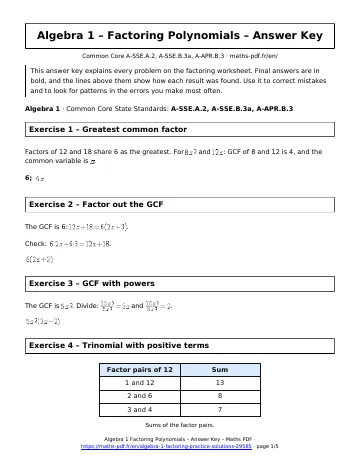
Algebra 1 · Common Core State Standards: A-SSE.A.2, A-SSE.B.3a, A-APR.B.3
Factoring practice solutions: exercises 1 to 10
Exercise 1 – Greatest common factor
Factors of 12 and 18 share 6 as the greatest. For \(8x^{2}\) and \(12x\): GCF of 8 and 12 is 4, and the common variable is \(x\).
6; \(4x\)
Exercise 2 – Factor out the GCF
The GCF is 6: \(12x + 18 = 6(2x + 3)\).
Check: \(6 \cdot 2x + 6 \cdot 3 = 12x + 18\).
\(6(2x + 3)\)
Exercise 3 – GCF with powers
The GCF is \(5x^{2}\). Divide: \(\frac{15x^{3}}{5x^{2}} = 3x\) and \(\frac{10x^{2}}{5x^{2}} = 2\).
\(5x^{2}(3x – 2)\)
Exercise 4 – Trinomial with positive terms
The numbers 3 and 4 have product 12 and sum 7.
\((x + 3)(x + 4)\)
Exercise 5 – Another positive trinomial
Find two numbers with product 21 and sum 10: 3 and 7.
\((x + 3)(x + 7)\)
Exercise 6 – Negative constant
Product \(-12\) and sum \(-1\): \(-4\) and 3.
\((x – 4)(x + 3)\)
Exercise 7 – Negative middle term
Product 15 and sum \(-8\): \(-3\) and \(-5\).
\((x – 3)(x – 5)\)
Exercise 8 – Mixed signs
Product \(-21\) and sum 4: 7 and \(-3\).
\((x + 7)(x – 3)\)
Exercise 9 – Trinomial with a equal to 3
Multiply \(3 \cdot 6 = 18\). The numbers 2 and 9 add to 11.
Split: \(3x^{2} + 2x + 9x + 6\). Group: \(x(3x + 2) + 3(3x + 2)\).
\((3x + 2)(x + 3)\)
Exercise 10 – Trinomial with a equal to 2
Multiply \(2 \cdot 10 = 20\). Find two numbers with product 20 and sum \(-9\): \(-4\) and \(-5\).
Split: \(2x^{2} – 4x – 5x + 10 = 2x(x – 2) – 5(x – 2)\).
\((2x – 5)(x – 2)\)
Exercises 11 and up
Exercise 11 – Harder trinomial
Multiply \(6 \cdot (-2) = -12\). The numbers 4 and \(-3\) add to 1.
Split: \(6x^{2} + 4x – 3x – 2 = 2x(3x + 2) – 1(3x + 2)\).
\((3x + 2)(2x – 1)\)
Exercise 12 – Difference of squares
\(x^{2} – 49 = x^{2} – 7^{2}\).
\((x – 7)(x + 7)\)
Exercise 13 – Difference of squares with a coefficient
\(4x^{2} = (2x)^{2}\) and \(25 = 5^{2}\).
\((2x – 5)(2x + 5)\)
Exercise 14 – Perfect square trinomials
\(x^{2} + 2(5)x + 5^{2} = (x + 5)^{2}\). \((3x)^{2} – 2(3x)(2) + 2^{2} = (3x – 2)^{2}\).
\((x + 5)^{2}\) and \((3x – 2)^{2}\)
Exercise 15 – Factor completely
Factor out the GCF 2: \(2(x^{2} – 9)\).
Then \(x^{2} – 9\) is a difference of squares.
\(2(x – 3)(x + 3)\)
Exercise 16 – Rectangle dimensions
Product 14 and sum 9: 2 and 7.
\(x^{2} + 9x + 14 = (x + 2)(x + 7)\).
Width \(x + 2\) feet and length \(x + 7\) feet
Exercise 17 – Ball in the air
The GCF is \(-16t\): \(h(t) = -16t(t – 4)\).
Set each factor to 0: \(t = 0\) or \(t = 4\).
\(-16t(t – 4)\); the ball lands after 4 seconds
Exercise 18 – Zeros of a function
Product \(-14\) and sum \(-5\): \(-7\) and 2, so \(f(x) = (x – 7)(x + 2)\).
Set each factor to 0.
\(x = 7\) and \(x = -2\)
Exercise 19 – Garden dimensions
The GCF is \(3x\): \(3x(x + 4)\).
Since area = length × width and the width is \(3x\), the length is \(x + 4\).
Length \(x + 4\) yards
Exercise 20 – Check by substitution
\(9^{2} – 16 = 81 – 16 = 65\) and \((9 – 4)(9 + 4) = 5 \cdot 13 = 65\).
Both equal 65
Exercise 21 – Mental math
\(51^{2} – 49^{2} = (51 – 49)(51 + 49)\).
\(= 2 \cdot 100 = 200\).
200
Key facts behind this factoring practice solutions
- Factor out the greatest common factor (GCF) first.
- For x² + bx + c, find two numbers with product c and sum b.
- Difference of squares: a² – b² = (a + b)(a – b).
- Perfect square trinomials: a² ± 2ab + b² = (a ± b)².
- If a product is zero, one of its factors is zero, so factored form shows the zeros.
How to use this factoring practice solutions
Cover each solution, solve the exercise again, then uncover it and compare every line. If your answer differs, find the first step that changed and redo the exercise from there.
Download the factoring practice solutions as a PDF with the button below and keep it with your notes.
All Algebra 1 chapters: Algebra 1 math.
Print this page
Download PDFDownload the Algebra 1 Factoring Polynomials Worksheet Solutions (PDF, 101 KB)More Algebra 1 math
Lessons
See all



Worksheets
See all


Tests
See all Graphing Linear Equations Test with Point Values
- Arithmetic and Geometric Sequences Test with Point Values
- Exponential Functions and Growth Test with Point Values
- Graphing Quadratic Functions and Transformations Test with Point Values
- Systems of Linear Equations Test with Point Values
- Functions and Function Notation Test with Point Values