Algebra 1 Solving Quadratic Equations Worksheet Solutions (PDF)

This algebra 1 quadratic equations answers for Algebra 1 covers solving quadratic equations (Common Core A-REI.B.4a, A-REI.B.4b, A-SSE.B.3a, A-CED.A.1), with a free PDF to print.
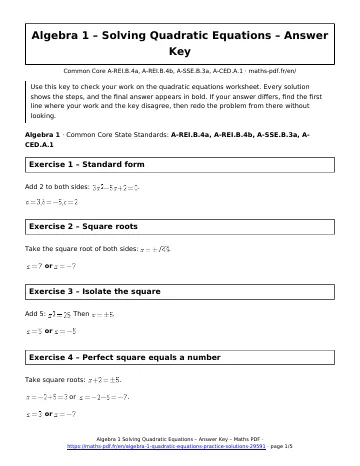
Algebra 1 · Common Core State Standards: A-REI.B.4a, A-REI.B.4b, A-SSE.B.3a, A-CED.A.1
Algebra 1 quadratic equations answers: exercises 1 to 10
Exercise 1 – Standard form
Add 2 to both sides: \(3x^{2} – 5x + 2 = 0\).
\(a = 3, b = -5, c = 2\)
Exercise 2 – Square roots
Take the square root of both sides: \(x = \pm\sqrt{49}\).
\(x = 7\) or \(x = -7\)
Exercise 3 – Isolate the square
Add 5: \(x^{2} = 25\). Then \(x = \pm 5\).
\(x = 5\) or \(x = -5\)
Exercise 4 – Perfect square equals a number
Take square roots: \(x + 2 = \pm 5\).
\(x = -2 + 5 = 3\) or \(x = -2 – 5 = -7\).
\(x = 3\) or \(x = -7\)
Exercise 5 – Coefficient on the square
Divide by 2: \(x^{2} = 9\).
\(x = 3\) or \(x = -3\)
Exercise 6 – Irrational solutions
\(x = \pm\sqrt{20} = \pm\sqrt{4 \cdot 5}\).
\(x = \pm 2\sqrt{5}\)
Exercise 7 – Factoring
\((x + 2)(x + 3) = 0\).
Set each factor to 0: \(x = -2\) or \(x = -3\).
\(x = -2\) or \(x = -3\)
Exercise 8 – Factoring with negatives
\((x – 3)(x – 4) = 0\).
\(x = 3\) or \(x = 4\)
Exercise 9 – Do not divide by x
Move everything to one side: \(x^{2} – 3x = 0\). Factor: \(x(x – 3) = 0\).
Dividing by \(x\) would lose the solution \(x = 0\).
\(x = 0\) or \(x = 3\)
Exercise 10 – Leading coefficient 2
Factor: \((2x – 1)(x + 3) = 0\).
\(2x – 1 = 0\) gives \(x = \frac{1}{2}\); \(x + 3 = 0\) gives \(x = -3\).
\(x = \frac{1}{2}\) or \(x = -3\)
Exercises 11 and up
Exercise 11 – Complete the square
Add \((6 \div 2)^{2} = 9\) to both sides: \(x^{2} + 6x + 9 = 16\).
\((x + 3)^{2} = 16\), so \(x + 3 = \pm 4\).
\(x = 1\) or \(x = -7\)
Exercise 12 – Complete the square again
Move the constant: \(x^{2} – 4x = 5\). Add \((-4 \div 2)^{2} = 4\): \(x^{2} – 4x + 4 = 9\).
\((x – 2)^{2} = 9\), so \(x – 2 = \pm 3\).
\(x = 5\) or \(x = -1\)
Exercise 13 – Quadratic formula
\(a = 1, b = 4, c = 1\).
\(x = \frac{-4 \pm \sqrt{16 – 4}}{2} = \frac{-4 \pm \sqrt{12}}{2} = \frac{-4 \pm 2\sqrt{3}}{2}\).
\(x = -2 \pm \sqrt{3}\)
Exercise 14 – Formula with rational roots
\(a = 2, b = -3, c = -5\). Discriminant: \(9 + 40 = 49\).
\(x = \frac{3 \pm 7}{4}\), so \(x = \frac{10}{4} = \frac{5}{2}\) or \(x = \frac{-4}{4} = -1\).
\(x = \frac{5}{2}\) or \(x = -1\)
Exercise 15 – Discriminant
(a) \(36 – 36 = 0\): one solution. (b) \(1 – 24 = -23\): no real solutions. (c) \(9 + 16 = 25\): two solutions.
(a) 0, one; (b) -23, none; (c) 25, two
Exercise 16 – Rectangle area
\(w(w + 3) = 40\), so \(w^{2} + 3w – 40 = 0\).
\((w + 8)(w – 5) = 0\), so \(w = -8\) or \(w = 5\). A width cannot be negative.
Width 5 feet, length 8 feet
Exercise 17 – Ball at a given height
Set \(-16t^{2} + 64t = 48\) and divide by \(-16\): \(t^{2} – 4t + 3 = 0\).
\((t – 1)(t – 3) = 0\), so \(t = 1\) or \(t = 3\).
The ball is at 48 feet on the way up and on the way down.
1 second and 3 seconds
Exercise 18 – Consecutive integers
\(n(n + 1) = 72\), so \(n^{2} + n – 72 = 0\).
\((n + 9)(n – 8) = 0\), so \(n = 8\) (positive).
8 and 9
Exercise 19 – Square pool
\((x + 4)^{2} = 100\), so \(x + 4 = \pm 10\).
\(x = 6\) or \(x = -14\). A side cannot be negative.
6 feet
Exercise 20 – Profit
Set \(-2x^{2} + 50x – 100 = 200\), so \(-2x^{2} + 50x – 300 = 0\).
Divide by \(-2\): \(x^{2} – 25x + 150 = 0\), so \((x – 10)(x – 15) = 0\).
10 items or 15 items
Exercise 21 – Ladder
\(b^{2} + (b + 7)^{2} = 13^{2}\), so \(2b^{2} + 14b + 49 = 169\).
\(2b^{2} + 14b – 120 = 0\), so \(b^{2} + 7b – 60 = 0\), which factors as \((b + 12)(b – 5) = 0\).
The base is \(b = 5\) feet and the height is \(5 + 7 = 12\) feet.
Base 5 feet, height 12 feet
Key facts behind this algebra 1 quadratic equations answers
- Standard form: ax² + bx + c = 0 with a ≠ 0.
- Zero product property: if A·B = 0, then A = 0 or B = 0.
- Square roots: x² = k gives x = ±√k.
- Quadratic formula: x = (-b ± √(b² – 4ac)) / 2a.
- The discriminant b² – 4ac: positive for two real solutions, zero for one, negative for none.
How to use this algebra 1 quadratic equations answers
Cover each solution, solve the exercise again, then uncover it and compare every line. If your answer differs, find the first step that changed and redo the exercise from there.
Download the algebra 1 quadratic equations answers as a PDF with the button below and keep it with your notes.
Download the algebra 1 quadratic equations answers as a PDF with the button below and keep it with your notes.
All Algebra 1 chapters: Algebra 1 math.
Print this page
Download PDFDownload the Algebra 1 Solving Quadratic Equations Worksheet Solutions (PDF, 111 KB)More Algebra 1 math
Lessons
See all




Worksheets
See all





Tests
See all Exponent Rules and Radicals Test with Point Values
- Factoring Polynomials Test with Point Values
- Systems of Linear Equations Test with Point Values
- Linear Inequalities in Two Variables and Systems Test with Point Values
- Exponential Functions and Growth Test with Point Values
- Graphing Quadratic Functions and Transformations Test with Point Values