Algebra 1 Arithmetic and Geometric Sequences Worksheet Solutions (PDF)
This sequences practice solutions for Algebra 1 covers arithmetic and geometric sequences (Common Core F-IF.A.3, F-BF.A.1a, F-BF.A.2, F-LE.A.2), with a free PDF to print.
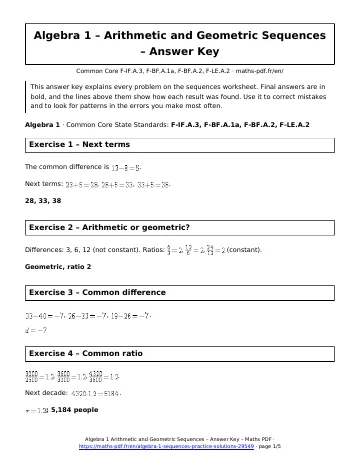
Algebra 1 · Common Core State Standards: F-IF.A.3, F-BF.A.1a, F-BF.A.2, F-LE.A.2
Sequences practice solutions: exercises 1 to 10
Exercise 1 – Next terms
The common difference is \(13 – 8 = 5\).
Next terms: \(23 + 5 = 28\), \(28 + 5 = 33\), \(33 + 5 = 38\).
28, 33, 38
Exercise 2 – Arithmetic or geometric?
Differences: 3, 6, 12 (not constant). Ratios: \(\frac{6}{3} = 2\), \(\frac{12}{6} = 2\), \(\frac{24}{12} = 2\) (constant).
Geometric, ratio 2
Exercise 3 – Common difference
\(33 – 40 = -7\), \(26 – 33 = -7\), \(19 – 26 = -7\).
\(d = -7\)
Exercise 4 – Common ratio
\(\frac{3000}{2500} = 1.2\), \(\frac{3600}{3000} = 1.2\), \(\frac{4320}{3600} = 1.2\).
Next decade: \(4320 \cdot 1.2 = 5184\).
\(r = 1.2\); 5,184 people
Exercise 5 – Explicit rule
The common difference is 5 and \(a_{1} = 7\).
\(a_{n} = 7 + (n – 1)(5) = 7 + 5n – 5 = 5n + 2\).
\(a_{n} = 5n + 2\)
Exercise 6 – A distant term
The rule is \(a_{n} = 4 + (n – 1)(3) = 3n + 1\).
\(a_{20} = 3(20) + 1 = 61\).
61
Exercise 7 – Recursive rule
The common difference is \(6 – 10 = -4\).
\(a_{1} = 10\), \(a_{n} = a_{n-1} – 4\)
Exercise 8 – Geometric explicit rule
The ratio is 2 and the first term is 3: \(a_{n} = 3 \cdot 2^{n-1}\).
\(a_{6} = 3 \cdot 2^{5} = 3 \cdot 32 = 96\).
\(a_{n} = 3 \cdot 2^{n-1}\); 96
Exercise 9 – Fractional ratio
The ratio is \(\frac{27}{81} = \frac{1}{3}\).
\(a_{n} = 81\left(\frac{1}{3}\right)^{n-1}\).
\(a_{5} = 81 \cdot \frac{1}{81} = 1\).
\(a_{n} = 81\left(\frac{1}{3}\right)^{n-1}\); 1
Exercise 10 – Which term?
The rule is \(a_{n} = 5n\). Solve \(5n = 95\): \(n = 19\).
The 19th term
Exercises 11 and up
Exercise 11 – Two terms given
From term 2 to term 6 is 4 steps: \(d = \frac{21 – 5}{4} = 4\).
Then \(a_{1} = 5 – 4 = 1\), so \(a_{n} = 1 + (n – 1)(4) = 4n – 3\).
\(d = 4\); \(a_{n} = 4n – 3\)
Exercise 12 – Evaluate a recursive rule
\(a_{2} = 3(2) – 1 = 5\), \(a_{3} = 3(5) – 1 = 14\), \(a_{4} = 3(14) – 1 = 41\).
41
Exercise 13 – Is 100 in the sequence?
The rule is \(a_{n} = 5n + 2\). Solve \(5n + 2 = 100\): \(5n = 98\), so \(n = 19.6\).
The position must be a whole number.
No
Exercise 14 – Graph of a sequence
The terms are 5, 8, 11, 14, so \(d = 3\) and \(a_{1} = 5\).
\(a_{n} = 5 + (n – 1)(3) = 3n + 2\).
\(a_{n} = 3n + 2\)
Exercise 15 – Pattern of squares
The differences are 2, so \(a_{n} = 5 + (n – 1)(2) = 2n + 3\).
\(a_{10} = 2(10) + 3 = 23\).
\(a_{n} = 2n + 3\); 23 squares
Exercise 16 – Weekly savings
\(a_{n} = 15 + (n – 1)(5) = 5n + 10\).
Week 12: \(5(12) + 10 = 70\). Solve \(5n + 10 = 100\): \(n = 18\).
\(a_{n} = 5n + 10\); $70; week 18
Exercise 17 – Bouncing ball
The ratio is \(\frac{1}{2}\).
\(a_{n} = 64\left(\frac{1}{2}\right)^{n-1}\). \(a_{5} = 64 \cdot \frac{1}{16} = 4\).
\(a_{n} = 64\left(\frac{1}{2}\right)^{n-1}\); 4 ft
Exercise 18 – Bacteria growth
\(a_{n} = 250 \cdot 2^{n-1}\). After 5 hours is term 6.
\(a_{6} = 250 \cdot 2^{5} = 250 \cdot 32 = 8000\).
\(a_{n} = 250 \cdot 2^{n-1}\); 8,000 bacteria
Exercise 19 – Stadium seats
\(a_{n} = 20 + (n – 1)(2) = 2n + 18\).
Row 25: \(2(25) + 18 = 68\). Solve \(2n + 18 = 100\): \(n = 41\).
\(a_{n} = 2n + 18\); 68 seats; row 41
Exercise 20 – Yearly raise
A 5% raise multiplies by 1.05: \(a_{n} = 40000(1.05)^{n-1}\).
\(a_{4} = 40000(1.05)^{3} = 40000(1.157625) = 46305\).
\(a_{n} = 40000(1.05)^{n-1}\); $46,305
Exercise 21 – Two pay plans
Plan A is arithmetic: \(a_{n} = 3n – 1\). Plan B is geometric: \(b_{n} = 2^{n-1}\).
Compare: day 4 is $11 versus $8, day 5 is $14 versus $16.
\(a_{n} = 3n – 1\); \(b_{n} = 2^{n-1}\); day 5
Key facts behind this sequences practice solutions
- A sequence is a function whose inputs are the positions 1, 2, 3, and so on.
- Arithmetic: add d each time; aₙ = a₁ + (n – 1)d.
- Geometric: multiply by r each time; aₙ = a₁ · r^(n-1).
- A recursive rule gives each term from the previous term; an explicit rule gives any term directly.
- Arithmetic sequences are linear; geometric sequences are exponential.
How to use this sequences practice solutions
Cover each solution, solve the exercise again, then uncover it and compare every line. If your answer differs, find the first step that changed and redo the exercise from there.
Download the sequences practice solutions as a PDF with the button below and keep it with your notes.
Download the sequences practice solutions as a PDF with the button below and keep it with your notes.
All Algebra 1 chapters: Algebra 1 math.
Print this page
Download PDFDownload the Algebra 1 Arithmetic and Geometric Sequences Worksheet Solutions (PDF, 105 KB)More Algebra 1 math
Lessons
See all

Worksheets
See all


Tests
See all Solving Quadratic Equations Test with Point Values
- Literal Equations and Formulas Test with Point Values
- Solving Linear Equations in One Variable Test with Point Values
- Exponential Functions and Growth Test with Point Values
- Graphing Quadratic Functions and Transformations Test with Point Values
- Linear Inequalities in One Variable Test with Point Values